Showing posts with label time horizon. Show all posts

Tuesday, September 20, 2022

CAPE Fear

I'm a walkin' in the rain
Tears are fallin' and I feel the pain
Wishin' you were here by me
To end this misery

--Del Shannon

Although stocks have come in, Robert Shiller's CAPE index suggests much more downside work must be done before 'normal' valuations return.

Could be, although I wonder how massive market stimulus and, now, structural goods/services inflation factor in.

Wednesday, September 14, 2022

See the Signs

Life is demanding
Without understanding

--Ace of Base

Article lays out five signs of recession currently flashing red:

1) Declining monetary base. As quantitative tightening proceeds, money supply should drop even more.

2) Inverted yield curve. Inverted yield curves are leading indicators of economic problems, and have preceded every recession for decades.

3) Tighter lending standards. Economic slowdowns increase risk aversion. Banks tighten credit standards to avoid losses during recessions. We're approaching tightness associated with past recessions.

4) Falling housing market prices. Mortgage rates have more than doubled over the past year. As prices and borrowing costs go up, demand for houses has gone down. Inventory is now above 10 months of supply--a threshold that has consistently been associated with past recessions.

5) Declining manufacturing and trade sales. Sales are down over one percent YOY. Declines below zero have coincided with every recession since the 1970s.

These indicators suggest that a recession is not imminent. Rather, it is likely already here.

Saturday, September 3, 2022

Tracing History

Dr Alexander Denny: You know you don't have to do this.
Doug Carlin: What if I already have?
--Deja Vu

Interesting analog comparing this year's market action to 2008-2009.

So far patterns are pretty similar.

Saturday, August 27, 2022

Utilities Yielding to Miners

"You know, the worst ain't so bad when it finally happens. Not half as bad as you figure it'll be before it's happened."
--Curtin (The Treasure of the Sierra Madre)

Those seeking dividend income often flock to utilities given the sector's consistently high payouts. However, the income-producing status of utes is currently being challenged by...mining stocks. The dividend yield differential has narrowed to decades+ lows.

Two things are going on. One is that utility stocks have been bid up recently, causing their yields to fall. The other is that mining stocks, despite their strong balance sheets and cash flows, have been crushed recently, causing their yields to rise.

While they have surely been disappointed that the sector has not yet responded to the present environment as expected, gold bulls are at least being paid well to wait.

position in gold

Friday, August 5, 2022

When the Going Gets Tough

I got something to tell you
I got something to say

--Billy Ocean

The two key charts, updated again. Fed funds rate, recessions/crises, and SPX.

QE, SPX, and related events.

When the going gets tough, what does the Fed do?

Wednesday, July 13, 2022

9%+

Hundred dollar car note
Two hundred rent
I get a check on Friday
But it's already spent

--Huey Lewis & the News

Another 40 yr high CPI print. Measured consumer goods and services inflation came in at a higher than expected 9.1%.

Interestingly, commodities and their associated stocks are green on the news. Also, interest rate futures are now pricing in 'policy reversal' rate cuts by early 2023.

How long before those rate cut bets start tricking into late 2022?

Wednesday, July 6, 2022

Ceiling Prices

We run though the day
And stare at the night
Is your head full of noises?
For me, well, it's just like
The Fourth of July

--Roger Daltrey

Among the dumbest of economic policies pursued by politicians is the price ceiling. The thinking is typical authoritarian. Think prices are too high? Then simply declare them lower. Set a maximum price for transactions on the market. Punish those who engage in transactions at a higher-than-mandated price.

What happens when producers are forcibly restrained from selling output at higher prices? Supply leaves the market. Shortages develop. 

Not only does present supply leave the market, but future sources do as well. Entrepreneurs are less motivated to develop marginal or substitute sources of supply when the profit signal of higher prices is suppressed.

Over time, prices are likely to be much higher--particularly if it takes a long time to replace capacity once it is taken off the market by the caps.

Cogitate on that as G-7 bureaucrats mull price caps on Russian oil.

Thursday, June 23, 2022

Oil's Embeddedness

Then one day, he was shootin' at some food
And up through the ground came a bubblin' crude
Oil, that is
Black gold...Texas tea

--Flatt & Scruggs

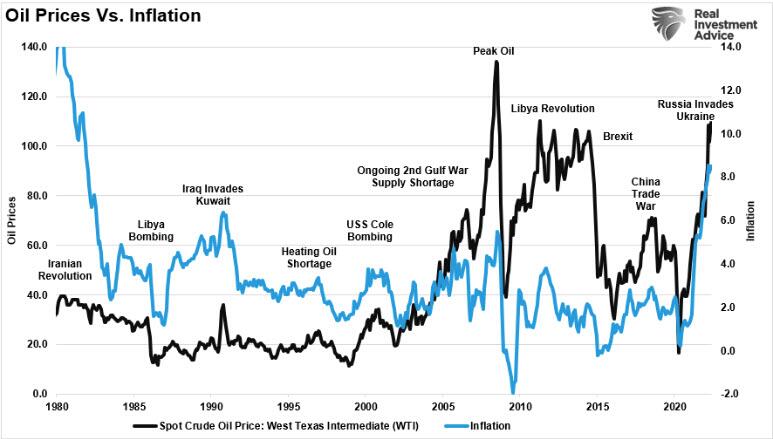
Couple of interesting oil charts. First, crude vs events:

Second, that same series alongside the CPI:

Many people don't seem to realize just how embedded oil is in our everyday lives.

Friday, June 17, 2022

75 Bips

Hot summer streets
The pavements are burning
I sit around
Trying to smile
But the air is so heavy and dry

--Bananarama

After signaling thru their WSJ mouthpiece that they were considering a 75 basis pt fed funds rate increase, the FOMC followed thru on Wed. The last time the Fed did 75 bips was 1994. 

This puts the fed fund rate target at 1.75-2%.

The infamous 'dot plot' showing forecasts by FOMC members of future fed fund rates find them firmly above 3% by year end.

The Fed's miserable record in forecasting anything accurately makes taking these dot plot projections seriously pretty laughable. 

As these page have noted, all previous rate hike cycles end when something breaks. This is because of the increased systemic leverage that results from the previous easing cycle--which never allows interest rates to return to previous cycle highs. A recession usually follows, along with more easy money from the Fed.

How high will rates go before triggering the next recession? A review of history suggests we may not be far from the peak. Perhaps this 75 bip move pushes things over the edge.

The 3%+ dot plot forecasts seem destined to be wrong (again).

Tuesday, June 14, 2022

Updated Charts

You can make or break
You can win or lose
That's a chance you take
When the heat's on you
And the heat is on

--Glenn Frey

Updated version of two very important charts. The first is Fed funds rate and the SPX since 1980. What does this chart suggest about how for the Fed can raise before crying uncle?

The second is Fed balance sheet assets and the SPX since the onset of QE. What does this chart suggest about how much the Fed can unwind its balance sheet before crying uncle?

As we have asked before, when facing a choice between keeping money/credit in the system to keep markets from collapsing or removing money/credit from the system to fight inflation, the Fed will choose which option?

Friday, June 10, 2022

Another High

First class and fancy free
She's high society
She's got the best of everything

--Tal Bachman

CPI prints another 40 yr high at 8.6%.

Gold up on the news as perhaps central banker's chronic incompetence is beginning to sink in w investors.

position in gold

Wednesday, June 8, 2022

Diverging Confidence

Chuck Scarett: How you feeling today?
Joe Scheffer: Confident.

--Joe Somebody

Two marquee measures of consumer confidence are diverging. The Conference Board's measure (blue line) is on the high end while the University of Michigan's measure (orange line) is tanking.

Although, as historical data indicate, the two series track each other well, there are periods of divergence--primarily because the Conference Board's measure appears to lag slightly behind UMich. 

When that divergence hits extremes, it is often noteworthy. Past instances where the difference between the two series has been this wide have corresponded to recessions.

It won't be too long before we find out whether history rhymes again.

Tuesday, April 12, 2022

Coming In Hot

You can make or break
You can win or lose
That's a chance you take
When the heat's on you
And the heat is on

--Glenn Frey

Headline CPI print +8.5% YOY. 

Hottest since 1981.

Saturday, March 19, 2022

Saving Rain

Here comes the rain again
Raining on my head like a tragedy
Tearing me apart like a new emotion

--Eurythmics

Nice graphic that shows that not only do Americans have no net savings, but that savings is negative after inflation.

As the Fed has suppressed interest rates over the past 30-40 yrs, people have had less incentive to save. Why put money into a savings account when there is little or no compensation to do so?

Now add inflation. As prices go higher, why put money away today when those dollars are expected to be worth less tomorrow?

Remember the saying 'Save it for a rainy day'?

No savings means no buffer against uncertainty (i.e., you'll get rained on). And, perhaps more importantly, no capital to fund productivity improvement.

Wednesday, March 16, 2022

Dot Matrix

"Whatever you're thinking, rethink it."
--Phil Broker (Homefront)

The Federal Reserve Open Market Committee (FOMC) announced that it will raise the fed funds rate target to the 0.25-0.50% range. It also indicated that it plans to begin reduction of the $9 trillion of balance sheet assets amassed during it various QE campaigns 'at a coming meeting.'

The lone dissenter was 'hawk' James Bullard who preferred a 50 bip increase in the fed funds rate instead of the 25 bip bump announced.

The Fed's 'dot plot,' which indicates current FOMC member forecasts of where the fed funds rate is headed suggests that Fed heads foresee higher rates in 2022-2024 than previously expected. However, longer run rates are seen as unchanged or slightly lower than previously forecast.

The dots suggest a couple of things. Several rate hikes this year--six of them if they are 25 bps each. Then a relatively benign longer run.

The FOMC also forecast price inflation of 4.1% by end of 2022.

Given the Fed's previous track record, don't be surprised if all if its guesses here are way off.

Thursday, March 10, 2022

Collective Security

War, children
It's just a shot away

--The Rolling Stones

Whenever a 'crisis' comes along, it is tempting to assume that this time is different--that we're at a unique point in history never before contemplated. With a little digging, however, one finds that this is rarely the case.

Murray Rothbard provides useful historical context (penned in 1982) for the present Ukraine situation, particularly as it relates to the notion of 'collective security' and interventionism. Collective security is the philosophy upon which the United Nations and NATO were founded. Each nation state is viewed as an 'individual.' When one state 'aggresses against' an individual state, then it is the duty of the collective to punish the 'aggressor.' No declaration of war is necessary because the collective response is a 'police action.' All nations in the collective, including their media organs, are expected to fall in line.

The left warmly embraced the collective security concept--so much so that they were ardent supporters of US entry into the Korean and Vietnam wars. 

Opposition to war was instead a characteristic of the 'old right.' From the 1930s to the 1950s, the old right was regarded as 'isolationist,' objecting American entry into WWII, the Marshall Plan, NATO, conscription of troops, and Korea. Among the politicians in this group were Robert Taft and Howard Buffett (Warren's dad). Garet Garrett and John T. Flynn were among the author/analysts.

The old right isolationists saw grave flaws in the collective security concept. One was that, in reality, there is no single world government or police force. Instead, there are hundreds of nation states, each with their own war-making capacity. In some cases, this capacity is quite formidable. Consequently, when gangs of states wade into a conflict, they invariably widen it. Every controversy invites the gang to decide who is the 'aggressor,' and then attach to the side considered virtuous.

It stands to reason, then, that collective security systems have the potential to turn local squabbles into global conflagrations.

Another problem with the collective security notion is that it can be difficult if not impossible to accurately identify the uniquely guilty parties in conflicts between states. Although the property rights of individuals make actions by an aggressor relatively easy to finger, the legitimate boundary lines of each state are more difficult to discern. This is because state borders are rarely demarcated by just and proper means. Instead, states generally exist through coercion over citizens and subjects; state boundaries are invariably determined by conquest and violence. 

Consequently, by condemning one state for crossing the borders of another, collective security systems implicitly recognize the validity of existing boundaries. Why should boundaries of a state be any more legitimate now than they were one hundred years ago? Why should borders be enshrined such that crossing them leads all members of the security collective to wage war, and to force their citizens to kill and die?

It is straightforward to apply the limitations of collective security to the Ukraine situation. Indeed, one can find both of the above problems raised by Vladimir Putin in his address explaining the rationale behind his country's action in Ukraine.

Once again, it seems that we have failed to learn from history.

Friday, February 11, 2022

Still Printing

I fear I'll do some damage
One fine day
But I would not be convicted
By a jury of my peers
Still crazy after all these years
--Paul Simon

This article raises an excellent question. With inflation soaring, why does the Fed continue in Quantitative easing?

Stated differently, how does printing money to buy assets do anything but add to the inflation problem? Indeed, classically defined, inflation is money printing.

The answer seems obvious.

Postscript: The Fed just released its POMO schedule for the next 4 weeks.

It plans at least another month of QE-related money printing and asset buying.

Thursday, February 10, 2022

Now vs Then

There are things we won't recall
And feelings we'll never find
It's taken so long to see it
'Cause we never seemed to have the time

--Phil Collins

The CPI printed above expectations once again. The annualized 7.5% increase is the highest since March 1982. Yes, the era of 15% APR certificates of deposit.

Interest rate markets are discounting more hawkish Fed policy in the near term but more dovish a couple yrs out.

Two interpretations being floated. 1) the Fed quickly gets inflation under control and engineers a soft landing. 2) The Fed makes a 'policy error' by raising rates and crashing the economy, which subsequently forces them to lower rates in attempt to pull the economy out of the abyss.

These pages have been pondering a scenario that fits door number 2 pretty well.

Despite rocketing prices, the Fed is behind the curve when it comes to 'fighting inflation' like the Paul Volcker-led Fed did in the early 1980s. Compare now vs then in the above graph.

It may be a while before we see those 15% CDs again.

Monday, February 7, 2022

Backwardation

Don't look back
A new day is breaking
It's been too long
Since I felt this way

--Boston

Backwardation is an unusual situation in futures markets where front month contract prices exceed those of out-month contracts. Usually futures curves slope in the other direction, with out-month prices higher than front month prices (due to carrying costs, etc). This condition is known as 'contango.'

Commonly, backwardation occurs when demand exceeds supply in the near term, leading to shortages. Shortages cause traders to bid up prices of front month contracts but leave farther out futures contracts relatively unaffected. This lends an atypical downward sloping shape to forward futures contract curves, and positive price spreads (i.e., the difference between front month contract prices and out month prices).

As this article reports, backwardation is happening in spades across commodities. While energy-related commodities have been the big headline grabbers, the phenomenon is occurring among other commodity groups. For example, most industrial metals have been in backwardation since late last year.

The glass half full interpretation is that backwardation-causing events are often acute situations that resolve themselves relatively quickly.

The glass half empty interpretation is that backwardation juices prices higher on the upstream ends of supply chains. If they remain persistent, then those pressures tend to work their way downstream to consumers.

Say it, Fed heads: backwardation rhymes with _____.

Yield Signs

When it gets too much
I need to feel your touch

--Bryan Adams

Ten year Treasury yields are now north of 1.9%. While not high by historical standards, T-note yields are beginning to challenge stock dividend yields. The yield on the S&P 500 is only about 1.3%.

Higher bond yields will slowly pry income-seeking investors away from stocks.

One more thing for the Fed to worry about...