Showing posts with label Depression. Show all posts

Wednesday, September 14, 2022

See the Signs

Life is demanding
Without understanding

--Ace of Base

Article lays out five signs of recession currently flashing red:

1) Declining monetary base. As quantitative tightening proceeds, money supply should drop even more.

2) Inverted yield curve. Inverted yield curves are leading indicators of economic problems, and have preceded every recession for decades.

3) Tighter lending standards. Economic slowdowns increase risk aversion. Banks tighten credit standards to avoid losses during recessions. We're approaching tightness associated with past recessions.

4) Falling housing market prices. Mortgage rates have more than doubled over the past year. As prices and borrowing costs go up, demand for houses has gone down. Inventory is now above 10 months of supply--a threshold that has consistently been associated with past recessions.

5) Declining manufacturing and trade sales. Sales are down over one percent YOY. Declines below zero have coincided with every recession since the 1970s.

These indicators suggest that a recession is not imminent. Rather, it is likely already here.

Wednesday, September 7, 2022

Sanctions Fever

Life goin' nowhere
Somebody help me
Somebody help me, yeah

--Bee Gees

Vladimir Putin attributes Europe's energy crisis and related probs to 'sanctions fever.' It is hard to disagree.

Watching a related special last nite on CNBC and host Brian Sullivan asked a guess whether he thought the West's sanctions on Russia were 'working.'

Perhaps he should have asked the millions around the world who face starvation and hypothermia due to these sanctions.

Sadly, this was predictable from the get go...

Monday, September 5, 2022

Frozen Policy

Hear the Salvation Army band
Down by the riverside
Bound to be a better ride
Than what you've got planned

--The Bangles

Europe seems headed toward a self-imposed depression. Sanctions against Russia, combined with previous 'green' policies, have exploded in the face of euro bureaucrats, leaving the EU facing a winter with insufficient heat, electricity, and gasoline.

Some gas and electric bills are already printing 5-10x year ago levels.

Policymakers appear to be doubling down by developing plans for rationing, price capping, and money printing.

Absent a quick policy about-face, it is difficult to see how the EU survives the next few months.

Sunday, September 4, 2022

Repos and QT

Then the door was opened
And the wind appeared
The candles blew
And then disappered

--Blue Oyster Cult

Interesting WSJ article suggesting that declining reserves stemming from the Fed's 'quantitative tightening' (QT) program poses a significant threat to financial markets. 

QT is the reverse of quantitative easing (QE). In QE, the Fed printed money out of thin air to buy bonds from banks. That printed money became 'reserves' that the banks have deposited with the Fed. Unsurprisingly, reserves have rocketed higher given the $9 trillion of bonds that the Fed now holds on its balance sheet via QE. 

Bank reserves serve various purposes. They can be used to settle trades with other banks. Reserves are also kept to satisfy regulatory requirements, which have generally been ratcheted higher since 2008, to provide some margin of safety in the event of another systemic credit event.

Reserves can also be used for investment purposes. One popular avenue toward this end is the repo market. Repos are contracts where one party sells securities to another party in exchange for cash. The buyer (who is engaging in what is called a 'reverse repo) promises to sell the securities back to the original holder at some future (usually near term) date and at a set (usually higher) price.

These pseudo loans help the pseudo borrowers manage short term cash obligations while providing the reverse repo pseudo lenders with quick profits.

When reserve levels are high then the 'interest rates' governing repos are low and usually in line with the Fed Funds Rate. However, when reserves decline, repo rates are prone to rise because there is less capacity for reverse repo 'lenders' to employ. 

As the Fed embarks on QT, reserves are beginning to fall. Although there are no signs yet of stress in the repo markets, there is belief that it is only a matter of time before problems surface. 

Indeed, in 2019, the Fed had to inject emergency shots of liquidity into these markets after previous QT programs resulted in skyrocketing repo rates that threatened to seize up money markets.

Given the size and centrality of money markets to contemporary market functioning, it may once again be time to fear the repo.

Saturday, September 3, 2022

Tracing History

Dr Alexander Denny: You know you don't have to do this.
Doug Carlin: What if I already have?
--Deja Vu

Interesting analog comparing this year's market action to 2008-2009.

So far patterns are pretty similar.

Thursday, September 1, 2022

Cause for Pause

How can you just leave me standing
Along in a world that's so cold?

--Prince

Our working hypothesis is that the Fed will pivot from its hawkish track when 'something breaks' in the market. That's been the historical pattern and there's no reason to believe this time will be any different.

But where will the breakage occur this time around? One possibility is something in the credit markets. The greater the systemic leverage, the more susceptible the system is to higher interest rates. And systemic leverage has never been higher.

After the Fed's historic tightening over the past six months (on a relative basis), some folks are on the lookout for cracks in credit. We recently noted, for example, that low rated debt spreads are widening toward alarm levels.

Another possibility, one stressed here, is that a funding crisis arises in Washington. Higher rates mean more interest expense on ever-escalating federal debt levels. We're currently on a run rate to spend over $1 annually on Treasury bond interest. How much longer before politicians exert enough pressure on the Fed before it breaks?

Finally, one possibility that I frankly had not entertained concerns the strong dollar. The dollar index (DXY) currently stands at its highest level since 2002. The broader Bloomberg dollar index has spiked above the pandemic highs.

There is growing suspicion that this is sparking margin calls in emerging markets stemming from short dollar positions. 

If so, then systemic contagion could provide another possible cause for Fed pause.

Tuesday, August 30, 2022

CCC Spreads

Papa don't preach
I'm in trouble deep
Papa don't preach
I've been losing sleep

--Madonna

As we remain on the lookout for cracks in the system, particularly credit, this chart is noteworthy.

Low quality CCC debt spreads have once again breached 1000 bips.

Trouble usually starts at the risky end of the credit stack...

Thursday, August 25, 2022

Be Poor and Like It

"Tis too much proved, that with devotion's visage and pious action, we do sugar o'er the devil himself."
-V (quoting Shakespeare) (V for Vendetta)

Another version of the 'suck it up' message. Euro leaders tell their people that 'abundance' is a thing of the past. Be poorer and like it.

One has to wonder how long a people is willing to endure hardship in support of a bureaucratic ideology.

Saturday, August 20, 2022

Lagged Effects

Take a chance like all dreamers
Can't find another way
You don't have to dream it all
Just live a day
--Duran Duran

Another insightful interview with Stephanie Pomboy. I find the Maven's focus on credit market fallout from the Fed's tightening program intuitive. In leveraged systems, rate hikes and tight money policies increase stress and lead to failure.

But, as Pomboy observes, the effects are often lagged. She points to recent trends from credit upgrades to downgrades, as well as a lender bankruptcy or two, as evidence since they come several months after the Fed began its tightening campaign.  

Recall the 2008 credit collapse. The Fed was raising rates in 2006 but it wasn't until early 2007 that the first substantial cracks started appearing. New Century Financial, anyone?

And then it took another year until the crescendo really started to build.

If Pomboy is correct, and I think she is, then additional data points that reflect credit market stress should be pending.

Friday, August 5, 2022

When the Going Gets Tough

I got something to tell you
I got something to say

--Billy Ocean

The two key charts, updated again. Fed funds rate, recessions/crises, and SPX.

QE, SPX, and related events.

When the going gets tough, what does the Fed do?

Tuesday, August 2, 2022

Inflation Reduction Act

I bought a novel, some perfume
A fortune all for you
But it's not my conscience
That hates to be untrue
I asked of my reflection,
"Tell me what is there to do?"

--Squeeze

As we've discussed, leftists are rarely honest with their rhetoric. They label things largely contrary of their actual effects.

Cast in point: the proposed Inflation Reduction Act. 

As Ron Paul discusses, the bill does the opposite. It increases government spending by hundreds of billions of dollars. It takes resources out of the hands of private citizens and puts them into the hands of bureaucrats.

Not only does this increase the risk of capital misallocation, but it must be funded. To the extent that citizens are taxed, it reduces economic resources available to people during an era of high price inflation and slowing economic activity.

It is a universal truth that slow economic activity motivates easier central bank monetary policy (read: inflation).

To the extent that taxes won't cover the spending, then those funds must either be a) borrowed, which taxes future incomes, or b) printed (the reason why inflation is called the 'invisible tax').

There is little doubt that the Inflation Reduction Act will ultimately result in more inflation, not less.

Saturday, July 30, 2022

Recession Now

When the good times never stay
And the cheap thrills always seem to fade away
When will we fall
When will we fall down?

--Toad the Wet Sprocket

The traditional definition of a recession is two consecutive quarters of negative real GDP growth. This has now occurred based on Q1 and Q2 GDP prints.

As these pages have discussed, political partisans are trying to manage the narrative away from the traditional definition--claiming that recessions only officially occur once they are declared by the 'experts' at the National Bureau of Economic Research (NBER).

Conveniently, such a declaration would occur sometime after the midterm elections in November.

What the partisan narrative managers fail to note is that two consecutive quarters of negative real GDP growth have always coincides with NBER's formal declaration of recession.

Thursday, July 28, 2022

Redline Fed Lines

You'll never say hello to you
Until you get it on the redline overload
You'll never know what you can do
Until you get it up as high as you can go
--Kenny Loggins

Yesterday the FOMC raised the Fed funds rate 75 bips as telegraphed. The overnight rate target now stands at 2.25-2.50%.

As is common anymore, the FOMC statement was 'redlined' for wording changes from the previous statement.

The only substantial change was the first sentence, which went from discussing economic strength to signs of economic weakness.

Couple that with the subsequent statement that the Fed is prepared to adjust its policy stance if risks emerge that threaten the attainment of the committee's goals, and you get early signs of a dovish pivot.

Reaching? Perhaps, but markets are partying on the prospects thus far.

Wednesday, July 27, 2022

Narrative Management

Nancy Oliver: What's the matter with the mistress? She don't look ill to me. Is she?
Elizabeth Tompkins: I don't know. Not as I can see. But the master keeps telling her she is.
--Gaslight

Leftists believe that words matter more than actions. This is why they respond like juveniles on the playground when someone says something they don't like. "He called me a name!"

Indeed, it seems that many leftists view hurtful words as equivalent to acts of physical aggression--acts that justify physical violence, perhaps by government agents, to quell the 'hate speech.'

This is also why leftists obsess with controlling narratives. Narratives are story lines. In reality, these story lines may be true or false. But regardless of whether narratives represent fact or fiction, leftists believe that they can manipulate behavior in their favor by manipulating language.

Controlling the narrative often begins by changing the definition of a word or phrase that is central to the storyline.

Leftists are currently focusing on the meaning of 'recession.' Rather than using the traditional definition of two consecutive quarters of negative GDP growth (which likely has occurred in Q1 and Q2 of this year), leftists are now arguing that the definition is more nebulous and requires (very conveniently) a panel of experts to determine--perhaps far after the fact of the recession's actual commencement.

The narrative can then manipulated. We're still in an economic expansion, they say, because the experts haven't called a recession yet.

Should recent history be any guide, leftists will also try to recruit their media cabal to label alternative narratives as 'disinformation.'

If they can get the public to buy in, then perhaps leftists can postpone widespread perception of recession until after the November midterm elections. Leftists well know that people experiencing economic hardship are prone to vote out people and parties in positions of political power.

This time around, that would be Democrats.

Use your capacity for reason. Ignore the gaslights of narrative management.

Monday, July 25, 2022

Cruel Summer

Strange voice are saying
What did they say?
Thinks I can't understand
It's too close for comfort
This heat has got right out of hand

--Bananarama

Regional Fed data increasingly suggest that economic activity is quickly contracting. While this may be alleviating near term price pressure per policymaker goals, it also portends nasty political consequences.

As one respondent from the Texas survey commented, "November can't get here fast enough."

Sunday, July 24, 2022

Don't Bet On It

They show you photographs of how your life should be
But they're just someone else's fantasy

--Styx

Policymakers seem to be betting that people would rather see inflation than recession. Current policies seek to curtail demand, lower wages, and raise unemployment--with the hope that these things will result in falling prices. 

And people are supposed to be happy with that outcome?

Don't bet on it.

I also wouldn't bet on the either/or proposition. What if it turns out that we get inflation and recession?

Thursday, July 14, 2022

On the QT

It happened one summer
It happened one time
It happened forever
For a short time

--Motels

Bank of America (BAC) analyst and former Fed staffer who has a good track record of predicting Fed policy shifts forecasts that the central bank's current quantitative tightening (QT) will be ended much sooner than expected. He thinks QT will cease in early 2023 with about $1 trillion in asset rolled off the Fed's balance sheet.

While consistent with what these pages have been suggesting, I'll pick the under on both. Sooner than early 2023 and less than $ trillion unwound.

position in BAC

Friday, July 8, 2022

Stocks Still

A gambler's share
The only risk that you would take
The only loss you could forsake
The only bluff you couldn't fake

--Bob Seger

Time series of AAII asset allocation indicates that, despite the nasty market pullback, individual investors have maintained their historical allocation to equities.


Usually, big market declines cause investors to dump stocks in favor of cash.

So far, however, stock allocations remain at about 70% of financial assets. There has been a slight uptick in cash to about 18% at the expense of bonds at about 12%.

Another point supporting the narrative that while individual investors feel bad about the market decline, they haven't acted on it in a substantial way--at least not via their investment accounts. 

Wednesday, June 29, 2022

Commitment to Stupidity

"He chose...poorly."
--Grail Knight (Indiana Jones and the Last Crusade)

The larger question for big government types is this: Have not the past couple of years demonstrated the sheer ineptitude of central planning?

Public health. War and sanctions. Economic and monetary policy. Et al.

Hayek called it the fatal conceit--the belief that bureaucrats in a room can choose better than billions of individuals.

Ongoing belief in central planning constitutes a genuine commitment to stupidity.

Thursday, June 23, 2022

Oil's Embeddedness

Then one day, he was shootin' at some food
And up through the ground came a bubblin' crude
Oil, that is
Black gold...Texas tea

--Flatt & Scruggs

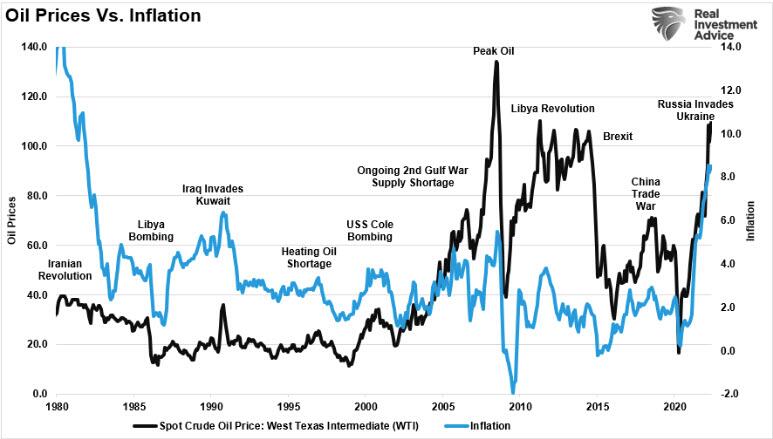
Couple of interesting oil charts. First, crude vs events:

Second, that same series alongside the CPI:

Many people don't seem to realize just how embedded oil is in our everyday lives.