"I put it all on Lucky Dan, half a million dollars to win."
--Doyle Lonnegan (The Sting)
A couple days back, Berkshire Hathaway (BRK.A) announced a $40+ billion acquisition of Burlington Northern Santa Fe Corp (BNI). Warren Buffett termed the purchase "an all-in wager on the economic future of the United States."
I (and others e.g., Toddo) find Buffett's actions (and choice of words) interesting. Berkshire will deplete considerable cash to fund this acquisition as well as issue significant stock. This will place Berk in a less liquid, more leveraged state, which may impact the company's credit rating.
The company will also split its B shares 50 to 1 to permit BNI shareholders to more easily participate in Berkshire stock. A stock split is something Buffett long claimed he would never do, since it attracts the hot money trading set.
Like his 'Buy Stocks' call last fall, I find Buffett's actions curious. BNI is no high margin/low capital business. Moreover, I don't see the current macro picture as fitting for making an 'all-in wager' on our economic future.
no positions
Showing posts sorted by relevance for query buffett. Sort by date Show all posts
Showing posts sorted by relevance for query buffett. Sort by date Show all posts
Thursday, November 5, 2009

Thursday, February 23, 2017
Hedge Funds Misrepresented
Amanda Jones: So, do you always bring an extra girl when you go out?
Keith Nelson: I like to cover my bets.
Amanda Jones: That's very cute. I'll have to remember that.
--Some Kind of Wonderful
WSJ article today touts a $1 million bet that Warren Buffett made 10 yrs ago that index funds would outperform hedge funds over a decade long period. The article suggests that, unless markets crash this year, then Buffett will win the bet.
But it is precisely during those periods of market turbulence that hedge funds outperform. The primary purpose of hedge funds, classically defined, is to 'hedge' bets with positions that move in opposite directions.

The article, which reads like an advertisement for Warren Buffett with graphics like the above, ignores the hedging purpose of hedge funds in what has transpired during the period of the bet.
Am pretty sure that the basket of hedge funds employed in the bet significantly outperformed Buffett's Vanguard S&P Index fund during the first two years of the bet. After all, this was the period during which the credit market collapse brought major stock indexes down by more than half.
Since then, however, markets have gone straight up with little correction, with many stock indexes more that quadrupling from their March 2009 lows. Major indexes currently rest at all time highs.
Basic market axiom: Long/short funds will generally under perform long-only funds in trending bull markets.
Yes, hedge fund fee structures are higher than passive index fund alternatives. But those fees have been declining due to competition. Moreover, the gains obtained from hedge funds during periods of market turbulence have far exceeded the fees.
We can be confident in this: If the last decade resulted in eight down stock market years and only two up (rather than the opposite), then Buffett would be the one getting ready to write the check.
Keith Nelson: I like to cover my bets.
Amanda Jones: That's very cute. I'll have to remember that.
--Some Kind of Wonderful
WSJ article today touts a $1 million bet that Warren Buffett made 10 yrs ago that index funds would outperform hedge funds over a decade long period. The article suggests that, unless markets crash this year, then Buffett will win the bet.
But it is precisely during those periods of market turbulence that hedge funds outperform. The primary purpose of hedge funds, classically defined, is to 'hedge' bets with positions that move in opposite directions.

The article, which reads like an advertisement for Warren Buffett with graphics like the above, ignores the hedging purpose of hedge funds in what has transpired during the period of the bet.
Am pretty sure that the basket of hedge funds employed in the bet significantly outperformed Buffett's Vanguard S&P Index fund during the first two years of the bet. After all, this was the period during which the credit market collapse brought major stock indexes down by more than half.
Since then, however, markets have gone straight up with little correction, with many stock indexes more that quadrupling from their March 2009 lows. Major indexes currently rest at all time highs.
Basic market axiom: Long/short funds will generally under perform long-only funds in trending bull markets.
Yes, hedge fund fee structures are higher than passive index fund alternatives. But those fees have been declining due to competition. Moreover, the gains obtained from hedge funds during periods of market turbulence have far exceeded the fees.
We can be confident in this: If the last decade resulted in eight down stock market years and only two up (rather than the opposite), then Buffett would be the one getting ready to write the check.
Thursday, February 9, 2012
Buffett's Gold Bubble
Help I'm stepping into the twilight zone
Place is a madhouse, feels like being cloned
My beacon's been moved under moon and star
Where am I to go now that I've gone too far?
--Golden Earring
In a preview of his annual letter to Berkshire Hathaway shareholders to appear in FORTUNE, Warren Buffett disses bonds and gold in favor of stocks. He suggests that gold's huge rise over the past 10 years resembles bubble like proportions. As in the past, he refers to gold as a 'non-productive' asset. It pays no dividend. It does no work.
Very true. But what he does not address is gold's function in since the beginning of economic exchange as a store of value. Buffett goes to some length seeking to demonstrate gold's overvalued nature versus 'productive' assets such as cropland and Exxon (XOM). But gold's value is not, as Adam Smith called it, 'value in use.' Gold's value is tied up in 'value in exchange.'
Buffett says that he would rather have all of US cropland +16 Exxons + $1 trillion USD rather than the total world's supply of gold (currently worth about $9.6 trillion). Stated differently, gold seems overvalued to him.
To others, of course, the opposite seems true. If all the gold in the world can buy only 16 large oil companies and one country's worth of crop land, then there is not enough gold in the world to pay for all other productive assets in the world.
Stated differently, perhaps US cropland and XOM are over valued. There are good arguments to be made here, with the market cap of XOM north of $400 billion. If this is indeed the case, then either the price of productive assets needs to come down, or the price and/or quantity of gold must go up.
One other point is that 'productive assets' like those represented by stocks require capital. But in today's debt-laden world, where more and more resources must be allocated toward debt service, real capital available for productive investment is vanishing.
Capital has been consumed rather than saved.
Printing paper money will not alleviate this capital shortage. With less capital, productive assets cannot function fully. If productive assets cannot function fully, then their value declines.
Then perhaps gold will be worth US, EU, and South American farmland, and 300 Exxons.
position in gold, agriculture, SPX
Place is a madhouse, feels like being cloned
My beacon's been moved under moon and star
Where am I to go now that I've gone too far?
--Golden Earring
In a preview of his annual letter to Berkshire Hathaway shareholders to appear in FORTUNE, Warren Buffett disses bonds and gold in favor of stocks. He suggests that gold's huge rise over the past 10 years resembles bubble like proportions. As in the past, he refers to gold as a 'non-productive' asset. It pays no dividend. It does no work.
Very true. But what he does not address is gold's function in since the beginning of economic exchange as a store of value. Buffett goes to some length seeking to demonstrate gold's overvalued nature versus 'productive' assets such as cropland and Exxon (XOM). But gold's value is not, as Adam Smith called it, 'value in use.' Gold's value is tied up in 'value in exchange.'
Buffett says that he would rather have all of US cropland +16 Exxons + $1 trillion USD rather than the total world's supply of gold (currently worth about $9.6 trillion). Stated differently, gold seems overvalued to him.
To others, of course, the opposite seems true. If all the gold in the world can buy only 16 large oil companies and one country's worth of crop land, then there is not enough gold in the world to pay for all other productive assets in the world.
Stated differently, perhaps US cropland and XOM are over valued. There are good arguments to be made here, with the market cap of XOM north of $400 billion. If this is indeed the case, then either the price of productive assets needs to come down, or the price and/or quantity of gold must go up.
One other point is that 'productive assets' like those represented by stocks require capital. But in today's debt-laden world, where more and more resources must be allocated toward debt service, real capital available for productive investment is vanishing.
Capital has been consumed rather than saved.
Printing paper money will not alleviate this capital shortage. With less capital, productive assets cannot function fully. If productive assets cannot function fully, then their value declines.
Then perhaps gold will be worth US, EU, and South American farmland, and 300 Exxons.
position in gold, agriculture, SPX
Monday, January 12, 2015
Buffett Indicator Update
She's so high
High above me
She's so lovely
--Tal Bachman
Nearly a year ago we discussed Doug Short's analysis of market cap to GDP--a valuation indicator made famous by Warren Buffett in a Fortune article near the top of the dot com bubble. Here's an update.
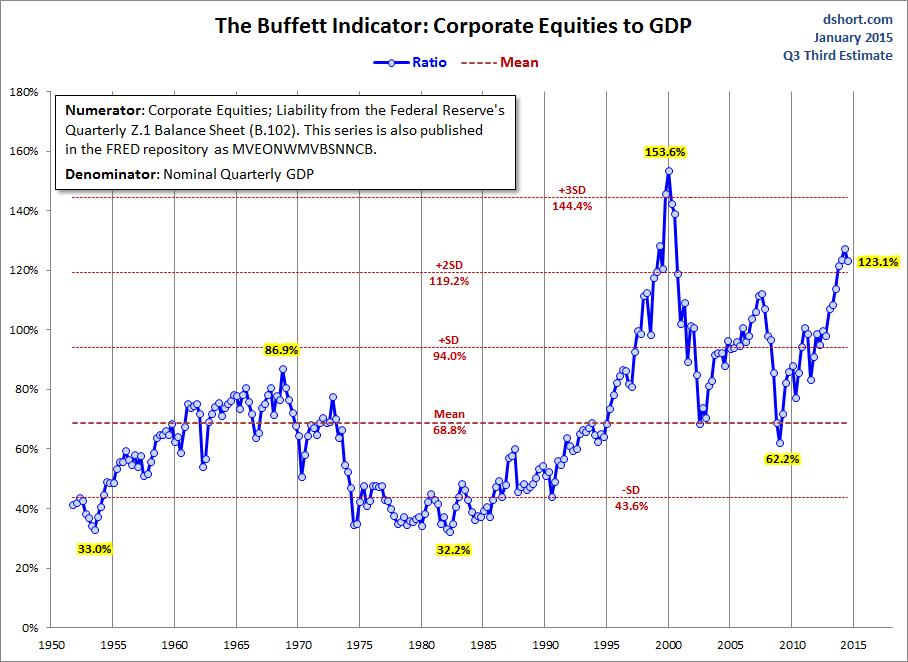
Market valuations have only moved further into nosebleed territory, eclipsed only by the dotcom zenith since 1950. To the extent that GDP may be over-reported, then current overvaluation estimates are conservative.
Doesn't mean that markets can't go higher or that things crash tomorrow. It does signify a significant wind in the face of further price advances.
position in SPX
High above me
She's so lovely
--Tal Bachman
Nearly a year ago we discussed Doug Short's analysis of market cap to GDP--a valuation indicator made famous by Warren Buffett in a Fortune article near the top of the dot com bubble. Here's an update.
Market valuations have only moved further into nosebleed territory, eclipsed only by the dotcom zenith since 1950. To the extent that GDP may be over-reported, then current overvaluation estimates are conservative.
Doesn't mean that markets can't go higher or that things crash tomorrow. It does signify a significant wind in the face of further price advances.
position in SPX
Saturday, December 1, 2012
Higher Taxes Reduce Prospective Returns
Will you recognize me?
Call my name, or walk on by?
Rain keeps falling, rain keeps falling
Down, down, down, down
--Simple Minds
Recently we observed that higher taxes reduce capital available for investment--despite Warren Buffett's ridiculous claim. More taxes mean less savings. Less savings mean less investment.
Prof Cochrane adds another dimension. Investment projects will look less attractive because discounted cash flow analysis will yield smaller prospective after tax returns on projects that are subject to higher tax rates. More simple math that seems to escape Mr Buffett.
Thus, the smaller amounts of capital still around after higher tax rates will be less likely to be put to work.
Call my name, or walk on by?
Rain keeps falling, rain keeps falling
Down, down, down, down
--Simple Minds
Recently we observed that higher taxes reduce capital available for investment--despite Warren Buffett's ridiculous claim. More taxes mean less savings. Less savings mean less investment.
Prof Cochrane adds another dimension. Investment projects will look less attractive because discounted cash flow analysis will yield smaller prospective after tax returns on projects that are subject to higher tax rates. More simple math that seems to escape Mr Buffett.
Thus, the smaller amounts of capital still around after higher tax rates will be less likely to be put to work.
Sunday, February 28, 2010
Immoral Hazard
Out along the edges
Always where I burn to be
The further on the edge
The hotter the intensity
--Kenny Loggins
Warren Buffett proposes that the 'solution' to excessive risk taking by bank execs is to excessively penalize these execs in the event of big losses. Shareholders didn't cause the recent meldowns, he suggests, but they have bourne the brunt of the losses.
Shareholders had no role in the meltdowns? They bid up share prices of highly leveraged firms, and voted in top execs, the boards, and lavish pay/incentive structures.
The way markets are supposed to work is that firms that make bad decisions get penalized. If the decisions are poor enough, then the firm goes away and someone else takes control of the resources who looks to be able to do a better job.
What role do shareholders have good decision-making? They can look at the level of risk on a firm's balance sheet and don't buy (or sell) shares of firms that have excessive leverage. Extreme leverage was visible to anyone willing to look prior to the meltdown. The argument can easily be made that shareholders, like managers, were willing making leveraged bets on a risky strategy that went awry.
Shareholders can also walk away from firms that have undesirable incentive structures.
Warren Buffett seeks to bake additional moral hazard into a system that already has millions of players thinking that someone has their back.
In properly functioning markets, shareholder they take responsibility for their role and bear the consequences their decisions.
Always where I burn to be
The further on the edge
The hotter the intensity
--Kenny Loggins
Warren Buffett proposes that the 'solution' to excessive risk taking by bank execs is to excessively penalize these execs in the event of big losses. Shareholders didn't cause the recent meldowns, he suggests, but they have bourne the brunt of the losses.
Shareholders had no role in the meltdowns? They bid up share prices of highly leveraged firms, and voted in top execs, the boards, and lavish pay/incentive structures.
The way markets are supposed to work is that firms that make bad decisions get penalized. If the decisions are poor enough, then the firm goes away and someone else takes control of the resources who looks to be able to do a better job.
What role do shareholders have good decision-making? They can look at the level of risk on a firm's balance sheet and don't buy (or sell) shares of firms that have excessive leverage. Extreme leverage was visible to anyone willing to look prior to the meltdown. The argument can easily be made that shareholders, like managers, were willing making leveraged bets on a risky strategy that went awry.
Shareholders can also walk away from firms that have undesirable incentive structures.
Warren Buffett seeks to bake additional moral hazard into a system that already has millions of players thinking that someone has their back.
In properly functioning markets, shareholder they take responsibility for their role and bear the consequences their decisions.
Sunday, February 26, 2012
Genuine Disingenuousness
There's things going on behind her back
Oh, they'll give you a heart attack
--Flesh for Lulu
On the heels of yesterday's release of Berkshire Hathaway's annual shareholder letter, I was chatting w/ friends and family about some of Warren Buffett's commentary. Characteristically, my commentary turned negative. It is no secret that I have soured on this man's approach over the past few years, and these pages have recorded such.
I do not like disingenuous behavior. In my view, WB's 'aw shucks' reputation serves as a disingenuous facade. For example, in his recent letter, Mr Buffett rails against the 'ugly result' of government policies that debase the value of money. He notes:
"Systemic forces will sometimes cause them [governments] to gravitate to policies that produce inflation. From time to time such policies spin out of control." (p. 17)
Were this of real concern to WB, he is in a strong position to do something about it--particularly given his cozy relationship w/ the Obama administration. For example, he could use his editorial page power to note how existing monetary policies serves to gut the wealth of savers, particularly older people. He could observe how these policies widen the divide between rich and poor. He could testify before Congress that central bank policies are destroying the value of the dollar and shouldering future generations with unworkable levels of debt.
But he doesn't.
Instead, he has used the media platform to condone such policies, suggesting that people should thank their lucky stars for the interventionary policies of Ben Bernanke & Co.
Even the most superficial review of Berkshire's business model finds a leveraged entity that depends on inflation. This model has been a beneficiary of government's interventionary policies to the tune of eleven or twelve figure size since 2008.
Crony capitalism at its finest.
That, my friends, is what irks me. WB could use his influence to make the system better. Instead, his behavior reinforces what is wrong with the system.
Oh, they'll give you a heart attack
--Flesh for Lulu
On the heels of yesterday's release of Berkshire Hathaway's annual shareholder letter, I was chatting w/ friends and family about some of Warren Buffett's commentary. Characteristically, my commentary turned negative. It is no secret that I have soured on this man's approach over the past few years, and these pages have recorded such.
I do not like disingenuous behavior. In my view, WB's 'aw shucks' reputation serves as a disingenuous facade. For example, in his recent letter, Mr Buffett rails against the 'ugly result' of government policies that debase the value of money. He notes:
"Systemic forces will sometimes cause them [governments] to gravitate to policies that produce inflation. From time to time such policies spin out of control." (p. 17)
Were this of real concern to WB, he is in a strong position to do something about it--particularly given his cozy relationship w/ the Obama administration. For example, he could use his editorial page power to note how existing monetary policies serves to gut the wealth of savers, particularly older people. He could observe how these policies widen the divide between rich and poor. He could testify before Congress that central bank policies are destroying the value of the dollar and shouldering future generations with unworkable levels of debt.
But he doesn't.
Instead, he has used the media platform to condone such policies, suggesting that people should thank their lucky stars for the interventionary policies of Ben Bernanke & Co.
Even the most superficial review of Berkshire's business model finds a leveraged entity that depends on inflation. This model has been a beneficiary of government's interventionary policies to the tune of eleven or twelve figure size since 2008.
Crony capitalism at its finest.
That, my friends, is what irks me. WB could use his influence to make the system better. Instead, his behavior reinforces what is wrong with the system.
Monday, February 13, 2012
Top Crony
If he makes you feel like a million dollar bill
Say oh, oh, say oh, oh
--Whitney Houston
This article argues that Warren Buffett's current successes are more about his political genius than his investment genius. We have positing such on these pages for some time. Nice rundown of his crony activities from end of Bush into the Obama administration.
Do the math yourself, but appears to me that Berkshire was direct or indirect recipient of 12 figure size in government support during the credit market meltdown, from which his firm easily cleared 11 figure size in profits.
And, as the article points out, WB is not done working his political connections.
Warren Buffett, political entrepreneur.
Say oh, oh, say oh, oh
--Whitney Houston
This article argues that Warren Buffett's current successes are more about his political genius than his investment genius. We have positing such on these pages for some time. Nice rundown of his crony activities from end of Bush into the Obama administration.
Do the math yourself, but appears to me that Berkshire was direct or indirect recipient of 12 figure size in government support during the credit market meltdown, from which his firm easily cleared 11 figure size in profits.
And, as the article points out, WB is not done working his political connections.
Warren Buffett, political entrepreneur.
Saturday, February 27, 2010
Filing Claims
Wyatt Donnelly: "Do you think Lisa's having a good time?"
Gary Wallace: "Lisa could have a good time at an insurance seminar, Wyatt."
--Weird Science
Just chewed thru the Berkshire Hathaway annual letter to shareholders posted this am. One of the least interesting letters I can remember.
The one comment that did catch my eye was on the bottom of p. 4 where Warren Buffett claims that Berkshire was not a beneficiary of the government bailout that transpired over the past yr and a half. One snippet:
"When the financial system went into cardiac arrest in September 2008, Berkshire was a supplier of liquidity and capital to the system, not a supplicant."
This commentary seems disingenuine to me. The leveraged financial entity that is Berkshire surely was, and continues to be, a net beneficiary of government stimulus.
I'd submit that Berkshire Hathaway is highly dependent on government's ongoing interventionary policies and inflationary bias.
no positions
Gary Wallace: "Lisa could have a good time at an insurance seminar, Wyatt."
--Weird Science
Just chewed thru the Berkshire Hathaway annual letter to shareholders posted this am. One of the least interesting letters I can remember.
The one comment that did catch my eye was on the bottom of p. 4 where Warren Buffett claims that Berkshire was not a beneficiary of the government bailout that transpired over the past yr and a half. One snippet:
"When the financial system went into cardiac arrest in September 2008, Berkshire was a supplier of liquidity and capital to the system, not a supplicant."
This commentary seems disingenuine to me. The leveraged financial entity that is Berkshire surely was, and continues to be, a net beneficiary of government stimulus.
I'd submit that Berkshire Hathaway is highly dependent on government's ongoing interventionary policies and inflationary bias.
no positions
Sunday, October 8, 2017
Global Market Cap
She's so high
Like Cleopatra, Joan of Arc
Or Aphrodite
--Tal Bachman
Global stock market cap is quickly approaching $90 trillion. World GDP currently resides at about $75 trillion.

What does this variant of the 'Buffett ratio' suggest about global stock market valuation and risk?
Like Cleopatra, Joan of Arc
Or Aphrodite
--Tal Bachman
Global stock market cap is quickly approaching $90 trillion. World GDP currently resides at about $75 trillion.

What does this variant of the 'Buffett ratio' suggest about global stock market valuation and risk?
Tuesday, November 27, 2012
Theater of the Absurd: Taxes and Investment
Henry Drummond: You know Hornbeck, I'm getting damn sick of you.
E.K. Hornbeck: Why?
Henry Drummond: You never pushed a noun against a verb except to blow something up.
--Inherit the Wind
As the 'fiscal cliff' approaches, I have seen a number of studies and op-eds (including this one by Democratic Party shill Warren Buffett) suggesting that higher tax rates do not impact investment. Such arguments do not pass ECON 101 basics.
Assume an individual makes $1 million in income. Further assume that the individual's total tax rate (fed, state, local, sales, etc) is 40% (could be closer to 50% in some states). The person is left with $600,000 after taxes. Suppose that the individual consumes $400,000, leaving $200,000 in savings.
Now taxes increase 25% to a total rate of 50%. On the same income, the new rate leaves the individual with $500,000 after taxes. If the person maintains a similar lifestyle (consumption of $400,000), then $100,000 remain for savings.
The economy has just lost $100K in savings that could have been invested in productivity improvement.
Any tax increase on income reduces the potential pool of savings that can be used for investment. How can it be otherwise?
Of course, there are no limits to what gets debated in the political Theater of the Absurd.
E.K. Hornbeck: Why?
Henry Drummond: You never pushed a noun against a verb except to blow something up.
--Inherit the Wind
As the 'fiscal cliff' approaches, I have seen a number of studies and op-eds (including this one by Democratic Party shill Warren Buffett) suggesting that higher tax rates do not impact investment. Such arguments do not pass ECON 101 basics.
Assume an individual makes $1 million in income. Further assume that the individual's total tax rate (fed, state, local, sales, etc) is 40% (could be closer to 50% in some states). The person is left with $600,000 after taxes. Suppose that the individual consumes $400,000, leaving $200,000 in savings.
Now taxes increase 25% to a total rate of 50%. On the same income, the new rate leaves the individual with $500,000 after taxes. If the person maintains a similar lifestyle (consumption of $400,000), then $100,000 remain for savings.
The economy has just lost $100K in savings that could have been invested in productivity improvement.
Any tax increase on income reduces the potential pool of savings that can be used for investment. How can it be otherwise?
Of course, there are no limits to what gets debated in the political Theater of the Absurd.
Thursday, February 6, 2014
Market Cap to GDP
First class and fancy free
She's high society
She's got the best of everything
--Tal Bachman
Over a decade ago, Warren Buffett offered the ratio of stock market capitalization to GDP as an effective measure of overall equity value. It is hard not to like the aggregate, macro feel of the numerator and denominator components. Moreover, the denominator is a bit harder to manipulate than some other valuation metrics such as the P/E ratio.
Doug Short provides an updated glimpse of the mkt cap:GDP metric in this missive.

His ratio of Wilshire 5000 market cap:GDP is shown above (FRED worksheet here).
By this metric, today's stock market valuations have surpassed the peak prior to the 2008 credit collapse. Current valuations are higher than any time since 1970 save for the late 1990s run-up prior to the dot.com bust.
Note also that the slopes of the declines following the two previous peaks are much steeper than the slopes of the advances that preceded the peaks.
position in SPX
She's high society
She's got the best of everything
--Tal Bachman
Over a decade ago, Warren Buffett offered the ratio of stock market capitalization to GDP as an effective measure of overall equity value. It is hard not to like the aggregate, macro feel of the numerator and denominator components. Moreover, the denominator is a bit harder to manipulate than some other valuation metrics such as the P/E ratio.
Doug Short provides an updated glimpse of the mkt cap:GDP metric in this missive.
His ratio of Wilshire 5000 market cap:GDP is shown above (FRED worksheet here).
By this metric, today's stock market valuations have surpassed the peak prior to the 2008 credit collapse. Current valuations are higher than any time since 1970 save for the late 1990s run-up prior to the dot.com bust.
Note also that the slopes of the declines following the two previous peaks are much steeper than the slopes of the advances that preceded the peaks.
position in SPX
Tuesday, May 29, 2012
Wisdom of Warrenbonds
"I heard that about you. You like to work alone."
--Ice Man (Top Gun)
John Hussman once again reinforces his message of overvalued, overleveraged markets that must 'clear' before real progress can be made. He thinks that perhaps that will occur in 2012. Implied, I think, is that stock prices would need to significantly decline.
I also like his analogy of Eurobonds to 'Warrenbonds." Suppose 9 broke people approached Warren Buffett that they would all get together and issue Warrenbonds to fund the activities of the ten. The activities would be backed by the assets of the consortium which, in this case, would be WB's assets. 90% of the 'group' would agree on the wisdom of this idea, and WB would be criticized as the lone, selfish holdout.
WB would never agree to such a plan unless he could impose strict controls over the activities of the others. Of course, the 9 broke people would be unlikely to consent to such loss of sovereignty, so the Warrenbond idea never gets off the ground.
Same for Eurobonds.
I might add that this analogy bears some resemblance to modern democracy and class warfare arguments.
position in SPX
--Ice Man (Top Gun)
John Hussman once again reinforces his message of overvalued, overleveraged markets that must 'clear' before real progress can be made. He thinks that perhaps that will occur in 2012. Implied, I think, is that stock prices would need to significantly decline.
I also like his analogy of Eurobonds to 'Warrenbonds." Suppose 9 broke people approached Warren Buffett that they would all get together and issue Warrenbonds to fund the activities of the ten. The activities would be backed by the assets of the consortium which, in this case, would be WB's assets. 90% of the 'group' would agree on the wisdom of this idea, and WB would be criticized as the lone, selfish holdout.
WB would never agree to such a plan unless he could impose strict controls over the activities of the others. Of course, the 9 broke people would be unlikely to consent to such loss of sovereignty, so the Warrenbond idea never gets off the ground.
Same for Eurobonds.
I might add that this analogy bears some resemblance to modern democracy and class warfare arguments.
position in SPX
Tuesday, October 28, 2008
Value Hunt
No way, you can fight it every day
But no matter what you say
You know it
The rhythm is gonna getcha
--Gloria Estefan
The recent price waterfall finds many value investors, and even a few long time bears, turning bullish. Buffett, Hussman, Grantham, others. The claim is that, for the first time in years, U.S. equities reflect compelling value.
To be sure, lower prices should make one more bullish. The time to be bearish was when prices were way higher. My own valuation work indeed suggests some pockets of value out there. For example, high quality big pharma names such as Merck (MRK) and Pfizer (PFE) are trading at enterprise value to free cash flow perpetuity levels below .9 (1.0 or lower indicates 'fair value') while sporting 6-8% yields. Historically, such levels have provided compelling entry points in this sector.
Basic materials also reveals some value. Oil refiner Valero (VLO), for instance, trades at a P/E of 3 and yields 4%.
Opportunities do seem to be surfacing, as one might expect with the Dow down nearly 40% this year.
That said, I would not go so far as to say that the entire market is a screaming buy. At true bear market bottoms, the S&P tends to trade at trailing P/Es of 5-7 and dividend yields of 7-8% or higher. Currently 12ish P/Es and 3%ish index yields suggest we have a ways to go--perhaps even 'overshooting' to the low side.
Moreover, my valuation work suggests that the median company is generating puny free cash flow and is lugging a bloated, debt laden balance sheet. Getting to a more positive median context likely requires an extended period of reduced growth and debt reduction.
Seemingly, then, stiff macro headwinds are likely to work against stock price increases. It doesn't mean prices can't go up. But from where I sit, this structural factor poses the primary risk to investment positions in the current market environment.
positions in MRK, PFE, VLO
But no matter what you say
You know it
The rhythm is gonna getcha
--Gloria Estefan
The recent price waterfall finds many value investors, and even a few long time bears, turning bullish. Buffett, Hussman, Grantham, others. The claim is that, for the first time in years, U.S. equities reflect compelling value.
To be sure, lower prices should make one more bullish. The time to be bearish was when prices were way higher. My own valuation work indeed suggests some pockets of value out there. For example, high quality big pharma names such as Merck (MRK) and Pfizer (PFE) are trading at enterprise value to free cash flow perpetuity levels below .9 (1.0 or lower indicates 'fair value') while sporting 6-8% yields. Historically, such levels have provided compelling entry points in this sector.
Basic materials also reveals some value. Oil refiner Valero (VLO), for instance, trades at a P/E of 3 and yields 4%.
Opportunities do seem to be surfacing, as one might expect with the Dow down nearly 40% this year.
That said, I would not go so far as to say that the entire market is a screaming buy. At true bear market bottoms, the S&P tends to trade at trailing P/Es of 5-7 and dividend yields of 7-8% or higher. Currently 12ish P/Es and 3%ish index yields suggest we have a ways to go--perhaps even 'overshooting' to the low side.
Moreover, my valuation work suggests that the median company is generating puny free cash flow and is lugging a bloated, debt laden balance sheet. Getting to a more positive median context likely requires an extended period of reduced growth and debt reduction.
Seemingly, then, stiff macro headwinds are likely to work against stock price increases. It doesn't mean prices can't go up. But from where I sit, this structural factor poses the primary risk to investment positions in the current market environment.
positions in MRK, PFE, VLO
Thursday, March 10, 2022
Collective Security
War, children
It's just a shot away
It's just a shot away
--The Rolling Stones
It's just a shot away
It's just a shot away
--The Rolling Stones
Whenever a 'crisis' comes along, it is tempting to assume that this time is different--that we're at a unique point in history never before contemplated. With a little digging, however, one finds that this is rarely the case.
Murray Rothbard provides useful historical context (penned in 1982) for the present Ukraine situation, particularly as it relates to the notion of 'collective security' and interventionism. Collective security is the philosophy upon which the United Nations and NATO were founded. Each nation state is viewed as an 'individual.' When one state 'aggresses against' an individual state, then it is the duty of the collective to punish the 'aggressor.' No declaration of war is necessary because the collective response is a 'police action.' All nations in the collective, including their media organs, are expected to fall in line.
The left warmly embraced the collective security concept--so much so that they were ardent supporters of US entry into the Korean and Vietnam wars.
Opposition to war was instead a characteristic of the 'old right.' From the 1930s to the 1950s, the old right was regarded as 'isolationist,' objecting American entry into WWII, the Marshall Plan, NATO, conscription of troops, and Korea. Among the politicians in this group were Robert Taft and Howard Buffett (Warren's dad). Garet Garrett and John T. Flynn were among the author/analysts.
The old right isolationists saw grave flaws in the collective security concept. One was that, in reality, there is no single world government or police force. Instead, there are hundreds of nation states, each with their own war-making capacity. In some cases, this capacity is quite formidable. Consequently, when gangs of states wade into a conflict, they invariably widen it. Every controversy invites the gang to decide who is the 'aggressor,' and then attach to the side considered virtuous.
It stands to reason, then, that collective security systems have the potential to turn local squabbles into global conflagrations.
Another problem with the collective security notion is that it can be difficult if not impossible to accurately identify the uniquely guilty parties in conflicts between states. Although the property rights of individuals make actions by an aggressor relatively easy to finger, the legitimate boundary lines of each state are more difficult to discern. This is because state borders are rarely demarcated by just and proper means. Instead, states generally exist through coercion over citizens and subjects; state boundaries are invariably determined by conquest and violence.
Consequently, by condemning one state for crossing the borders of another, collective security systems implicitly recognize the validity of existing boundaries. Why should boundaries of a state be any more legitimate now than they were one hundred years ago? Why should borders be enshrined such that crossing them leads all members of the security collective to wage war, and to force their citizens to kill and die?
It is straightforward to apply the limitations of collective security to the Ukraine situation. Indeed, one can find both of the above problems raised by Vladimir Putin in his address explaining the rationale behind his country's action in Ukraine.
Once again, it seems that we have failed to learn from history.
Sunday, January 29, 2012
Double Taxation of Dividends
If you drive your car, I'll tax the street
If you try to sit, I'll tax your seat
If you get too cold, I'll tax the heat
If you take a walk, I'll tax your feet
--The Beatles
The Left is once again fixating on dividend income and its tax characteristics. Since 2003, ordinary dividends have been taxed at 15% for individuals in that marginal tax bracket or higher. Although set to expire in 2010, the 15% dividend tax rate was extended thru 2012 by legislation signed into law by the Obama administration.
Liberals detest the 15% dividend tax rate because wealthy individuals who receive dividend income often realize an effective tax rate significantly lower than the current 35% top bracket. This is the gist of Warren Buffett's absurd argument that his secretary pays less tax than he does. Although the reality is that wealthy people pay the lion's share of all taxes in the US, with nearly 50% of all people paying next to no income tax, those on the Left want...more.
In a back-and-forth Facebook thread on this issue that I was observing the other day, someone noted that, while the tax rate on dividends is 15%, dividends are double taxed--once at the corporate level and then a second time when shareholders receive dividend checks. If corporations pay a 35% rate, then total taxes paid on dividend income amount to a 50% rate.
A second contributor, obviously sympathetic to the notion that dividends are undertaxed, subsequently offered two arguments in attempt to refute the double taxation observation. One argument was along the lines of: 'all income is taxed multiple times, so double taxation of dividends is nothing special.' He suggested that a store owner, for instance, could not avoid paying taxes on dollars received from patrons even though the patrons had presumably already paid income taxes on dollars used to purchase goods or services in the store.
This argument is in error.
Income is defined as an individual's rightful share of output gained thru productive effort. Prior to the inception of money, income was measured in terms of tangible production. If I chopped wood for a living, then my income was a fraction of the cordage produced by me that I could rightfully claim as my own.
Although income is commonly measured in units of currency today, it still reflects production claimed as personal property. Since passage of the Sixteenth Amendment in 1913, government can legally tax a fraction of that production claimed as individual income.
The error of the second contributor's claim lies in viewing the transaction between store owner and patron as a one sided transfer of resources. If a patron purchases a box of ceral for $4, the patron plainly does not 'give' after tax income to the store owner. Instead, the patron exchanges his/her income for a quantity of product/services rendered by the store owner.
In addition to the cereal, the patron might pay for the convenience of the store's location, or for the selection that the store offers. Indeed, such service attributes is how retail establishments commonly add value.
The important point is that the store owner has generated new production, The proprietor has provided goods and services that were previously unavailable to the market. The $4 represents the price of the store owner's output in terms of the resources that the patron was willing to trade to get that output. After accounting for costs of business, the store owner hopes to generate a positive income--i.e., his own fraction of output to be claimed as personal property that, under our current system, will be subject to income tax.
As such, this situation describes already taxed resources owned by someone being traded for newly produced resources owned by someone else that have yet to be taxed. There is no double taxation here.
The second argument offered by the second contributor was that taxes on dividends do not constitute double taxation at all. Companies pay taxes, then individuals pay taxes when companies send them dividends. Two different owners, two different taxes.
This is argument is also misguided, as the owners are the same in both instances.
Shareholders are the owners of corporations. When dividends are declared, shareholders receive the payouts. Those payouts typically come from earnings realized from the company's activities. Corporate income is subject to tax when reported. Because shareholders have a rightful claim on corporate earnings streams, any corporate income tax paid is effectively taxing shareholders, because there is now less income available for subsequent distribution to the owners.
To further grasp the impact of corporate taxes on shareholders, suppose that the corporate tax rate was 100% . In this case, corporate shares would be worthless since no cash generating capacity would be available to owners.
Higher taxes reduce income available to shareholders.
Should the company declare a dividend subsequent to paying corporate taxes, then those earnings declared as dividends are once again subject to tax. Currently this is the 15% levied on dividend income.
Dividends are indeed double taxed, because shareholders have ownership claims on earnings taxed at corporate rates as well as dividend payouts taxed at individual rates.
Unfortunately, history suggests that reason is unlikely to sway the minds of liberals in pursuit of a cause. The cause in this case is a redistribution of resources among people using government force, a cause that is at odds with nature.
Taxation of dividends is but one of a litany of rationalizations recited by the Left seeking to legitimize the taking of life, liberty, and property at gunpoint.
If you try to sit, I'll tax your seat
If you get too cold, I'll tax the heat
If you take a walk, I'll tax your feet
--The Beatles
The Left is once again fixating on dividend income and its tax characteristics. Since 2003, ordinary dividends have been taxed at 15% for individuals in that marginal tax bracket or higher. Although set to expire in 2010, the 15% dividend tax rate was extended thru 2012 by legislation signed into law by the Obama administration.
Liberals detest the 15% dividend tax rate because wealthy individuals who receive dividend income often realize an effective tax rate significantly lower than the current 35% top bracket. This is the gist of Warren Buffett's absurd argument that his secretary pays less tax than he does. Although the reality is that wealthy people pay the lion's share of all taxes in the US, with nearly 50% of all people paying next to no income tax, those on the Left want...more.
In a back-and-forth Facebook thread on this issue that I was observing the other day, someone noted that, while the tax rate on dividends is 15%, dividends are double taxed--once at the corporate level and then a second time when shareholders receive dividend checks. If corporations pay a 35% rate, then total taxes paid on dividend income amount to a 50% rate.
A second contributor, obviously sympathetic to the notion that dividends are undertaxed, subsequently offered two arguments in attempt to refute the double taxation observation. One argument was along the lines of: 'all income is taxed multiple times, so double taxation of dividends is nothing special.' He suggested that a store owner, for instance, could not avoid paying taxes on dollars received from patrons even though the patrons had presumably already paid income taxes on dollars used to purchase goods or services in the store.
This argument is in error.
Income is defined as an individual's rightful share of output gained thru productive effort. Prior to the inception of money, income was measured in terms of tangible production. If I chopped wood for a living, then my income was a fraction of the cordage produced by me that I could rightfully claim as my own.
Although income is commonly measured in units of currency today, it still reflects production claimed as personal property. Since passage of the Sixteenth Amendment in 1913, government can legally tax a fraction of that production claimed as individual income.
The error of the second contributor's claim lies in viewing the transaction between store owner and patron as a one sided transfer of resources. If a patron purchases a box of ceral for $4, the patron plainly does not 'give' after tax income to the store owner. Instead, the patron exchanges his/her income for a quantity of product/services rendered by the store owner.
In addition to the cereal, the patron might pay for the convenience of the store's location, or for the selection that the store offers. Indeed, such service attributes is how retail establishments commonly add value.
The important point is that the store owner has generated new production, The proprietor has provided goods and services that were previously unavailable to the market. The $4 represents the price of the store owner's output in terms of the resources that the patron was willing to trade to get that output. After accounting for costs of business, the store owner hopes to generate a positive income--i.e., his own fraction of output to be claimed as personal property that, under our current system, will be subject to income tax.
As such, this situation describes already taxed resources owned by someone being traded for newly produced resources owned by someone else that have yet to be taxed. There is no double taxation here.
The second argument offered by the second contributor was that taxes on dividends do not constitute double taxation at all. Companies pay taxes, then individuals pay taxes when companies send them dividends. Two different owners, two different taxes.
This is argument is also misguided, as the owners are the same in both instances.
Shareholders are the owners of corporations. When dividends are declared, shareholders receive the payouts. Those payouts typically come from earnings realized from the company's activities. Corporate income is subject to tax when reported. Because shareholders have a rightful claim on corporate earnings streams, any corporate income tax paid is effectively taxing shareholders, because there is now less income available for subsequent distribution to the owners.
To further grasp the impact of corporate taxes on shareholders, suppose that the corporate tax rate was 100% . In this case, corporate shares would be worthless since no cash generating capacity would be available to owners.
Higher taxes reduce income available to shareholders.
Should the company declare a dividend subsequent to paying corporate taxes, then those earnings declared as dividends are once again subject to tax. Currently this is the 15% levied on dividend income.
Dividends are indeed double taxed, because shareholders have ownership claims on earnings taxed at corporate rates as well as dividend payouts taxed at individual rates.
Unfortunately, history suggests that reason is unlikely to sway the minds of liberals in pursuit of a cause. The cause in this case is a redistribution of resources among people using government force, a cause that is at odds with nature.
Taxation of dividends is but one of a litany of rationalizations recited by the Left seeking to legitimize the taking of life, liberty, and property at gunpoint.
Wednesday, November 17, 2010
Spinning from Omaha
Other people's thoughts they ain't your hand me downs
Would it be so bad to simply turn around
--Spin Doctors
Warren Buffett could have made this op-ed much more straightforward. He could have just said this:
"Thanks, US Government, for bailing out my firm and others who took too much risk. Since it was you that offered the ultra cheap credit upon which the leveraged house of cards was built, I figured that you'd step in and make us whole.
Indeed, you have made me $ billions at the expense of those who were prudent.
I look forward to the next round of bailouts.
Your partner in moral hazard, WB."
It is easy to regard this piece as an effort to elevate public sentiment in favor of government intrusion--to offset the hawkish tone carried by many incoming members of Congress.
We get it, Warren. You're in the pocket of bureaucrats, and you're returning the favor by spewing spin.
position in XLF
Would it be so bad to simply turn around
--Spin Doctors
Warren Buffett could have made this op-ed much more straightforward. He could have just said this:
"Thanks, US Government, for bailing out my firm and others who took too much risk. Since it was you that offered the ultra cheap credit upon which the leveraged house of cards was built, I figured that you'd step in and make us whole.
Indeed, you have made me $ billions at the expense of those who were prudent.
I look forward to the next round of bailouts.
Your partner in moral hazard, WB."
It is easy to regard this piece as an effort to elevate public sentiment in favor of government intrusion--to offset the hawkish tone carried by many incoming members of Congress.
We get it, Warren. You're in the pocket of bureaucrats, and you're returning the favor by spewing spin.
position in XLF
Friday, January 22, 2010
My Man Ben
"Sorry, Mr President. I don't dance."
--Jack Ryan (Clear and Present Danger)
An interesting development today is that a few Democrat senators are suddenly turning their hats around and signaling thumbs down for reconfirming Ben Bernanke as Fed Head. Today, Senators Feingold (D-WI) and Boxer (D-CA) blinked, making the total now five against reappointment.
Why such a big deal? Mr Bernanke is President Obama's choice. In lieu of deciphering the 'message' sent by voters in Massuchesetts on Tues, some senators seem to be hedging some political capital away from the president.
The old Potomac two step...
All the more interesting given Mr Bernanke's selection as Time's Man of the Year and Warren Buffett's suggestion that we should thank our lucky stars for Ben's actions last yr.
--Jack Ryan (Clear and Present Danger)
An interesting development today is that a few Democrat senators are suddenly turning their hats around and signaling thumbs down for reconfirming Ben Bernanke as Fed Head. Today, Senators Feingold (D-WI) and Boxer (D-CA) blinked, making the total now five against reappointment.
Why such a big deal? Mr Bernanke is President Obama's choice. In lieu of deciphering the 'message' sent by voters in Massuchesetts on Tues, some senators seem to be hedging some political capital away from the president.
The old Potomac two step...
All the more interesting given Mr Bernanke's selection as Time's Man of the Year and Warren Buffett's suggestion that we should thank our lucky stars for Ben's actions last yr.
Thursday, November 13, 2014
Battery Acid
"You're walking around blind without a cane, pal. A fool and his money are lucky enough to get together in the first place."
--Gordon Gekko (Wall Street)
This morning it was announced that Procter & Gamble will sell its Duracell subsidiary to Warren Buffett's Berkshire Hathaway. The terms of the deal have PG injecting $1.8 billion in cash into Duracell, and then BRK trading its PG stock position currently valued at $4.7 billion for Duracell.
Suppose that PG shares are overvalued and that their intrinsic value is half the current price. If true, then Buffet is paying with currency that is actually worth $2.35 billion. Moreover, PG kicks in $1.8 billion in cash--cash that is on margin via corporate borrowing.
As such, Buffet surrenders about $500 million ($4.7 - 2.35 - 1.8 billion) in real value for Duracell. PG shareholders get a pile of overvalued shares, and they have fewer productive assets with which to create future value (part of which would go to servicing the debt used to fund the cash surrendered in the Duracell transaction).
The better deal appears to belong to which side?
no positions
--Gordon Gekko (Wall Street)
This morning it was announced that Procter & Gamble will sell its Duracell subsidiary to Warren Buffett's Berkshire Hathaway. The terms of the deal have PG injecting $1.8 billion in cash into Duracell, and then BRK trading its PG stock position currently valued at $4.7 billion for Duracell.
Suppose that PG shares are overvalued and that their intrinsic value is half the current price. If true, then Buffet is paying with currency that is actually worth $2.35 billion. Moreover, PG kicks in $1.8 billion in cash--cash that is on margin via corporate borrowing.
As such, Buffet surrenders about $500 million ($4.7 - 2.35 - 1.8 billion) in real value for Duracell. PG shareholders get a pile of overvalued shares, and they have fewer productive assets with which to create future value (part of which would go to servicing the debt used to fund the cash surrendered in the Duracell transaction).
The better deal appears to belong to which side?
no positions
Monday, March 2, 2009
Long and Wrong
"On any other day, that might seem strange."
--Cameron Poe (Con Air)
In his annual Letter to Shareholders, Berkshire Hathaway chairman Warren Buffett often discusses a 'mistake du jour'--an investment error that he made during the previous year.
My mistake du jour in 2009 is shaping up to be getting involved in select pharma names ahead of this market meltdown. I liked the valuation of drugmakers Merck (MRK) and Pfizer (PFE) along with their nice dividends in a low yield world. I also thought that chances were high that the new administration would keep hands off this sector during the weak economy likely to persist over the next few years.
Since President Obama's speech to Congress last week, health care sectors have been leading markets to the downside. Given the president's rhetoric, many believe that health care reforms will now begin sooner rather than later. Should these reforms occur as specified by the new administration, then returns on capital are likely to suffer among the drugmakers (as, of course, will standard of living as innovation and efficiency exits this sector).
 Previously, my time horizon (5+ yrs) had me insensitive to near term price fluctuations in these names. But now I wonder whether the long term fundamentals of this sector will not be impaired for many years.
As such, I'm considering an exit strategy for at least part of my position.
positions in MRK, PFE
--Cameron Poe (Con Air)
In his annual Letter to Shareholders, Berkshire Hathaway chairman Warren Buffett often discusses a 'mistake du jour'--an investment error that he made during the previous year.
My mistake du jour in 2009 is shaping up to be getting involved in select pharma names ahead of this market meltdown. I liked the valuation of drugmakers Merck (MRK) and Pfizer (PFE) along with their nice dividends in a low yield world. I also thought that chances were high that the new administration would keep hands off this sector during the weak economy likely to persist over the next few years.
Since President Obama's speech to Congress last week, health care sectors have been leading markets to the downside. Given the president's rhetoric, many believe that health care reforms will now begin sooner rather than later. Should these reforms occur as specified by the new administration, then returns on capital are likely to suffer among the drugmakers (as, of course, will standard of living as innovation and efficiency exits this sector).
 Previously, my time horizon (5+ yrs) had me insensitive to near term price fluctuations in these names. But now I wonder whether the long term fundamentals of this sector will not be impaired for many years.
As such, I'm considering an exit strategy for at least part of my position.
positions in MRK, PFE
Subscribe to:
Posts (Atom)
![[Most Recent Quotes from www.kitco.com]](http://www.kitconet.com/charts/metals/gold/t24_au_en_usoz_2.gif)