The moon looks mean
And the crew ain't stayin'
There's gonna be some blood
They're all sayin'
--Jay Ferguson
Increasingly, people seem to be convincing themselves that as long as 'risk free' interest rates are suppressed low, then risky asset classes will move higher. If the yield on a security is greater than zero, then it is worth buying, the basic rationale goes. Even more so because central banks seem willing to backstop such investment policy.
This rationale is grounds for financial suicide. How much will you pay for a dollar of annual yield? As people are willing to pay more and more for less and less, they are walking further out on the risk plank.
A whole lot of people will be wondering what they were thinking when the plank drops away.
Monday, June 30, 2014

Sunday, June 29, 2014
Intervention is Aggression
Here comes the rain again
Raining in my head like a tragedy
Tearing me apart like a new emotion
--Eurythmics
Market intervention, whether it be via monetary policy, regulation, subsidies, taxes, price ceilings/floors, et al., is aggression. It forcibly interferes with voluntary cooperation among individuals engaged in production and trade.
This aggression is marshalled by special interest principals who employ strong-armed government agents to get their way. The intent is to benefit thru the use of force on others--rather than thru one's own productive effort or peaceful influence.
Market intervention disturbs the peace. It offends natural forces that push prosperity higher over time.
By interfering with free will and reasoned judgment, intervention compromises God's gift for alleviating impoverishment in the world.
Saturday, June 28, 2014
Secular Decline in GDP Growth
There's a place where the light won't find you
Holding hands while the walls come tumbling down
When they do, I'll be right behind you
--Tears for Fears
The 'final' revision' of Q1 GDP found that the US economy contracted at a 2.9% annual rate. In other words, output shrank. Back in January, 'consensus' estimates were for a gain of 2.6%. The government, just like corporations, blame the miss on 'weather.'
While the large near term drop in output is disturbing, the bigger picture problem is secular decline in US GDP growth.
The graph below plots annual percentage change in GDP using quarterly real GDP since 1947. It is clear that GDP growth has been slowing for decades.
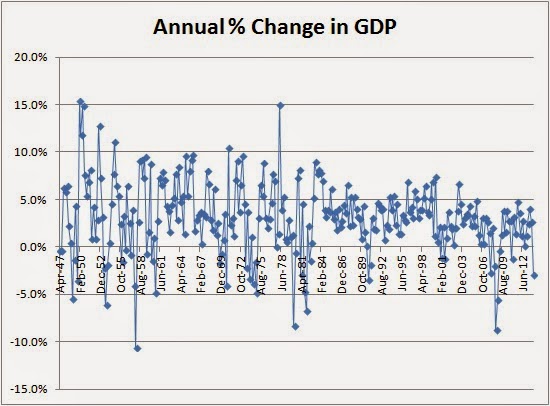
From 1950-1969, GDP growth averaged 4.2%. From 1970-1999 growth slowed to 3.2% (two sample t-test for difference in means p = .084). Since 2000, mean GDP growth has slipped to 1.7% (p = .003).
Because 'real' GDP over-reports output because it under-reports CPI-based inflation, actual decline in GDP growth is likely much worse.
Why is GDP growth slowing or perhaps contracting? Markets are becoming less free, and savings--the basis for investment and productivity improvement--is evaporating in favor of debt.
Because output and prosperity go hand in hand, we're tracing a decline of prosperity.
Holding hands while the walls come tumbling down
When they do, I'll be right behind you
--Tears for Fears
The 'final' revision' of Q1 GDP found that the US economy contracted at a 2.9% annual rate. In other words, output shrank. Back in January, 'consensus' estimates were for a gain of 2.6%. The government, just like corporations, blame the miss on 'weather.'
While the large near term drop in output is disturbing, the bigger picture problem is secular decline in US GDP growth.
The graph below plots annual percentage change in GDP using quarterly real GDP since 1947. It is clear that GDP growth has been slowing for decades.
From 1950-1969, GDP growth averaged 4.2%. From 1970-1999 growth slowed to 3.2% (two sample t-test for difference in means p = .084). Since 2000, mean GDP growth has slipped to 1.7% (p = .003).
Because 'real' GDP over-reports output because it under-reports CPI-based inflation, actual decline in GDP growth is likely much worse.
Why is GDP growth slowing or perhaps contracting? Markets are becoming less free, and savings--the basis for investment and productivity improvement--is evaporating in favor of debt.
Because output and prosperity go hand in hand, we're tracing a decline of prosperity.
Friday, June 27, 2014
Social Opposition to the Fed
It's time we stop
Hey, what's that sound?
Everybody look what's going down
--Buffalo Springfield
Is it possible that the Fed's radical inflationary actions will be hamstrung by public opinion? Thru its actions, the Fed is facilitating the greatest wealth transfer in the history of the world. What if the public catches on? What if the public demands a stop to polices that skew wealth in an unnatural manner?
Many statists face a dilemma. They endorse government force to 'fix' problems. Yet they see wealth skewing more to the rich as a result of government policy. Moreover, prices are rising in many categories as purchasing power is destroyed. Yet, to demand an end to inflationary Fed policy would be to admit that government force is making things worse instead of better.
Such a thought is surely difficult for many statists to process.
However, as $trillions are printed and supplied to the privileged--who in turn exchange that cash for real economic resources produced by others--perhaps the cognitive dissonance grows to the point where the public mind breaks thru its mental block and recognizes the truth.
If it did, then the Fed's current policies and perhaps the institution itself would be history.
Thursday, June 26, 2014
The Simon Trade
"I'm here for one reason and one reason only. I'm here to guess what the music might do in a week, a month, a year from now. That's it. Nothing more. And standing here tonight, I'm afraid that I don't...here...a think. Just...silence."
--John Tuld (Margin Call)
Nose bleed stock prices and uber low vols found me revisiting the Minyanville classic about Simon. John Succo tells the tale of a trading desk friend who bought cheap out-of-the-money S&P index puts in the summer of 1987 and rode them down the subsequent October crash.
What makes the story so interesting is not just that Simon got the timing right on trading a market meltdown, but that he was able to express his trade in a vehicle that was extraordinarily priced.
Option selling had been in vogue for years. Market makers had been making a killing selling puts in a rising market, collecting the premium, then watching the puts go to zero. The popularity of 'portfolio insurance' added to The Street's 'short vol' position.
Somewhat like today's situation where investors are overreaching for yield in an era of interest rate repression, put sellers in 1987 were willing to sell puts at very low prices because they figured that the premium, however low, was like free money. Not only was this creating a dangerous macro environment due to the increased leveraged wrought from massive put selling, but it was suppressing put premiums to extraordinary lows.
John notes that Simon was able to buy six month 10% out-of-the-money puts for less than 0.05% of the index. This enabled Simon to control more than 20 times the underlying stock compared to today, where similar puts typically cost ~1% of the index price.
Stated differently, Simon was able to secure far more leverage per trading dollar than a trader could purchase in today's environment.
As markets weakened and his puts grabbed delta, Simon's P/L exploded higher. When Simon closed his project on the day of the crash, the result was...early retirement. By my calcs, Simon's $12,500 investment (2000 puts @ $.0625) grew to $11.8 million (2000 puts @ $59).
So, with current volatility indexes tickling record lows, does this mean that a bearish market participant can leg into a trade similar to Simon's?
Nope.
Although low implied vols mean that many at-the-money options are cheaper than usual, there is still demand for out-of-the-money puts. Currently, a 10% out-of-the-money put on the SPY costs about 1.1%, and there is chunky open interest at strikes down option chain. The condition where volatilities implied by prices paid for out-of-the-money options are high compared to implied volatilities for at-the-money options is sometimes referred to as 'skew.'
In short, despite the decline in implied volatility in general, prices of out-of-the-money puts have not come down much. Skew is high.
This does not mean that buying index puts to express a bearish view is necessarily a bad idea. A six month 10% out-of-the-money SPY put currently costs about $2. If the SPX drops 20% between now and December expiry then that option will be worth $20+.
A ten bagger would surely be a great trade. However, it requires a large decline in the SPX over the next six months. The probabilities of such an event, coupled with relatively high prices for the speculative instrument, do not match the risk:reward profile of The Simon Trade.
position in SPX
Wednesday, June 25, 2014
Population Center of Gravity
And after all the violence and the double talk
There's just a song in all the trouble and the strife
You do the walk, yeah, you do the walk of life
You do the walk of life
--Dire Straits
Interesting center of gravity analysis of US population since 1790 (interactive version here).

Center of gravity has consistently shifted west with every census. And since the 1930 census, pop center has been shifting south as well.
In 1880, COG was close to Cincinnati. Current center of gravity is Texas County, Missouri.
There's just a song in all the trouble and the strife
You do the walk, yeah, you do the walk of life
You do the walk of life
--Dire Straits
Interesting center of gravity analysis of US population since 1790 (interactive version here).
Center of gravity has consistently shifted west with every census. And since the 1930 census, pop center has been shifting south as well.
In 1880, COG was close to Cincinnati. Current center of gravity is Texas County, Missouri.
Tuesday, June 24, 2014
Losing IRS Emails
Illusion never changed
Into something real
--Natalie Imbruglia
The Obama administration is pushing its lawlessness to new levels with recent announcements that emails from key bureaucrats involved in the IRS scandal have been...lost.

This administration continues to operate is if it believes that the citizenry is either apathetic or stupid.
Into something real
--Natalie Imbruglia
The Obama administration is pushing its lawlessness to new levels with recent announcements that emails from key bureaucrats involved in the IRS scandal have been...lost.
This administration continues to operate is if it believes that the citizenry is either apathetic or stupid.
Monday, June 23, 2014
Democracy and Minority Rights
Kreese: What's the matter? The boy can't take care of his own problems?
Miyagi: One to one problem, yes. FIVE to one problem, too much ask anyone.
--Karate Kid
Laughable statement uttered this morning on the radio by a well known political analyst (paraphrased): The definition of democracy is not majority rule but respect for minority rights.
This person is either delusional or hopes that listeners are stupid.
Democracy is in fact majority rule--the process of putting majority opinion into law. It is an expression of positivism. If a group can conjure the majority of votes, then what this group says, goes. Why? Because they control the government agents who tote the guns.
By definition, minority rights are subservient to the whims of the majority in a democracy. In fact, the majority is likely to rationalize aggression on minorities to no end.
Because it grants privilege rather than preserves rights, democracy discriminates against minority interests.
Respect for minority rights requires rule of law. Democracy facilitates rule by discretion--unequal treatment under the law.
Sunday, June 22, 2014
Patriotism
"Why should I trade one tyrant three thousand miles away for three thousand tyrants one mile away? An elected legislature can trample a man's rights as easily as a king can."
--Benjamin Martin (The Patriot)
Patriotism is often framed as devotion to nation over self. It is not just 'loving one's country,' but doing things in the name of country that one might not do otherwise.
Military contexts often foster patriotic accolades. Fighting for one's country' is commonly deemed patriotic. Military veterans are often labeled as patriots.
The thing about patriotism is that it is usually employed by a group seeking to influence the behavior of others. A person is patriotic if he/she acts in favor of the group and unpatriotic otherwise.
As such, patriotism is a form of social control--a potent and dangerous one at that. The most powerful nation states in world history bathed in patriotism. Citizens acting in the name of country have committed the worst of human atrocities.
Can there be a 'good' form of patriotism. Perhaps. Perhaps good patriotism consists of individuals who see their government going on the offensive, and act to restrain the scope of government to its natural limits.
Many actions of our founding ancestors reflected this notion of patriotism.
Saturday, June 21, 2014
Fed Funds and Instability
If you leave
Don't look back
I'll be running the other way
--OMD
Many things to ponder when viewing this chart.

Fed funds rate has declined from ~18% in 1980 to effectively zero today. A secular decline. The distortions wrought by this policy over the past 30 yrs are mind boggling.
GDP growth has slowed with Fed funds rate decline. This is no spurious correlation.
Not shown here, but lay stock, bond, real estate prices on top of this graph and see what you get. Again, the correlation is not spurious.
The Fed intervenes with easy credit at every 'crisis' point. Can there be more fertile ground for moral hazard?
The secular decline in Fed funds rate indicates that the Fed never fully takes the punch bowl away. Residual stimulus is left in the system after each 'crisis.' There is no 'neutral' funds rate. This is a recipe for addiction.
With Fed funds rate at zero, the Fed has reached the notorious 'zero bound.' Does that mean that they are out of gas? Hardly. There are negative fed funds rates. There is outright asset purchase (a.k.a. 'quantitative easing'). There is straight money printing (e.g., sending people 'stimulus checks').
The tilt to the graph suggests diminishing returns to each unit of Fed intervention. It also suggests that natural market forces are building. At some point that potential energy will turn kinetic--and the Fed will have less counterforce to cope.
Declining Fed funds is a reflection of growing instability.
Don't look back
I'll be running the other way
--OMD
Many things to ponder when viewing this chart.
Fed funds rate has declined from ~18% in 1980 to effectively zero today. A secular decline. The distortions wrought by this policy over the past 30 yrs are mind boggling.
GDP growth has slowed with Fed funds rate decline. This is no spurious correlation.
Not shown here, but lay stock, bond, real estate prices on top of this graph and see what you get. Again, the correlation is not spurious.
The Fed intervenes with easy credit at every 'crisis' point. Can there be more fertile ground for moral hazard?
The secular decline in Fed funds rate indicates that the Fed never fully takes the punch bowl away. Residual stimulus is left in the system after each 'crisis.' There is no 'neutral' funds rate. This is a recipe for addiction.
With Fed funds rate at zero, the Fed has reached the notorious 'zero bound.' Does that mean that they are out of gas? Hardly. There are negative fed funds rates. There is outright asset purchase (a.k.a. 'quantitative easing'). There is straight money printing (e.g., sending people 'stimulus checks').
The tilt to the graph suggests diminishing returns to each unit of Fed intervention. It also suggests that natural market forces are building. At some point that potential energy will turn kinetic--and the Fed will have less counterforce to cope.
Declining Fed funds is a reflection of growing instability.
Subscribe to:
Posts (Atom)