"Hey, Cyn, guess where I am?"
--Tess McGill (Working Girl)
Spot on observation that although President Obama calls growing income inequality 'morally wrong,' income disparity has grown more on his watch than in other recent administration. These pages have frequently discussed the effects of government policy, and this administration's efforts in particular, on the distribution of income and wealth (examples here, here, here, here).
Income inequality itself is not morally wrong. In fact, it is an essential feature of a thriving market economy, as it empowers consumers to motivate producers to better meet marketplace needs. Those producers who do so are compensated well; those who do not do so are paid less.
Although it gets less attention, an even more important feature of a market economy is income mobility, defined as the extent to which people can move (up or down) in income. In unhampered markets, people who better serve the needs of the market move to higher income brackets; those who do not do so drop to lower levels.
Distributions of income and wealth therefore have natural shapes and variances to them, reflecting voluntary cooperation among people seeking to improve their circumstances.
The problem occurs when force is applied to unnaturally alter the distributions. When people use force on their own to alter income or wealth distributions, it is called robbery, fraud, slavery, etc.
When people employ government agents to forcefully alter income or wealth patterns, the associated policies go by many names: welfare, war, fiscal policy, monetary policy, et al. Some of these policies force the distribution tighter while others serve to widen it.
Currently, the policies enacted by the Obama administration are, on the net, serving to force the distribution wider.
If this president is serious about reducing income inequality then he should not apply even more force to the system in hopes of reducing the spread between rich and poor.
The correct response is to remove force from the system.
Showing posts sorted by relevance for query income inequality. Sort by date Show all posts
Showing posts sorted by relevance for query income inequality. Sort by date Show all posts
Wednesday, July 31, 2013

Wednesday, January 29, 2014
Income Envy
I've never seen a diamond in the flesh
I cut my teeth on wedding rings in the movies
And I'm not pround of my address
In the torn up town
No post code envy
--Lorde
Jacob Hornberger reinforces many of the observations made on these pages about income inequality, including the difference between income inequality that occurs naturally and income inequality that occurs by force. Currently, force is distorting income and wealth distribution.
At the end of his piece, JH poses the following hypothetical. Which would you prefer?
a) A society in which the rich earn hundreds of $millions, the middle class earn $200,000, and the bottom ten percent earn $40,000.
b) A society in which everyone receives the same amount, $10,000 per year, by virtue of government tax-and-spend equalization decree.
Those who value liberty will overwhelmingly prefer a) if the distribution of income is driven by natural (i.e., free market forces).
JH proposes leftists will lean toward b) because this group's obsessive concern with income inequality is likely grounded in envy and covetousness. They have trouble coping with the reality that some have more than others.
Indeed, many years ago Mises suggested that a pathology of resentment was central to socialism.
I cut my teeth on wedding rings in the movies
And I'm not pround of my address
In the torn up town
No post code envy
--Lorde
Jacob Hornberger reinforces many of the observations made on these pages about income inequality, including the difference between income inequality that occurs naturally and income inequality that occurs by force. Currently, force is distorting income and wealth distribution.
At the end of his piece, JH poses the following hypothetical. Which would you prefer?
a) A society in which the rich earn hundreds of $millions, the middle class earn $200,000, and the bottom ten percent earn $40,000.
b) A society in which everyone receives the same amount, $10,000 per year, by virtue of government tax-and-spend equalization decree.
Those who value liberty will overwhelmingly prefer a) if the distribution of income is driven by natural (i.e., free market forces).
JH proposes leftists will lean toward b) because this group's obsessive concern with income inequality is likely grounded in envy and covetousness. They have trouble coping with the reality that some have more than others.
Indeed, many years ago Mises suggested that a pathology of resentment was central to socialism.
Monday, March 25, 2019
Unequal Incomes by Force
And I get so tired when I have to explain
When you're so far away from me
See you've been in the sun and I've been in the rain
And you're so far away from me
--Dire Straits
As these pages have observed, income inequality is not a bad thing when it occurs naturally. In fact, it is an essential feature of a thriving market economy. The specter of higher incomes motivates producers to become more productive. When producers are compensated (by consumers) for being more productive (either thru innovation or efficiency gains), then standard of living improves for all.
Problems arise, however, when income inequality is increased by force. "Huh?," you ask, "I thought income equality is what bureaucrats seek to achieve by force--using, for example, socialist tactics of re-distribution."
Yes, but while income equality can be forced, so can income inequality. The primary platform for increased income (and wealth) inequality is central bank policy. Whenever the Fed and other central banks ease monetary policy, which requires force to do so, then incomes become more unequal.
When rates are forced lower, financial assets like stocks and bonds are bid higher. Wealthy individuals, who tend to own more financial assets, benefit in an out-sized way compared to people of lesser means. Moreover, people of lesser means, who commonly climb the first few rungs of the economic prosperity ladder by saving more of their incomes in interest-bearing accounts, get paid less for doing so. With less incentive to save, many lower income people save far less than they otherwise would--and may even take on more debt since the cost of borrowing has been forced lower. Yet, more debt and less saving is precisely the opposite of what poorer people need to do to boost income and wealth over time.
Another group that benefits from easy monetary policy is the financial sector. Because banks, brokers, et al. get first dibs on newly created cash and credit money by central banks, they can buy things (financial securities in particular) while prices are still low and then profit handsomely as prices rise when those lower in the food chain subsequently get their hands on the money and bid things higher in an inflationary cycle.
With central bankers engaged in the most radical monetary policies that the world has ever seen, we can be confident that these policies have forced income distribution markedly wider in their wake.
When you're so far away from me
See you've been in the sun and I've been in the rain
And you're so far away from me
--Dire Straits
As these pages have observed, income inequality is not a bad thing when it occurs naturally. In fact, it is an essential feature of a thriving market economy. The specter of higher incomes motivates producers to become more productive. When producers are compensated (by consumers) for being more productive (either thru innovation or efficiency gains), then standard of living improves for all.
Problems arise, however, when income inequality is increased by force. "Huh?," you ask, "I thought income equality is what bureaucrats seek to achieve by force--using, for example, socialist tactics of re-distribution."
Yes, but while income equality can be forced, so can income inequality. The primary platform for increased income (and wealth) inequality is central bank policy. Whenever the Fed and other central banks ease monetary policy, which requires force to do so, then incomes become more unequal.
When rates are forced lower, financial assets like stocks and bonds are bid higher. Wealthy individuals, who tend to own more financial assets, benefit in an out-sized way compared to people of lesser means. Moreover, people of lesser means, who commonly climb the first few rungs of the economic prosperity ladder by saving more of their incomes in interest-bearing accounts, get paid less for doing so. With less incentive to save, many lower income people save far less than they otherwise would--and may even take on more debt since the cost of borrowing has been forced lower. Yet, more debt and less saving is precisely the opposite of what poorer people need to do to boost income and wealth over time.
Another group that benefits from easy monetary policy is the financial sector. Because banks, brokers, et al. get first dibs on newly created cash and credit money by central banks, they can buy things (financial securities in particular) while prices are still low and then profit handsomely as prices rise when those lower in the food chain subsequently get their hands on the money and bid things higher in an inflationary cycle.
With central bankers engaged in the most radical monetary policies that the world has ever seen, we can be confident that these policies have forced income distribution markedly wider in their wake.
Monday, August 22, 2011
The Folly of Income Equality
When the walls come tumblin' down
When the walls come crumblin' crumblin'
When the walls come tumblin' tumblin' down
--John Mellencamp
Keen insight, as always, from Mises on wealth and income inequality. The phenomenon of unequal distribution of wealth and income is as old as civilization itself, although formal study is often considered to have commenced with Pareto's work in the 1800s.
Mises sagely observes that inequality is an essential feature of a market economy. In a market economy, consumers, not producers, are supreme. Inequality empowers consumers to motivate those engaged in production to comply with their demands. Producers maintain possession of productive assets as long as they successfully satisfy consumers. If they are unsuccessful, then profits fall and producers cede control of productive assets to those more capable.
If there was no inequality of income permitted in society, then producers would not be driven to improve productivity and innovate to better satisfy buyer needs. Inequality of income drives higher standard of living for all, including those at the bottom of the social pyramid. This relationship is something that socialists fail or refuse to understand.
Were it possible to to evenly distribute income (a debateable thing, as we've never seen it on a large scale in the history of the world), then society is destined for squalor. There is no incentive for producers to innovate. Moreover, investment capital necessary for improving productivity would not exist it is typically accumulated by those with high incomes. Indeed, those who control production, which in a socialistic system are the central planners, reign supreme. Consumers are forced to take what the planners mandate. Productivity declines; standard of living falls.
Mises notes that contemporary socialists often claim that they don't to do away with inequality altogether. Instead, they espouse a 'lesser degree' of inequality. Of course, determining that lesser degree is an exercise in subjectivity that leads down the slippery slope. Mises correctly notes that once a society undertakes a policy of equalization, it is unlikely that there will be a future point where that policy can be checked. Quoting the master:
"Under the sway of the doctrines taught by contemporary pseudoeconomists, all but a few reasonable men believe that they are injured by the mere fact that their own income is smaller than that of other people and that it is not a bad policy to confiscate the difference." [emphasis mine]
So progressives clamor for ever more 'social justice' from their government agents of force...as the walls crumble around them.
When the walls come crumblin' crumblin'
When the walls come tumblin' tumblin' down
--John Mellencamp
Keen insight, as always, from Mises on wealth and income inequality. The phenomenon of unequal distribution of wealth and income is as old as civilization itself, although formal study is often considered to have commenced with Pareto's work in the 1800s.
Mises sagely observes that inequality is an essential feature of a market economy. In a market economy, consumers, not producers, are supreme. Inequality empowers consumers to motivate those engaged in production to comply with their demands. Producers maintain possession of productive assets as long as they successfully satisfy consumers. If they are unsuccessful, then profits fall and producers cede control of productive assets to those more capable.
If there was no inequality of income permitted in society, then producers would not be driven to improve productivity and innovate to better satisfy buyer needs. Inequality of income drives higher standard of living for all, including those at the bottom of the social pyramid. This relationship is something that socialists fail or refuse to understand.
Were it possible to to evenly distribute income (a debateable thing, as we've never seen it on a large scale in the history of the world), then society is destined for squalor. There is no incentive for producers to innovate. Moreover, investment capital necessary for improving productivity would not exist it is typically accumulated by those with high incomes. Indeed, those who control production, which in a socialistic system are the central planners, reign supreme. Consumers are forced to take what the planners mandate. Productivity declines; standard of living falls.
Mises notes that contemporary socialists often claim that they don't to do away with inequality altogether. Instead, they espouse a 'lesser degree' of inequality. Of course, determining that lesser degree is an exercise in subjectivity that leads down the slippery slope. Mises correctly notes that once a society undertakes a policy of equalization, it is unlikely that there will be a future point where that policy can be checked. Quoting the master:
"Under the sway of the doctrines taught by contemporary pseudoeconomists, all but a few reasonable men believe that they are injured by the mere fact that their own income is smaller than that of other people and that it is not a bad policy to confiscate the difference." [emphasis mine]
So progressives clamor for ever more 'social justice' from their government agents of force...as the walls crumble around them.
Monday, November 14, 2011
Income Mobility
Out in the woods
Or in the city
It's all the same to me
When I'm driving free
The world's my home
When I'm mobile
--The Who
Nice little missive warning against concluding much about 'income inequality' from distribution of income studies like the one recently issued by CBO.
An important limitation of income distribution studies is that they group earners by category. For example, earners are often filed into one of five categories, top 20%, next 20%,..., bottom 20%. Thus, when CBO reports change in income for the top 20% compared to change in income for the bottom 20% over a given period, it is tempting to conclude that individual incomes in each group changed, on average, by that amount.
Such an approach is prone to faulty conclusions because it ignores the influence of income mobility. Income mobility measures the extent to which individuals move between categorical brackets.
Citing findings from a recent income mobility study by Treasury, the author demonstrates that many individuals tracked over periods of time move in directions opposite those suggested by the static distribution of income studies. In the Treasury study, for example, incomes of those in the top one and five percent in 1996 were actually lower in 2005, while those in the bottom 20% in 1996 saw their incomes increase on average by 91% in 2005.
Static income distribution studies miss the dynamic effects of income mobility as the situations of individuals change over time.
Or in the city
It's all the same to me
When I'm driving free
The world's my home
When I'm mobile
--The Who
Nice little missive warning against concluding much about 'income inequality' from distribution of income studies like the one recently issued by CBO.
An important limitation of income distribution studies is that they group earners by category. For example, earners are often filed into one of five categories, top 20%, next 20%,..., bottom 20%. Thus, when CBO reports change in income for the top 20% compared to change in income for the bottom 20% over a given period, it is tempting to conclude that individual incomes in each group changed, on average, by that amount.
Such an approach is prone to faulty conclusions because it ignores the influence of income mobility. Income mobility measures the extent to which individuals move between categorical brackets.
Citing findings from a recent income mobility study by Treasury, the author demonstrates that many individuals tracked over periods of time move in directions opposite those suggested by the static distribution of income studies. In the Treasury study, for example, incomes of those in the top one and five percent in 1996 were actually lower in 2005, while those in the bottom 20% in 1996 saw their incomes increase on average by 91% in 2005.
Static income distribution studies miss the dynamic effects of income mobility as the situations of individuals change over time.
Wednesday, November 10, 2010
Reducing Income Inequality
If I told you what it takes to reach the highest high
You'd laugh and say nothing's that simple
--The Who
Interesting article in the most recent Journal of Finance by Beck, Levine, and Levkov (2010). The researchers assess the impact of banking deregulation from 1976 to 1994 on income distribution.
Common wisdom is that industry regulation is necessary to improve social welfare. Otherwise the rich get richer at the expense of the poor.
The researchers found the opposite. After controlling for various economic and sociodemographic variables, income disparity actually narrowed during the study period. Social welfare, as reflected by income inequality, improved with bank deregulation.
While surprising to some, these findings should actually be expected. Regulation squelches competition and raises barriers to entry in an industry--effectively protecting the franchises of incumbents. A mountain of research suggests that innovation and efficiency gains are most often achieved by new enterprises rather than by the entreched establishment.
Cutting regs encourages Schumpeter's (1942) capitalistic 'process of creative destruction.' This process pushes general standards of living higher, not lower.
We're doing the opposite currently--saddling economic environments with ever more interventionary action by government. And the chasm between rich and poor widens...
Another laughably sad situation.
position in XLF
Reference
Beck, T., Levine, R., & Levkov, A. 2010. Big bad banks? The winners and losers from bank deregulation in the United States. Journal of Finance, 65: 1637-1667.
Schumpeter, J.A. 1942. Capitalism, socialism & democracy. New York: Harper & Brothers.
You'd laugh and say nothing's that simple
--The Who
Interesting article in the most recent Journal of Finance by Beck, Levine, and Levkov (2010). The researchers assess the impact of banking deregulation from 1976 to 1994 on income distribution.
Common wisdom is that industry regulation is necessary to improve social welfare. Otherwise the rich get richer at the expense of the poor.
The researchers found the opposite. After controlling for various economic and sociodemographic variables, income disparity actually narrowed during the study period. Social welfare, as reflected by income inequality, improved with bank deregulation.
While surprising to some, these findings should actually be expected. Regulation squelches competition and raises barriers to entry in an industry--effectively protecting the franchises of incumbents. A mountain of research suggests that innovation and efficiency gains are most often achieved by new enterprises rather than by the entreched establishment.
Cutting regs encourages Schumpeter's (1942) capitalistic 'process of creative destruction.' This process pushes general standards of living higher, not lower.
We're doing the opposite currently--saddling economic environments with ever more interventionary action by government. And the chasm between rich and poor widens...
Another laughably sad situation.
position in XLF
Reference
Beck, T., Levine, R., & Levkov, A. 2010. Big bad banks? The winners and losers from bank deregulation in the United States. Journal of Finance, 65: 1637-1667.
Schumpeter, J.A. 1942. Capitalism, socialism & democracy. New York: Harper & Brothers.
Tuesday, January 24, 2012
Income Mobility vs Wealth Mobility
The world was on fire and no one could save me but you
It's strange what desire will make foolish people do
--Chris Isaak
In a Facebook thread initiated by my sister, a contributor noted that defining 'rich' in terms of 'wealth' (stock of resources) is more appropriate than defining rich in terms of 'income' (flow of resources).
Indeed. But the reality is that 'rich' and 'income' enjoy popular association, as evidenced by the piles of income inequality pieces published in the mainstream press (one dated but still instructive example here by the NYT).
The contributor also discounted the use of income mobility studies to discern the extent that 'the rich stay rich,' arguing that incomes can vary wildly from year to year for individuals. And, to be sure, a rich person could own a stock of resources that generates little income.
I can't be sure, but I believe this person was implying that 'wealth mobility' measures would be more accurate measures of the durability of 'richness' over time.
I am not familiar w 'wealth mobility' studies in kind, but my sense is that they too would reflect significant temporal change. Those who own equities, for example, see big changes in net worth when markets move. And because wealthier people own more equities as well as other risky securities, it stands to reason that top wealth brackets are pretty volatile.
For those unsatisfied with current distribution of wealth, let me submit that the most nefarious activity that favors 'the rich' is the immense government intervention in markets that serves to prop up asset prices. Government intervention in markets clearly benefits the wealthy and helps them stay 'rich.'
The NYT data noted above provide some empirical support. Overlay, for example, a chart of the S&P 500 since the 1970s over the timelines shown and you'll find a pretty good correlation.
Remove monetary, fiscal, and regulatory stimulus that is propping up markets worldwide, and watch the gap between rich and poor narrow.
position in SPX
It's strange what desire will make foolish people do
--Chris Isaak
In a Facebook thread initiated by my sister, a contributor noted that defining 'rich' in terms of 'wealth' (stock of resources) is more appropriate than defining rich in terms of 'income' (flow of resources).
Indeed. But the reality is that 'rich' and 'income' enjoy popular association, as evidenced by the piles of income inequality pieces published in the mainstream press (one dated but still instructive example here by the NYT).
The contributor also discounted the use of income mobility studies to discern the extent that 'the rich stay rich,' arguing that incomes can vary wildly from year to year for individuals. And, to be sure, a rich person could own a stock of resources that generates little income.
I can't be sure, but I believe this person was implying that 'wealth mobility' measures would be more accurate measures of the durability of 'richness' over time.
I am not familiar w 'wealth mobility' studies in kind, but my sense is that they too would reflect significant temporal change. Those who own equities, for example, see big changes in net worth when markets move. And because wealthier people own more equities as well as other risky securities, it stands to reason that top wealth brackets are pretty volatile.
For those unsatisfied with current distribution of wealth, let me submit that the most nefarious activity that favors 'the rich' is the immense government intervention in markets that serves to prop up asset prices. Government intervention in markets clearly benefits the wealthy and helps them stay 'rich.'
The NYT data noted above provide some empirical support. Overlay, for example, a chart of the S&P 500 since the 1970s over the timelines shown and you'll find a pretty good correlation.
Remove monetary, fiscal, and regulatory stimulus that is propping up markets worldwide, and watch the gap between rich and poor narrow.
position in SPX
Friday, April 18, 2014
Measuring Economic Inequality II
Every summer we can rent a cottage
In the Isle of Wright
If it's not too dear
We shall scrimp and save
--The Beatles
In a previous post, we highlighted a common problem in studies of economic inequality--the commingling of income and wealth data. Another issue involves income and wealth differences by age.
Suppose that all people entered the workforce at age 20 s making $20,000/yr. Each decade, they get a $10,000/yr raise. They also save 5% of their income annually and get no return on their savings. Assuming the same number of people in each ten year age bracket, the distribution of income and end-of-age-bracket wealth would resemble the following:
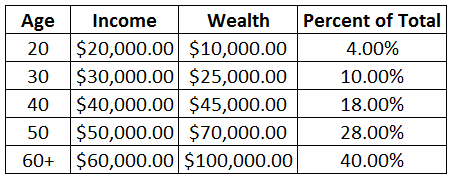
Those aged 50 or older own more than 2/3 of the wealth.
The above model assumes equal work skills, similar saving habits, and no returns on savings. Sprinkle more reality into the example and the distribution skews more.
Age alone creates economic inequality.
In the Isle of Wright
If it's not too dear
We shall scrimp and save
--The Beatles
In a previous post, we highlighted a common problem in studies of economic inequality--the commingling of income and wealth data. Another issue involves income and wealth differences by age.
Suppose that all people entered the workforce at age 20 s making $20,000/yr. Each decade, they get a $10,000/yr raise. They also save 5% of their income annually and get no return on their savings. Assuming the same number of people in each ten year age bracket, the distribution of income and end-of-age-bracket wealth would resemble the following:
Those aged 50 or older own more than 2/3 of the wealth.
The above model assumes equal work skills, similar saving habits, and no returns on savings. Sprinkle more reality into the example and the distribution skews more.
Age alone creates economic inequality.
Sunday, April 18, 2010
Spreading the Wealth
"I'm looking, and I don't like what I see."
--Bud Fox (Wall Street)
I ran across this year old NYT piece discussing growing income inequality in the US. If we accept the NYT measure of income capture as limited to the fraction of all income earned by the top %1 of US households (many studies I've seen use a more inclusive percentage such as top 5, 10%), then in 2007 the top 1% claimed 24% of the total--a fraction matched before only by the runup before the Crash of '29 (which should right away give some hint as to source of the spread).
The article suggests that 'market forces' drove much of the increasing spread. But this claim holds little water as our markets have been becoming less free over the past 100 yrs, not more free. Interestingly, btw, the time period for the data reported was 1913 forward--which corresponds roughly with the advent of the Progressive Movement. 1913, btw, saw the passage of both the Federal Reserve Act and the Sixteenth Amendments as part of President Wilson's 'New Freedom' initiative.
So shouldn't the obvious and intellectually honest question go something like this: Why in a century of 'progressivism, where markets became less free and government intervention, which included the institution of a progressive tax code, increasingly became the norm, did we get periods of record income spreads between high and low earners? Could it be some combination of the interventions themselves that drives periods of bigger spreads?
While not addressing this question directly, the article does note that the spread has widened since 1980 (the beginning of the great bull market in stocks), and that most of the increase in high earners comes from stocks and bond investments. It also indicates that the wealth spread is coming in with lower stock prices.
Those seriously looking for insight into the causes of increasing income spreads in the US over the past century, then, might want to start with questions such as:
-->What interventionary policies have triggered big run ups in stock prices (look at a chart of the S&P 500 since 1980 and ask youself if that represents 'normal' market behavior)?
-->What policies help the wealthy to lever up risk capital beyond what would be facilitated in free markets alone?
-->What policies help the wealthy protect huge gains from being wiped out if (when) excessive risk taking goes awry?
Few people seem to want to go down this road.
position in SPX
--Bud Fox (Wall Street)
I ran across this year old NYT piece discussing growing income inequality in the US. If we accept the NYT measure of income capture as limited to the fraction of all income earned by the top %1 of US households (many studies I've seen use a more inclusive percentage such as top 5, 10%), then in 2007 the top 1% claimed 24% of the total--a fraction matched before only by the runup before the Crash of '29 (which should right away give some hint as to source of the spread).
The article suggests that 'market forces' drove much of the increasing spread. But this claim holds little water as our markets have been becoming less free over the past 100 yrs, not more free. Interestingly, btw, the time period for the data reported was 1913 forward--which corresponds roughly with the advent of the Progressive Movement. 1913, btw, saw the passage of both the Federal Reserve Act and the Sixteenth Amendments as part of President Wilson's 'New Freedom' initiative.
So shouldn't the obvious and intellectually honest question go something like this: Why in a century of 'progressivism, where markets became less free and government intervention, which included the institution of a progressive tax code, increasingly became the norm, did we get periods of record income spreads between high and low earners? Could it be some combination of the interventions themselves that drives periods of bigger spreads?
While not addressing this question directly, the article does note that the spread has widened since 1980 (the beginning of the great bull market in stocks), and that most of the increase in high earners comes from stocks and bond investments. It also indicates that the wealth spread is coming in with lower stock prices.
Those seriously looking for insight into the causes of increasing income spreads in the US over the past century, then, might want to start with questions such as:
-->What interventionary policies have triggered big run ups in stock prices (look at a chart of the S&P 500 since 1980 and ask youself if that represents 'normal' market behavior)?
-->What policies help the wealthy to lever up risk capital beyond what would be facilitated in free markets alone?
-->What policies help the wealthy protect huge gains from being wiped out if (when) excessive risk taking goes awry?
Few people seem to want to go down this road.
position in SPX
Tuesday, April 1, 2014
Measuring Economic Inequality I
Drawn into the stream
Of undefined illusion
Those diamond dreams
They can't disguise the truth
--Level 42
Nice review of common mistakes when measuring economic inequality. A whopper, using a 2011 paper by Norton and Ariely as an example, is the commingling of income and wealth inequality measures. Norton and Ariely asked survey participants to indicate their preference between pie charts depicting wealth distribution in the US and income distribution in Sweden--while framing both as wealth distributions.
In fact, wealth distributions of the US and Sweden are much closer than presented by the researchers. Ariely has since admitted that it is difficult to find a country that has a relatively equitable distribtution of wealth.
Finding such an example is likely to prove more than difficult. It is probably impossible. Concentrated wealth has been a condition of society since the beginning, with observers such as Pareto considering the phenomenon along the way. Even countries positioned far toward the socialism end of the economic spectrum are likely to reflect large quantitities of wealth concentrated in small fractions of their populations.
An important but usually unaddressed issue is the extent to which wealth distributions are skewed by force.
Returning to Norton and Ariely's paper, add the fact that the authors did not merely present two hypothetical distributions (e.g., A and B) to reduce respondent bias related to particular countries and you get results that are highly contestable at best and severely slanted at worst. It is easy to construe this paper as more propaganda than research.
That this study appeared in a peer reviewed outlet demonstrates that any paper can pass editorial muster if the review board is sympathetic to a particular ideological viewpoint.
There are several other good points made by this author concerning the (mis)measurement of economic inequality. We will consider some of them in future posts.
Of undefined illusion
Those diamond dreams
They can't disguise the truth
--Level 42
Nice review of common mistakes when measuring economic inequality. A whopper, using a 2011 paper by Norton and Ariely as an example, is the commingling of income and wealth inequality measures. Norton and Ariely asked survey participants to indicate their preference between pie charts depicting wealth distribution in the US and income distribution in Sweden--while framing both as wealth distributions.
In fact, wealth distributions of the US and Sweden are much closer than presented by the researchers. Ariely has since admitted that it is difficult to find a country that has a relatively equitable distribtution of wealth.
Finding such an example is likely to prove more than difficult. It is probably impossible. Concentrated wealth has been a condition of society since the beginning, with observers such as Pareto considering the phenomenon along the way. Even countries positioned far toward the socialism end of the economic spectrum are likely to reflect large quantitities of wealth concentrated in small fractions of their populations.
An important but usually unaddressed issue is the extent to which wealth distributions are skewed by force.
Returning to Norton and Ariely's paper, add the fact that the authors did not merely present two hypothetical distributions (e.g., A and B) to reduce respondent bias related to particular countries and you get results that are highly contestable at best and severely slanted at worst. It is easy to construe this paper as more propaganda than research.
That this study appeared in a peer reviewed outlet demonstrates that any paper can pass editorial muster if the review board is sympathetic to a particular ideological viewpoint.
There are several other good points made by this author concerning the (mis)measurement of economic inequality. We will consider some of them in future posts.
Wednesday, March 13, 2019
Incomes and Fairness
Drawn into the stream
Of undefined illusion
Those diamond dreams
They can't disguise the truth
--Level 42
Prof Williams considers whether inequality of incomes is 'fair.' If it was obtained by force, as in the case of a person robbing another, then such income would not be fairly obtained. That property needs to be taken from the thief and returned to its rightful owner.
If the income was obtained thru production and trade, then that income is is fairly obtained. That income serves as proof that the individual who obtained it has served his fellow man. As Williams notes, "A system that requires that one serve his fellow man to have a claim on what he produces is far more moral than the system without it." The more a person serve others, the greater that person's income.
Compare that to the system promoted by many politicians that works like this: "You don't need to work to have a claim on the production of others. Instead, just vote for me. Via the tax code, I will take some of what your fellow man produces and give it to you in the name of 'fairness.'
How could such a morally corrupt system ever get traction? Because the distribution of wealth is naturally skewed. A few have a lot compared to many who have less. Merge that with a democratic political process where majorities get their way and control the strong arm of government, and it is easy to see how the many rationalize their theft of the few in the name of 'fairness.'
Of undefined illusion
Those diamond dreams
They can't disguise the truth
--Level 42
Prof Williams considers whether inequality of incomes is 'fair.' If it was obtained by force, as in the case of a person robbing another, then such income would not be fairly obtained. That property needs to be taken from the thief and returned to its rightful owner.
If the income was obtained thru production and trade, then that income is is fairly obtained. That income serves as proof that the individual who obtained it has served his fellow man. As Williams notes, "A system that requires that one serve his fellow man to have a claim on what he produces is far more moral than the system without it." The more a person serve others, the greater that person's income.
Compare that to the system promoted by many politicians that works like this: "You don't need to work to have a claim on the production of others. Instead, just vote for me. Via the tax code, I will take some of what your fellow man produces and give it to you in the name of 'fairness.'
How could such a morally corrupt system ever get traction? Because the distribution of wealth is naturally skewed. A few have a lot compared to many who have less. Merge that with a democratic political process where majorities get their way and control the strong arm of government, and it is easy to see how the many rationalize their theft of the few in the name of 'fairness.'
Wednesday, June 22, 2011
More Fudge in the CPI Numbers
"You've been living in a dream world, Neo."
--The Matrix
As part of the federal budget talks, there is a proposal on the table to alter the way that the consumer price index (CPI) is calculated. Essentially, the proposed method would try to take into account the fact that consumers often trade down (e.g., go from steak to hamburger) when prices rise.
If passed, the alteration would make the 'headline' inflation number smaller.
Why is this on the table as part of the budget debate? Because a smaller inflation number would lower federal payouts (such as social security) that include cost of living adjustments. Viola! An instant $200 billion in budget savings.
This would not be the first time that the CPI has been dumbed down. There have been multiple changes to the methodology over the past couple of decades. The weird (criminal) thing is that when the goverment changes the method, they do not go back and alter the historical series. Those looking at historical CPI data are not comparing apples to apples (the same is true for unemployment, GDP, and other measures). If we were measuring the CPI the same way as in 1980, the headline inflation number would be nearly triple the currently reported level.
How such a practice is viewed as legitimate and is tolerated is beyond me. If I had tried to manage measurement systems like this during my industry days, then I would surely have been fired.
Make sure you understand the dynamic here. The federal government is printing money, which undermines the value of the dollar. Government officials are then supressing the metric that is supposed to reflect the dollar's value, effectively under-reporting reporting the inflationary consequences of their activities.
I continue to shake my head in disbelief at those people who see the widening income/wealth chasm as driven by 'big bad business', the private sector rich, et al. They fail or refuse to recognize the impact of government policies such devaluing the currency on real income inequality. Inflation guts the wealth of savers, and transfers it to those with political interests. Those at the bottom of the economic pyramid are hit especially hard in this regard...and the divide widens.
--The Matrix
As part of the federal budget talks, there is a proposal on the table to alter the way that the consumer price index (CPI) is calculated. Essentially, the proposed method would try to take into account the fact that consumers often trade down (e.g., go from steak to hamburger) when prices rise.
If passed, the alteration would make the 'headline' inflation number smaller.
Why is this on the table as part of the budget debate? Because a smaller inflation number would lower federal payouts (such as social security) that include cost of living adjustments. Viola! An instant $200 billion in budget savings.
This would not be the first time that the CPI has been dumbed down. There have been multiple changes to the methodology over the past couple of decades. The weird (criminal) thing is that when the goverment changes the method, they do not go back and alter the historical series. Those looking at historical CPI data are not comparing apples to apples (the same is true for unemployment, GDP, and other measures). If we were measuring the CPI the same way as in 1980, the headline inflation number would be nearly triple the currently reported level.
How such a practice is viewed as legitimate and is tolerated is beyond me. If I had tried to manage measurement systems like this during my industry days, then I would surely have been fired.
Make sure you understand the dynamic here. The federal government is printing money, which undermines the value of the dollar. Government officials are then supressing the metric that is supposed to reflect the dollar's value, effectively under-reporting reporting the inflationary consequences of their activities.
I continue to shake my head in disbelief at those people who see the widening income/wealth chasm as driven by 'big bad business', the private sector rich, et al. They fail or refuse to recognize the impact of government policies such devaluing the currency on real income inequality. Inflation guts the wealth of savers, and transfers it to those with political interests. Those at the bottom of the economic pyramid are hit especially hard in this regard...and the divide widens.
Tuesday, March 5, 2013
Distributing Wealth by Force
"It's the story of the greatest wealth transfer in the history of the world."
--Jake Moore (Wall Street: Money Never Sleeps)
Income inequality is a natural and desirable feature of a free society. Precisely what the distribution of wealth looks like in a free society is unpredictable. We know that it will be dynamic, however, for it reflects voluntary cooperation among people to improve their circumstances--whatever their capacity for doing so.
When the scope of government expands beyond helping people protect their property to taking property from some people for the benefit of others, then the distribution of wealth becomes unnatural. It is a distribution shaped by force rather than by freedom.
Various policies shape the distribution of wealth unnaturally. The policies aim at doing one of two things: a) forcing wealth to be more even between people, or b) forcing wealth to be more uneven between people. Let's consider an example of each type of policy.
a) Forcing wealth to be more even. The centerpiece of US tax policy is the progressive income tax, which takes increasingly larger fractions of a person's production (i.e., the more you produce, the greater the percentage of production taken) for the benefit of others. If the production is redistributed to those who have less, then the result should be a leveling of wealth among people.
Political mischief, of course, may reduce the likelihood of that unnatural outcome in favor of another unnatural outcome--that of the politically connected siphoning off a significant share of the tax receipts for their own interests (which perversely could make this policy more type b than a).
b) Forcing wealth to be more uneven. Monetary policy also shapes distribution of wealth in unnatural ways. Current zero interest rate policy (ZIRP) of the Federal Reserve gives large financial institutions access to ultra cheap credit. Those institutions borrow as much as they can and then lever up to buy financial assets of all shapes and sizes--with the implicit backing of the government to do so. Because they are first users of newly minted money, these institutions can take control of assets while prices are relatively unchanged. By the time that money trickles down to the rest of the population, prices have been bid up. The late users have lost purchasing power and have gotten poorer vs the first users of printed money.
In addition to the bankers, those who own financial assets (stocks, bonds, real estate, etc) benefit from stimulative policies of the Fed. The Fed has said as much. However, most financial assets are owned by a small fraction of the population (i.e., the wealthy), meaning that policies aimed at elevating asset prices are likely to skew the distribution of wealth unnaturally toward the rich.
Although both types of policies are at work in the US, type b policies appear to have the upper hand. The rich are getting unnaturally richer.
This has proponents of type a policies shouting for more taxes on the rich. They want to add to the force already in the system. As in war, opposing forces do not cancel each other out. The damage done is additive.
The proper response is to remove force from the system.
--Jake Moore (Wall Street: Money Never Sleeps)
Income inequality is a natural and desirable feature of a free society. Precisely what the distribution of wealth looks like in a free society is unpredictable. We know that it will be dynamic, however, for it reflects voluntary cooperation among people to improve their circumstances--whatever their capacity for doing so.
When the scope of government expands beyond helping people protect their property to taking property from some people for the benefit of others, then the distribution of wealth becomes unnatural. It is a distribution shaped by force rather than by freedom.
Various policies shape the distribution of wealth unnaturally. The policies aim at doing one of two things: a) forcing wealth to be more even between people, or b) forcing wealth to be more uneven between people. Let's consider an example of each type of policy.
a) Forcing wealth to be more even. The centerpiece of US tax policy is the progressive income tax, which takes increasingly larger fractions of a person's production (i.e., the more you produce, the greater the percentage of production taken) for the benefit of others. If the production is redistributed to those who have less, then the result should be a leveling of wealth among people.
Political mischief, of course, may reduce the likelihood of that unnatural outcome in favor of another unnatural outcome--that of the politically connected siphoning off a significant share of the tax receipts for their own interests (which perversely could make this policy more type b than a).
b) Forcing wealth to be more uneven. Monetary policy also shapes distribution of wealth in unnatural ways. Current zero interest rate policy (ZIRP) of the Federal Reserve gives large financial institutions access to ultra cheap credit. Those institutions borrow as much as they can and then lever up to buy financial assets of all shapes and sizes--with the implicit backing of the government to do so. Because they are first users of newly minted money, these institutions can take control of assets while prices are relatively unchanged. By the time that money trickles down to the rest of the population, prices have been bid up. The late users have lost purchasing power and have gotten poorer vs the first users of printed money.
In addition to the bankers, those who own financial assets (stocks, bonds, real estate, etc) benefit from stimulative policies of the Fed. The Fed has said as much. However, most financial assets are owned by a small fraction of the population (i.e., the wealthy), meaning that policies aimed at elevating asset prices are likely to skew the distribution of wealth unnaturally toward the rich.
Although both types of policies are at work in the US, type b policies appear to have the upper hand. The rich are getting unnaturally richer.
This has proponents of type a policies shouting for more taxes on the rich. They want to add to the force already in the system. As in war, opposing forces do not cancel each other out. The damage done is additive.
The proper response is to remove force from the system.
Tuesday, August 20, 2013
Wrong Rights and Real Bubbles
"Who's the more foolish? The fool, or the fool that follows him?"
--Obi-Wan Kenobi (Star Wars)
This president has made some laughable comments, but some recent ones are among his most ludicrous. He appears to be engaging in the classic propaganda tactic of linking terms that garner people's sympathies with wrong meanings in hope that, over time, people will reassign the wrong meaning to the term.
For example, in his weekly radio address last weekend that featured comments on his floundering Affordable Care Act, he proclaimed that "in the United States of America, health insurance isn't a privilege - it is your right."
Correctly defined, a right is something that simultaneously exists among all people and imposes no obligation on another - except that of non-interference. Americans are particularly sympathetic to the concept of rights through the writings of Jefferson and others who observed that rights come from our Creators or from nature rather than from government, and that government cannot legitimately revoke these rights (i.e., they are inalienable).
The 'right' that the president speaks of is not a right but indeed a privilege - a privilege that only government can provide by forcibly take resources from some for the benefit of others. People are treated unequally under the law in order to achieve some faction's vision of equally of condition. There is nothing natural or durable about this privilege as it could, as the president correctly observed in his speech, be revoked by a different regime that manages to get control of government's strong arm.
The president has also been voicing concern about financial bubbles in his recent speeches. On the surface, this is commendable. Once again, however, he appears to be appealing to people's capacity for fast rather than slow thinking in order to push an agenda.
For example, in a recent speech, he noted, "When wealth concentrates at the very top, it can inflate unstable bubbles that threaten the economy." He coupled this with comments that narrowing the gap between rich and poor is "my highest priority."
As these pages have observed many times, income inequality, while being an essential feature of a thriving economic system, is driven to unnatural extremes by interventionary policy. This president has overseen policies that have widened, not narrowed, the divide.
Concentration of wealth does not inflate financial bubbles. But wealth can become more concentrated as a consequence of government policies that do blow bubble.
Mr Obama is presiding over policies that are and always have been at the root of bubble creation.

This president wants you to believe that he opposes financial bubbles and income disparity while in reality he has been a major architect of both.
--Obi-Wan Kenobi (Star Wars)
This president has made some laughable comments, but some recent ones are among his most ludicrous. He appears to be engaging in the classic propaganda tactic of linking terms that garner people's sympathies with wrong meanings in hope that, over time, people will reassign the wrong meaning to the term.
For example, in his weekly radio address last weekend that featured comments on his floundering Affordable Care Act, he proclaimed that "in the United States of America, health insurance isn't a privilege - it is your right."
Correctly defined, a right is something that simultaneously exists among all people and imposes no obligation on another - except that of non-interference. Americans are particularly sympathetic to the concept of rights through the writings of Jefferson and others who observed that rights come from our Creators or from nature rather than from government, and that government cannot legitimately revoke these rights (i.e., they are inalienable).
The 'right' that the president speaks of is not a right but indeed a privilege - a privilege that only government can provide by forcibly take resources from some for the benefit of others. People are treated unequally under the law in order to achieve some faction's vision of equally of condition. There is nothing natural or durable about this privilege as it could, as the president correctly observed in his speech, be revoked by a different regime that manages to get control of government's strong arm.
The president has also been voicing concern about financial bubbles in his recent speeches. On the surface, this is commendable. Once again, however, he appears to be appealing to people's capacity for fast rather than slow thinking in order to push an agenda.
For example, in a recent speech, he noted, "When wealth concentrates at the very top, it can inflate unstable bubbles that threaten the economy." He coupled this with comments that narrowing the gap between rich and poor is "my highest priority."
As these pages have observed many times, income inequality, while being an essential feature of a thriving economic system, is driven to unnatural extremes by interventionary policy. This president has overseen policies that have widened, not narrowed, the divide.
Concentration of wealth does not inflate financial bubbles. But wealth can become more concentrated as a consequence of government policies that do blow bubble.
Mr Obama is presiding over policies that are and always have been at the root of bubble creation.

This president wants you to believe that he opposes financial bubbles and income disparity while in reality he has been a major architect of both.
Saturday, May 10, 2014
Picketty's Problem
These changing years
They add to your confusion
Oh and you need to hear
The time that told the truth
--Level 42
Critique of some major theoretical and empirical problems with Thomas Picketty's recent work. The book that houses this work, Capital in the Twenty First Century, has lit up media channels and has become an instant hit with the Left due to its central proposition that wealth grows faster than the general economy, and therefore the wealthy keep getting richer compared to everyone else.
I do not plan to read this book, as its thesis appears consistent with crank works dating back through Keynes to Marx and Engels. Once such drivel has been decisively refuted, revisiting it is a waste of time.
Notwithstanding criticisms such as those noted in the above article, to get me to seriously consider his work, Picketty would need to satisfactorally answer questions linked to basic assumptions that underpin his work, such as:
1) Why is economic inequality undesirable? If it flows from unhampered production and trade (a.k.a. capitalism), then wealth is created when producers reduce scarcity in a manner that serves the needs of others. The world is better off when this occurs, lest there would be no trade.
To turn my head Picketty must convincingly argue why such inequality is bad rather than merely a smokescreen for the greed and envy of some seeking to employ force to benefit from the work of others.
2) How are empirical trends toward greater economic inequality a product of capitalism? If he seeks to relate longitudinal data reflecting greater inequality today, then Picketty must convincingly explain how capitalism has been also been growing commensurately. In fact, it seems easier to argue the opposite--that capitalism has been on the decline for at least a century.
What has been increasing? Socialism--a trend which explains unnatural skew in economic wealth and income.
They add to your confusion
Oh and you need to hear
The time that told the truth
--Level 42
Critique of some major theoretical and empirical problems with Thomas Picketty's recent work. The book that houses this work, Capital in the Twenty First Century, has lit up media channels and has become an instant hit with the Left due to its central proposition that wealth grows faster than the general economy, and therefore the wealthy keep getting richer compared to everyone else.
I do not plan to read this book, as its thesis appears consistent with crank works dating back through Keynes to Marx and Engels. Once such drivel has been decisively refuted, revisiting it is a waste of time.
Notwithstanding criticisms such as those noted in the above article, to get me to seriously consider his work, Picketty would need to satisfactorally answer questions linked to basic assumptions that underpin his work, such as:
1) Why is economic inequality undesirable? If it flows from unhampered production and trade (a.k.a. capitalism), then wealth is created when producers reduce scarcity in a manner that serves the needs of others. The world is better off when this occurs, lest there would be no trade.
To turn my head Picketty must convincingly argue why such inequality is bad rather than merely a smokescreen for the greed and envy of some seeking to employ force to benefit from the work of others.
2) How are empirical trends toward greater economic inequality a product of capitalism? If he seeks to relate longitudinal data reflecting greater inequality today, then Picketty must convincingly explain how capitalism has been also been growing commensurately. In fact, it seems easier to argue the opposite--that capitalism has been on the decline for at least a century.
What has been increasing? Socialism--a trend which explains unnatural skew in economic wealth and income.
Subscribe to:
Posts (Atom)
![[Most Recent Quotes from www.kitco.com]](http://www.kitconet.com/charts/metals/gold/t24_au_en_usoz_2.gif)