Sunday, May 3, 2020
Virus of Propaganda
--Dr Yen Lo (The Manchurian Candidate)
In times of war the US government has engaged in propaganda campaigns to influence public opinion and to create 'enthusiasm' about the war effort. FDR's administration did similar to shape sentiment surrounding his New Deal programs. Many of those propaganda campaigns were supported by corporate interests as well.
Now we're witnessing propaganda supporting draconian lockdown measures spreading faster than the coronavirus itself. Thru every media channel imaginable, people are being told that we're #AloneTogether and that together we can Stop the Spread.
Corporations have jumped in with both feet, overtly telling us how their altruistic actions are helping the effort along.
Does the American mind possess the wherewithal to stop the spread of this virus of propaganda?
Thursday, February 4, 2010
Truth or Consequences
Col Nathan Jessup: "You can't handle the truth!"
--A Few Good Men
My sister observes that propaganda is not a phenomenon of Communist regimes only; there is evidence of propagandizing here in the US. Last nite I chewed thru Hayek's (1944) Ch 11 "The End of Truth." In this chapter Hayek discusses the nature of propaganda in socialist regimes.
He argues that a defining feature of socialist propaganda is that it is meant to undermine the sense of and respect for the truth. Myths must be created in order to compel folllowers, and capacity for reason must be stunted in order to motivate compliance.
Hayek argues that the most effective way to get people to accept the validity of a set of arbitrary values is to persuade them that these values are really the same as those which they have always held, but which were formerly misunderstood. Sagely, he observes that the most effective technique to this end is to appropriate old words and change their meaning.
And we have seen just this sort of phenomenon take place over the past century or so. Words such as equality, justice, and, yes, even 'liberal' have had their meanings twisted around. 'Freedom', for example, is reshaped into a concept relating to compliance with the collective. Oxymorons abound.
Hayek suggests that it is difficult to appreciate the degree of confusion which this causes, and the barriers to rational discussion that it creates, without actually experiencing it. I would submit that we are in fact in the midst of such experience, as reflected by the chaotic thought spouted daily by mainstream media.
Hayek notes,
"Gradually, as this process continues, the whole language becomes despoiled, and words become empty shells deprived of any definite meaning, as capable of denoting one thing as its opposite and used solely for emotional associations which still adhere to them."
The weird heuristic seems to be:
a) locate a word important to a freedom loving people
b) change the meaning to something that supports the socialist state
c) keep the word so that people can still feel good about using the word
d) create chaos in processes for rational thought and critical thinking
It is thru rational thought processes that people get closer to the truth.
Socialist regimes need to prevent truth seeking, lest a collective cannot be attained or unchallenged.
To be sure, even in free thinking peoples, only a subset of individuals are likely to engage in independent thought. However, as Hayek observes, intellectual freedom is a prime mover of progress not because everybody may be able to think or write anything, but because any cause or idea may be argued by somebody. As long as dissent is not suppressed, a free society increases the change that some will question ideas ruling over their contemporaries and put new ideas to the test of argument.
Propaganda seeks to overthrow the truth-seeking process.
Reference
Hayek, F. 1944. The road to serfdom. Chicago: The University of Chicago.
Thursday, April 22, 2010
The 95% Delusion
--Tommy Ryan (Titanic)
The Left continues to churn out propaganda aimed at countering the Tea Party movement. One of the latest themes suggests that 95% of US taxpayers received a tax cut in 2009, and that surveys indicate that the majority of Tea Partiers surveyed were not aware of this 'fact'--once again implying Tea Party individuals as ignorant or stupid.
First, let's remind ourselves what propaganda is:
Any systematic, widespread dissemination or promotion of particular ideas, doctrines, practices, etc. to further one's own cause or to damage an opposing one.
OR
Ideas, doctrines, or allegations spread in a deceptive or disparaging manner.
This, of course, characterizes nearly the entire universe of political media. The rule of thumb, therefore, is that if it's political in nature, then it's likely to be biased and one sided. Achieving more balance requires that we put our critical thinking caps on.
In early 2009 the Obama Administration indeed enacted tax cuts as part of various stimulus initiatives to counter the economic slowdown. For earners between $200,000 (singles) and $250,000 (fams) (which currently does reflect nearly 95% of workers), then paycheck withholding was reduced to reflect annual reductions of $400 (single) to $800 (fam).
But the relevant question along these lines should not be 'Did you receive a tax cut?' but 'Did you pay lower taxes in 2009?' The real answer to the latter question won't be known until all returns are in. But my guess is that far fewer than 95% paid less taxes in 2009 than in 2008. For example, if you were single and made $50,000 in 2008 and received a 3% raise in 2009, then the incremental tax you paid on your additional wages in 2009 just about offset your 'tax cut.'
Despite the slow economy and bleak job picture I believe I have seen data showing that the majority of workers actually saw wage increases from 2008 to 2009, albiet lower than in the past.
The tax cut question as framed by the Left also ignores other taxes. Estate, state, local, property. Factor the whole package in and I believe, tilts things the other way. I for one paid far higher taxes in 2009 despite a wage freeze at my place of work.
If I could place an over/under bet on the fraction of workers paying lower total tax in 2009 vs 2008 = 95% of workers, I would be all in on 'under'...
It also must be noted that tax cuts of a few hundred dollars per capita are meaningless when government is spending, borrowing, and inflating by the $trillions. $1 trillion in debt burdens each US worker with upwards of $10,000 in principal alone. Government's spending, borrowing, and inflating activities amount to transfers of resources from citizens to government. Some of those transfers occur right away; others later.
Think deck chairs and Titanic...
The Tea Party focus is not a myopic one on taxes. Instead, the concern is fiscal resonsibility, limited government, and liberty.
Should the Left truly believe the underlying message of its propaganda--that 95% of workers are better off now under the policies of this administration--then this group is delusional.
Wednesday, October 7, 2009
Dealing Propaganda
Gee it's good to be back home
Leave it till tomorrow to unpack my case
Honey disconnect the phone
--The Beatles
My friend Vitaliy discusses the new Michael Moore 'Capitalism' movie thru his lens of a former citizen of the Soviet Union. He proposes that successful propaganda efforts share three characteristics:
1) influencing attitudes rather than providing information
2) selectively presenting facts (what he calls 'lying by omission')
3) eliciting emotional rather than rational response
The short story is that, if people engage their brains and employ their capacity to reason, then propaganda is rendered useless.
Sunday, July 15, 2018
Committee on Public Information
What you're thinking
There are some things you can't hide
--Information Society
Nazi Germany's Ministry of Public Enlightenment and Propaganda headed by Joseph Goebbels is often held as the benchmark of state sponsored information production and manipulation. However, it is a good bet that Goebbels learned much from a previous propaganda machine commissioned by the US government during WWI.
In April, 1917, President Woodrow Wilson signed Executive Order 2594. The order established the Committee on Public Information (CPI) to be headed by journalist and politician George Creel. Because America was deeply divided over the prospect of going to war in Europe, an engagement that Wilson was seeking, the CPI was created to influence public opinion and to create 'enthusiasm' for the war effort.
The CPI engaged in multimedia campaigns to disseminate patriotic information and info about how citizens could contribute to the war effort. Millions of posters, pamphlets, newspaper releases, films, and magazine advertisements were created. The CPI also trained 75,000 volunteers to deliver short patriotic speeches in theaters, churches, town halls, et al. These people became known as the 'Four Minute Men.'
The CPI also worked with government agencies such as the post office to censor what was viewed as seditious anti-war counter propaganda. It sought to pressure people into supporting the war effort and expose those who resisted. For instance, the CPI worked with local newspapers to publish names of people and families who bought war bonds and participated in rationing programs. Lists of those who did not engage in such programs were also published. Patriotic organizations such as the National Security League used these lists to strong arm holdouts into supporting the war effort.
State-sponsored speech is never free speech because resources to fund it are taken under conditions of force. Moreover, state speech crowds out speech that is legitimately free. And, as demonstrated by the Committee on Public Information, entities that act as agencies of state information are prone to engage in more overt acts of suppression as well.
Thursday, January 27, 2011
Investing in Propaganda
I look pretty tall but my heels are high
The simple things you see are all complicated
I look pretty young but I'm just back-dated, yeah
--The Who
One characteristic of propaganda is that it often employs 'positive substitute symbols.' Let's say that you're the president of the United States, and that you want to increase spending on government programs.
Flatly stating that 'we need to spend more' could be a problem, however, because a large portion of the country (very much to your chagrin) has been catching on to the reality that government spending is thru the roof and that the nation already shoulders a crushing debt burden.
So you open your dog eared copy of Rhetoric for Government Propogandists in search of a word that could replace 'spending'-- one that would be more palatable to an increasingly austere citizenry. Let's see...ah yes, here it is: 'investing.' Investing connotes optimism and building for the future. By proposing investment programs rather than spending programs, then perhaps the public will be more prone to get behind your proposals.
Investing, therefore, becomes a positive substitute symbol for spending.
Let the spin begin.
Will it work? Politicians spew spin because they know that it often works. On the other hand, level of public engagement in political happenings has been increasing. Engagement means active minds.
And active minds are the propagandist's worst nightmare.
Saturday, May 14, 2016
Falsification of History
And feelings we'll never find
It's taken so long to see it
'Cause we never seemed to have the time
--Phil Collins
In a series of essays first published in 1952, Mises penned "How Modern History is Taught" which essentially described the propaganda war against capitalism waged primarily by historians, teachers of social science, journalists, and other intellectuals. In this excerpt, Mises notes many of the urban legends perpetuated by the propagandists, including:
Life was better prior to the Industrial Revolution. Capitalists converted plenty into scarcity.
Central planning is the preferred way to organize economically. Currently floundering experiments with central planning suffer only from not have the right bureaucrats in charge of production and distribution decisions.
The enemy of the common man is business.
The rise of industry rose not out of the demands of the ordinary person, but of the rich. Business caters to the needs of the few, not the many.
Diseases and other social problems today have, at their root cause, capitalism to blame.
Sixty plus years after Mises wrote this essay, little has changed in the propaganda war against capitalism. Hampered markets, the hallmark of socialism, perpetuate the falsification of history.
Monday, January 21, 2013
Inflation Expectations
Obi-Wan: You don't need to see his identification.
Stormtrooper: We don't need to see his identification.
Obi-Wan: These aren't the droids you're looking for.
Stormtrooper: These aren't the droids we're looking for.
Obi-Wan: He can go about his business.
Stormtrooper: You can go about your business.
Obi-Wan: Move along.
Stormtrooper: Move along, move along.
--Star Wars
Because governments are perpetually inflating the money supply, one has to wonder how they get away with it. Why doesn't the citizenry catch on and either demand a halt to inflation or dump the currency?
People would likely do one or the other of these things if they understood what was going on. But inflation sometimes unfolds slowly over long periods of time. Its insidious nature reduces detectability. However, even low rates of inflation destroy wealth over time.
Even if inflation was readily detectable and rapid, governments try to convince the public otherwise by managing 'inflation expectations.' This is the Fed-i Mind Trick. If people are told that inflation is low and that officials in power do not expect inflation to rear its ugly head in the future, then perhaps people will believe it and keep those colored pieces of paper in their wallets rather than furiously unloading them for things of value.
The federal government engages in such a propaganda campaign and has been doing so for many years. The first step was to control the semantics of inflation, and shift the conversation away from the expansion of money and credit supply (the classical definition of inflation) to the increase in prices of consumer goods and services (one of the many possible consequences of inflation).
Next, control how inflation is measured. The headline metric is based on what has become known as the Consumer Price Index (CPI). The CPI is supposed to reflect changes in the price of a hypothetical basket of consumer goods. It takes no PhD to realize that this metric can be subject to severe manipulation, i.e., what goods are included in the basket, how to adjust for product innovations improvements, how to compensate for substitution effects (people eat more hamburger when steak gets expensive), etc.
Finally, populate the Federal Reserve with impressively credentialed people and have those people constantly state that they support a strong dollar policy and foresee no inflation on the horizon.
What we know from history is that managing inflation expectations works until it doesn't. Confidence in a currency can change on a dime (!). When it does, no amount of propaganda can keep people from swapping out of colored paper and into things of greater value.
Saturday, April 16, 2022
Why Silence Speech?
--Sextus (Ben-Hur)
Why would people seek to silence speech they don't like? Several explanations are plausible.
One is that would-be censors simply can't handle the psychic pain of disagreement. Rather than reason with dissenters or simply walking away, they instead attempt to muzzle the unpleasantries.
Censors might also fear that those listening to dissenting voices are unable to think for themselves. When listening to independent viewpoints, those uncritical thinkers might believe what they hear even though, in the minds of the censors, that speech is obviously 'disinformation.' Because the censors believe that they have been enlightened to understand what the truth actually is, it is their duty to silence the disinformation and flood the pipes with 'facts.'
Of course, it is also possible that the censors fully understand that others are capable of thinking for themselves. They fear that, instead of blindly accepting the party line, listeners to opposing viewpoints will conclude that truth lies elsewhere--and that the truth will set them free. To keep people in the dark, censors seek to keep the light of truth switched off.
Finally, censoring is an essential tool of the propagandist. The central objective of propaganda is to undermine sense of truth. As successful propaganda campaigns have demonstrated, censoring seeks to keep truth out while lies are delivered in well insulated echo chambers.
Censoring helps to keep the signal of the propagandists' message high compared to the noise of the truth.
Wednesday, March 2, 2022
War, Propaganda, and Politics
--Capt Frank Ramsey (Crimson Tide)
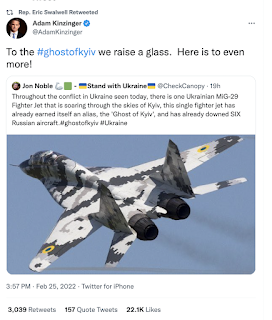
Doubt you'll find a better analysis of propaganda as applied to media coverage of the Ukraine situation. In the case of the US, this means that any pro-Ukraine or anti-Russian claim spreads rapidly while dissenters are vilified as traitors or Russian agents.
Emblematic of the situation was the 'Ghost of Kiev' meme which quickly went viral on social media. The Ghost was a rogue Ukranian pilot who, while protecting the skies over Kiev, shot down 6 Russian planes. Although the Ghost wasn't real, I doubt the Congressmen who helped perpetuate the fable cared much.
Meanwhile those questioning the fables are deemed apologists for the Kremlin.
However, all of this is nothing new. False narratives, censoring dissent, etc have been ratcheting higher thru Trump and CV19.
Although truth has indeed been a casualty of this war, it had already been compromised for years.
Indeed, war is indeed a continuation of politics by other means.
Tuesday, October 29, 2013
Advertising, Government, Propaganda
You could only repeat what we told you
Your axe belongs to a dying nation
They don't know that we own you
--The Who
Statists often point to advertising as a prime reason why government intervention is necessary in markets. Advertising can be biased and can cause people to get confused and make wrong choices, statists claim. Better to have government oversee advertising process and content to ensure that it is clear and accurate and that people do not get manipulated. Perhaps government should just decide for the consumer, rather than having individuals collect information on their own and then make potentially erroneous choices.
Thursday, September 6, 2018
Democracy and Propaganda
--Dr Yen Lo (The Manchurian Candidate)
Ron Paul observes that propaganda has conditioned Americans to believe that democracy is associated with freedom and liberty. It isn't, of course. In fact the opposite is true. Democracy, defined as a process for making political decisions by force based on the desires of the voting majority, compromises the freedom of some for the benefit of others.
A favorite tool of propagandists is to manipulate language to create 'positive substitute symbols.' Take a word that people value in a positive manner (liberty), and gradually connect it to a new word (democracy) initially associated with a concept that people are prone to dislike (democracy = system of decision-making by majority force). With enough repetition, the negative connotation linked to the new word is likely to decline in favor of a positive connotation (democracy is a component of liberty).
Presto, the new word becomes cherished and people are berated for treating it in a negative light.
Perversely, then, if you don't support democracy today, then you are viewed as an enemy of freedom.
Thursday, January 5, 2017
Gaslighting
--Paula Anton (Gaslight)
In the classic 1944 film, Gaslight, Gregory Anton (played by Charles Boyer) tries to get his recent bride Paula (played by Ingrid Bergman) to believe that her perception of reality is wrong and that she is going mad. For example, Gregory moves things in the house and then claims that Paula did it even though she has no recollection of it. He also isolates Paula so that she has little contact with people outside of the house.
The film's title refers to the gaslights that illuminate the couple's old London townhouse previously owned by Paula's rich aunt. Paula occasionally hears footsteps up in the attic, the door to which is locked. Whenever she hears the footsteps, the gaslights dim. Whenever Paula tells Gregory about this, he tells her that she must be imagining it.
Over time, the reinforcement that her perceptions of reality are wrong coupled with little exposure to outsiders leads Paula to doubt her sanity.
It turns out that Gregory had murdered his wife's rich aunt before he and Paula were married, and is snooping around the attic to look for the aunt's valuable jewels that he is convinced are there. Whenever he climbs into the attic thru a roof-side window and turns on the attic lights, the gaslights dim on the floors below.
Ultimately, Scotland Yard investigator Brian Cameron (played by Joseph Cotton) intervenes. He pegs Gregory for the murder/thief that he is, and sneaks into the house one night to see Paula while Gregory is up in the attic. He demonstrates the cause and effect of the footstep/gaslight phenomenon which helps restore Paula's sanity. Cameron, of course, subsequently gets his man--and perhaps, we are lead to believe, the girl as well.
This article describes the psychological tactic of 'gaslighting' as practiced by the political Left. Gaslighting is defined as a form of mental and emotional abuse in which a domineering person denies the memories and perceptions of an intended victim until the victim begins to doubt his perception of reality. The article suggests that the Left's version of gaslighting is to push a false view of reality and then try to convince mainstream Americans that their views are extreme and not grounded in reality.
Benghazi, Obamacare, racism, global warming, Islamophobia, Trump's election, Russian hacking. Most if not all major narratives chanted by the Left contain gaslighting features.
Of course, the Left owns no monopoly on gaslighting methodology. For example, the national security state construct coddled by Neocons is pushed by a great deal of gaslighting as well.
How to counter gaslighting? Develop capacity for processing information and be confident in your ability to reason. Shun dependence on strong, mesmerizing personalities who can sway your thinking. Avoid excessive socializing with narrow groups so that you can grow your mind, and develop and test plausible rival hypotheses.
Gaslighting can be seen as a form of propaganda. Strengthen your mind to avoid succumbing to narrative-driven propaganda that gaslighting promotes.
Saturday, December 11, 2010
Disinformation Discontent
--Ed Hucheson (Deadline USA)
In the 1930s FDR was able to convince the American public to swap their gold for pieces of paper. One reason that sham likely 'worked' was that there were limited avenues for other views to bubble forth. Yes, there were contradictory voices like Garet Garrett at the Saturday Evening Post and Isabel Paterson at the New York Herald Tribune, but their reach was largely isolated by geography and subscription base.
It seems unlikely that FDR could have realized such a coup today. Witness the widespread pushback to Fed chairman Ben Bernanke's propaganda campaign. He and others are making the rounds trying to convince the public that the Fed is not printing money via its Quantitative Easing campaigns. Hundreds of thousands of outlets have contested Bernankes claims.
Hard to keep the toothpaste in the tube today with so many alternative media sources. Bad for government propaganda, good for freedom.
There have been rumblings in the FCC and other government agencies may pursue initiatives to restrict this freedom in some manner--in the name of 'security' or 'balance.'
How the public responds to further government attempts to limit freedom of expression may signal just how strong the flame of liberty still burns in this country.
Tuesday, December 29, 2015
Political Correctness
--Edgar Friendly (Demolition Man)
Article proposes that political correctness is about control rather than politeness. Political correctness (PC) is defined as "the conscious, intentional manipulation of language intended to change the way people speak, write, think, feel, and act, in furtherance of an agenda." Use of positive substitute symbols is a common tool of those seeking to foster political correctness.
Political correctness can be considered propaganda. However, unlike other forms of propaganda, PC tends to be all-encompassing, seeking to mold individuals into submissive beings with no capacity for critical thinking. In a politically correct world, natural law is diverted and rerouted. Truth is not absolute, and can be bent to serve the purposes of those who manipulate language.
The author credits much of 19th century Austrian Edward Bernays with much of the basis of political correctness. Bernays was a press agent. He was employed by the Wilson administration to gin up popular support for US entry into WWI. He was also employed by the private sector to direct several successful advertising campaigns for consumer products such as Ivory soap and Lucky Strike cigarettes.
Central to Bernays approach was the exploitation of herd psychology in the "manufacturing of consent," a term used by British psychologist Wilfred Trotter in his work Instincts of the Herd in Peace and War published in 1919.
Herd instinct relates to concepts in social identity theory and involves deep seated desire to win the approval of social groups. Through the herding lens, the desire to fit in is seen as paramount and overwhelms most other human urges.
Bernays viewed herd instinct as volatile, irrational, and unpredictable. To control it, herd psychology must be steered by 'smarter people' in many small, imperceptible ways. Imperceptible because it is important that the people being herded do not realize that their thoughts are being influenced.
As such, Bernays employed techniques designed under the basis of several assumptions. One was that people are generally not creative and individualistic at heart. Instead, they are malleable and desperate to fit in with groups. He also understood the importance of third party authorities (e.g., athletes, actors, politicians, wealthy elites) to promote causes and products. People take their cues from positions of authority. Finally, he understood the role that emotion plays in tastes and preferences. It is not the substance of the political candidate or consumer product that we deem important, Bernays believed, but rather the emotional content that affects us.
Today, PC campaigns are designed with similar assumptions in mind. People who permit statists to frame debates and control narratives are likely to cede power over their lives.
Sunday, March 7, 2010
Capital Punishment
--Joel Goodson (Risky Business)
Capitalism, an economic system grounded in private ownership of the means of production, is public enemy #1 to socialists who want to abolish private property. Thru propaganda campaigns, they seek to paint capitalism in a negative light. By and large the propaganda campaign, which has been in force for about 100 yrs, has been pretty successful. My guess is that, even in the US, capitalism currently sparks negative connotations in 50% or more of Americans.
Reason suggests otherwise.
The progression goes like this:
1) Humans have nearly unlimited wants. Once basic needs are met, they pursue other wants. The quest for filling human desires never ends.
2) Nature in its raw form provides scarce means for basic subsistence--let alone the stuff capabile of fulfilling advanced human desires.
3) Creating a more abundant situation requires production--combining nature's raw materials with labor to produce consumable output.
4) Humans have an aversion to labor. They seek as much satisfaction as possible from the least amount of work.
5) Humans thus create tools that serve to reduce the amount of labor required for production. These labor saving devices are known as capital.
Capital is essential to improving labor related productivity, which equals the amount of output produced per unit of labor. Higher productivity is necessary to achieve a higher standard of living, which of course aligns with 1) above.
As such, individuals have been capitalists since cavepeople fabricated primative axes, knives, and other tools in the early days of human existence.
There should be nothing unnatural or undesirable about capital formation in the hands of individuals.
Thursday, April 11, 2019
Spy Games
--Harry Tasker (True Lies)
When they face unpleasant situations, people on the left like to change the language associated with the problem to something that is friendlier to them. Governments don't spend. Rather, they 'invest.' Instead of global warming, it's 'climate change.' They are not illegal immigrants; they are 'dreamers.'
A popular one right now is that the Trump campaign was not spied upon. No, it was subject to 'unauthorized surveillance.'
I often wonder whether leftists truly believe that their use of positive substitute symbols, spin, propaganda, et al will actually alter viewpoints of others in their favor. Or whether these games are inwardly focused therapies to ease the pain of a collective psychosis.
Tuesday, March 8, 2022
Stepping on Gas
Hell bent or heaven sent
Listen to the propaganda
Listen to the latest slander
--Elvis Costello
...Speaking of oil, the administration announced this morning that, as part of the accumulating pile of sanctions levied against Russia, the US would ban Russian oil and gas imports (which amount to about 10% of total imports). Crude immediately shot higher on the news.
Domestic gas prices are now at record highs. In some places they are touching $7/gallon.
Two observations. One is that much of the recent craziness in commodity prices can be attributed to government intervention (read: force). Regulation, tariffs, sanctions, war of course. What we are seeing is not the outcome of people voluntarily and peacefully engaging in production and trade.
Stated differently, the craziness has been imposed.
The second observation is that, for an administration seeking to boost sagging poll numbers, forcibly raising gas prices in front of voters seems a strange approach...
position in CVX
Wednesday, August 11, 2010
The Deflation Mind Trick
Words like conviction can turn into a sentence
--General Public
Propaganda claiming that inflation is good and deflation is bad has been around a long time. It is misleading for a number of reasons.
One is that it distorts the meaning of inflation and deflation. Classically defined, inflation is an increase in quantity of money and credit while deflation is a decrease in the quantity of money and credit. Modern definitions deflect attention away from quantity, which is something that bureaucrats perpetually want to increase, to price, something that may or may not change immediately with a change in monetary quantitiy. As such, we fixate on whether metrics like the consumer price index go up and down, and by how much. All the while, the real focus should be on money and credit quantity. A neat Jedi Mind Trick...
Next, consider the condition likely to prevail in an unhampered economy. In an unhampered economy, no central bank or other entity intervenes to create more paper currency. What is likely to happen when the quantity of money stays relatively constant yet economic output increases over time due to productivity improvement? The natural condition is for prices to decline (constant money spread across more goods means lower $/good). This is the opposite of what we've been conditioned to believe. We're told that a 'little' inflation is a good thing for long term prosperity. Of course, it has been that 'little' inflation that has devalued the USD by about 97% over the past 100 yrs.
Finally, considered the sequence of events that motivate the business cycle in a hampered economy. Policymakers, for political reasons, prefer to expand the money supply. This inflation motivates a boom, as borrowers gorge on cheap money and credit. At some point, however, the optimism hits an extreme and people decide they have overdone it. At that point, the inflation peaks. Subsequently, people begin to dial back. They borrow less, save more, and poorly chosen projects funded with credit default. This is deflationary.
In a hampered economy, inflation cannot last forever. This is much to politicians' chagrin; they are likely to try to perpetuate inflation with every tool at their disposal. At some point, however, the mountain of debt that builds under inflationary regimes is likely to sink under its own weight despite interventionary efforts.
In a hampered economy, deflation counterbalances inflationary excess.
position in USD
Saturday, July 8, 2017
Evaluating Healthcare Policy Consequences
Four thousand holes in Blackburn, Lancashire
And though the holes were rather small
They had to count them all
--The Beatles
One of the best books someone can read to improve their economic thought process, particularly w.r.t. evaluating economic policy, is Henry Hazlitt's classic Economics in One Lesson.
Using various policy topics (e.g., minimum wage, tariffs, welfare programs), Hazlitt repeatedly demonstrates how to apply Bastiat's analysis of 'that which is seen and that which is not seen.' Hazlitt prompts the reader to look beyond outcomes that typically make headlines (e.g., "layoffs resulting from process automation") to the less discussed but usually important consequences (e.g., long run effects on prosperity from productivity improvement projects).
Such perspective is invaluable when making sense of public policy issues, such as the current healthcare debate. Proponents of state-run healthcare splash headlines with threats that millions of people will die, or at least lose their healthcare coverage, if Obamacare is repealed and/or replaced. Such claims, of course, are dubious to begin with (e.g., here, here, here) and smacks of emotional capture propaganda.
But even if those claims contained elements of truth, a complete and honest analysis involves evaluating other policy. What has been the effect of Obamacare on jobs, for instance? On the availability of healthcare resources? On health insurance premiums? On healthcare productivity and innovation?
Consider as well the social consequences of forcing some people to produce healthcare resources for the benefit of others? And what would have happened had those resources not been forcibly diverted?
Small minds respond to what is fed to them about healthcare. Inquiring minds go beyond.


![[Most Recent Quotes from www.kitco.com]](http://www.kitconet.com/charts/metals/gold/t24_au_en_usoz_2.gif)