When it gets too much
I need to feel your touch
--Bryan Adams
Many traders eyeing the triangular wedge or pennant pattern forming in the major indexes. Textbook technical analysis posits that the pattern will resolve in the direction of the prevailing trend.
Perhaps that is the question that traders are noodling. Just what is the direction of the prevailing trend?
position in SPX
Thursday, September 10, 2015
Wednesday, September 9, 2015
Evolution of Liberal
Will you recognize me
Call my name or walk on by
Rain keeps falling, rain keeps falling
Down, down, down, down
--Simple Minds
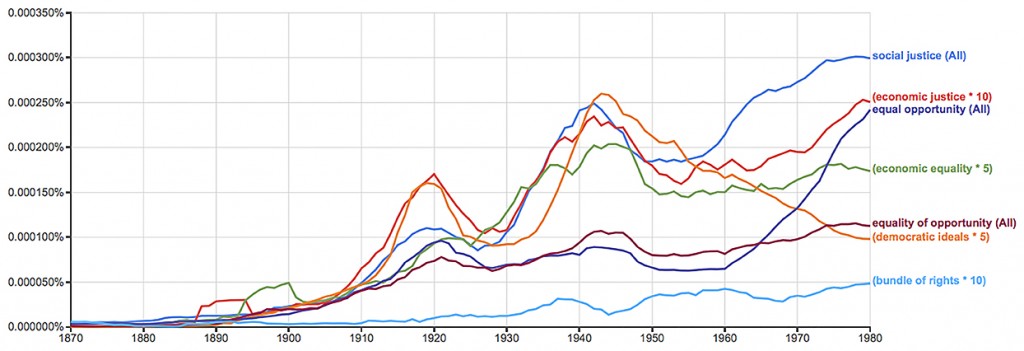
These pages have discussed the hijacking of the word 'liberal' by progressives (e.g., here, here, here). Nice analysis here by GMU econ prof Dan Klein of the evolution of the word using Google's ngram tool.
A simple ngram of 'liberal' reveals that usage of the word nearly quadrupled in the late 1700s. Klein links this pattern with the development of political and economic meanings of the word put forth by authors such as Locke and Smith. In this context, liberal was clearly associated with concepts of freedom and liberty.
The ngram then indicates that usage of the word liberal declined somewhat in the 1800s only to pick up again in the 1900s. Klein connects the second wave to the collectivist, statist movement which was becoming popular by the turn of the 20th century. Klein's 1894 quote of a Fabian socialist ("Laissez-faire individualist political philosophy is dead") helps capture the sentiment.
Because people still remembered what liberalism had been, progressives invented the term 'new liberalism' to reflect socialistic reform.
As memories of 'old liberalism' faded, progressives were able to clip the off the 'new.' And voila, liberal joined the stable of a positive substitute symbols that have become embedded in the American mind.
Call my name or walk on by
Rain keeps falling, rain keeps falling
Down, down, down, down
--Simple Minds
These pages have discussed the hijacking of the word 'liberal' by progressives (e.g., here, here, here). Nice analysis here by GMU econ prof Dan Klein of the evolution of the word using Google's ngram tool.
A simple ngram of 'liberal' reveals that usage of the word nearly quadrupled in the late 1700s. Klein links this pattern with the development of political and economic meanings of the word put forth by authors such as Locke and Smith. In this context, liberal was clearly associated with concepts of freedom and liberty.
The ngram then indicates that usage of the word liberal declined somewhat in the 1800s only to pick up again in the 1900s. Klein connects the second wave to the collectivist, statist movement which was becoming popular by the turn of the 20th century. Klein's 1894 quote of a Fabian socialist ("Laissez-faire individualist political philosophy is dead") helps capture the sentiment.
Because people still remembered what liberalism had been, progressives invented the term 'new liberalism' to reflect socialistic reform.
As memories of 'old liberalism' faded, progressives were able to clip the off the 'new.' And voila, liberal joined the stable of a positive substitute symbols that have become embedded in the American mind.
Labels:
founders,
freedom,
liberty,
manipulation,
measurement,
media,
rhetoric,
sentiment,
socialism
Tuesday, September 8, 2015
Central Bank Stock Pool
All the paintings on the tombs
They do the sand dance don't you know
If they move too quick
They're fallin' down like a domino
--Bangles
Discussion of why and how central banks could send stocks soaring from here. Central banks can't let stock prices fall in a over-leveraged financial system that makes the 2008 backdrop look like a Sunday school picnic. In other words, CBs are 'all in' and believe that they need high stock prices if they are to have a fighting chance at holding their Keynesian fantasy together.
As these pages have discussed, the 'how' involves a variation of the old stock pool arrangement. At least two colluding players trade buying and selling stocks to each other, hoping that they can lure others into the game. All the while, prices spiral higher.
I believe that central banks, including the Fed, have been playing this game. It can work in low volume situations until outsiders lose their risk appetites and begin to sell. Or until colluding players soak up so many shares that Everyman no longer associates stock prices with economic well being.
The question is whether we're on the cusp of central bank stock pool irrelevance.
position in SPX
They do the sand dance don't you know
If they move too quick
They're fallin' down like a domino
--Bangles
Discussion of why and how central banks could send stocks soaring from here. Central banks can't let stock prices fall in a over-leveraged financial system that makes the 2008 backdrop look like a Sunday school picnic. In other words, CBs are 'all in' and believe that they need high stock prices if they are to have a fighting chance at holding their Keynesian fantasy together.
As these pages have discussed, the 'how' involves a variation of the old stock pool arrangement. At least two colluding players trade buying and selling stocks to each other, hoping that they can lure others into the game. All the while, prices spiral higher.
I believe that central banks, including the Fed, have been playing this game. It can work in low volume situations until outsiders lose their risk appetites and begin to sell. Or until colluding players soak up so many shares that Everyman no longer associates stock prices with economic well being.
The question is whether we're on the cusp of central bank stock pool irrelevance.
position in SPX
Labels:
central banks,
Depression,
Fed,
intervention,
manipulation,
ponzi,
sentiment
Monday, September 7, 2015
Enriching Labor
Standing in line, marking time
Waiting for the welfare dime
'Cause they can't buy a job
--Bruce Hornsby & The Range
There is only one way to enrich labor peacefully: capitalism. As Tom DiLorenzo explains, capitalism has been responsible for pulling the working class from destitution, for increasing wages as worker productivity grows from investment, for shortening the work week, for the demise of child labor, and for safer workplaces.
However, because individuals generally favor less work than more work, they are tempted to acquire resources through political means (read: aggression) rather than through peaceful cooperation, production, and exchange. For example, labor unions and proponents of minimum wage laws, with the assistance of strong armed government agents, seek to force the wages of those in their interest groups above market rates. Perversely, such interventions reduce reduce the amount of labor demanded to the extent that wage rates are indeed forced above the productive capabilities of workers.
Regulations generally impoverish workers as well. For instance, safety regulations impose unnecessary costs on producers who are well motivated in competitive environments to make workplaces safer to reduce compensating difference and retain talent. As unnecessary costs rise, demand for labor declines and workplaces become more dangerous as less incentive exists for markets to create innovative solutions to workplace hazards.
Indeed, it is straightforward to view such interventions as anti-labor. Remove the aggression and encourage voluntary cooperation, along with the investment that it attracts, and the living standards of workers will flourish.
Waiting for the welfare dime
'Cause they can't buy a job
--Bruce Hornsby & The Range
There is only one way to enrich labor peacefully: capitalism. As Tom DiLorenzo explains, capitalism has been responsible for pulling the working class from destitution, for increasing wages as worker productivity grows from investment, for shortening the work week, for the demise of child labor, and for safer workplaces.
However, because individuals generally favor less work than more work, they are tempted to acquire resources through political means (read: aggression) rather than through peaceful cooperation, production, and exchange. For example, labor unions and proponents of minimum wage laws, with the assistance of strong armed government agents, seek to force the wages of those in their interest groups above market rates. Perversely, such interventions reduce reduce the amount of labor demanded to the extent that wage rates are indeed forced above the productive capabilities of workers.
Regulations generally impoverish workers as well. For instance, safety regulations impose unnecessary costs on producers who are well motivated in competitive environments to make workplaces safer to reduce compensating difference and retain talent. As unnecessary costs rise, demand for labor declines and workplaces become more dangerous as less incentive exists for markets to create innovative solutions to workplace hazards.
Indeed, it is straightforward to view such interventions as anti-labor. Remove the aggression and encourage voluntary cooperation, along with the investment that it attracts, and the living standards of workers will flourish.
Sunday, September 6, 2015
Lincoln's Italian Prospect
"You're like the thief who isn't the least bit sorry he stole, but is terribly, terribly sorry he's going to jail."
--Rhett Butler (Gone With The Wind)
Tom DiLorenzo discusses Lincoln's attempt to outsource command of the Northern army to an Italian mercenary named Giuseppe Garibaldi. After a string of defeats and firing McClellan, Lincoln offered the command to Garibaldi who had built a reputation for paramilitary forays and terrorism during both an Italian civil war and campaigns in South America.
Garibaldi declined Lincoln's offer. Perhaps he didn't savor the prospects of engaging Lee's army rather than the unarmed civilians that he was used to.
Unable to hire an international mercenary, Lincoln subsequently settled on domestic generals willing to enact the president's version of domestic terrorism.
--Rhett Butler (Gone With The Wind)
Tom DiLorenzo discusses Lincoln's attempt to outsource command of the Northern army to an Italian mercenary named Giuseppe Garibaldi. After a string of defeats and firing McClellan, Lincoln offered the command to Garibaldi who had built a reputation for paramilitary forays and terrorism during both an Italian civil war and campaigns in South America.
Garibaldi declined Lincoln's offer. Perhaps he didn't savor the prospects of engaging Lee's army rather than the unarmed civilians that he was used to.
Unable to hire an international mercenary, Lincoln subsequently settled on domestic generals willing to enact the president's version of domestic terrorism.
Saturday, September 5, 2015
Quantitative Tightening
Relax said the night man
We are programmed to receive
You can check out any time you like
But you can never leave
--The Eagles
Quantitative easing (QE) constitutes central bank bond buying to force long-dated interest rates lower (and provide a buyer for government and agency debt). Peter Schiff suggests that the unwinding of QE, i.e., when central banks unload bonds from their balance sheets, should be called "Quantitative Tightening."
I suppose, although I'd wager that we're much more likely to see more QE before any QT.
We are programmed to receive
You can check out any time you like
But you can never leave
--The Eagles
Quantitative easing (QE) constitutes central bank bond buying to force long-dated interest rates lower (and provide a buyer for government and agency debt). Peter Schiff suggests that the unwinding of QE, i.e., when central banks unload bonds from their balance sheets, should be called "Quantitative Tightening."
I suppose, although I'd wager that we're much more likely to see more QE before any QT.
Labels:
balance sheet,
bonds,
central banks,
Fed,
intervention,
manipulation,
socialism,
yields
Friday, September 4, 2015
Money Printing Regimes
How can you just leave me standing
Alone in a world that's so cold?
--Prince
Nice perspective on base money supply by Fed regime.
Recent Bernanke/Yellen tandem makes Greenspan look like a hawk by comparison.
Alone in a world that's so cold?
--Prince
Nice perspective on base money supply by Fed regime.
Recent Bernanke/Yellen tandem makes Greenspan look like a hawk by comparison.
Thursday, September 3, 2015
Government and Scapegoats
No message could have been any clearer
If you want to make the world a better place
Take a look at yourself
And make the change
--Michael Jackson
When was the last time a government official stepped up and said that he/she owned a problem? Jacob Hornberger suggests that the answer is never. Government is always looking for scapegoats.
Credit crisis, Iraq/Middle East, Holocaust, immigration, drugs, et al.
While interventionism brings death and suffering, the interventionists avoid the mirror.
If you want to make the world a better place
Take a look at yourself
And make the change
--Michael Jackson
When was the last time a government official stepped up and said that he/she owned a problem? Jacob Hornberger suggests that the answer is never. Government is always looking for scapegoats.
Credit crisis, Iraq/Middle East, Holocaust, immigration, drugs, et al.
While interventionism brings death and suffering, the interventionists avoid the mirror.
Labels:
credit,
Depression,
government,
intervention,
Iran,
pharma,
rhetoric,
socialism,
war
Wednesday, September 2, 2015
Gross Distortions
Oh, see the fire's sweepin'
Our very street today
Burns like a red coal carpet
Mad bull lost it's way
--The Rolling Stones
Bill Gross notes two primary distortions of the extremely low interest rates forced on markets by central banks over the past few years. One is lower propensity to save. "If savings wither then so does its Siamese Twin - investment - and with it, long term productivity."
The other is asset prices. "Artificially low interest rates have propelled financial markets."
His view is that the imbalances caused by low interest rate policies are beginning to push back, with financial markets reeling in response.
He likes cash or 'near cash' (i.e., short term corporates) here.
position in SPX
Our very street today
Burns like a red coal carpet
Mad bull lost it's way
--The Rolling Stones
Bill Gross notes two primary distortions of the extremely low interest rates forced on markets by central banks over the past few years. One is lower propensity to save. "If savings wither then so does its Siamese Twin - investment - and with it, long term productivity."
The other is asset prices. "Artificially low interest rates have propelled financial markets."
His view is that the imbalances caused by low interest rate policies are beginning to push back, with financial markets reeling in response.
He likes cash or 'near cash' (i.e., short term corporates) here.
position in SPX
Labels:
asset allocation,
bonds,
capital,
central banks,
fund management,
intervention,
media,
productivity,
risk,
saving,
socialism,
yields
Tuesday, September 1, 2015
Never Enough
So glad we've almost made it
So sad they had to fade it
--Tears for Fears
Never short enough on these gap down moves. Did reload some INTC puts yesterday to gain some exposure.
Feels like the bulls have put a call in to Snapper. Whether he picks up is another thing entirely.
position in SPX, INTC
So sad they had to fade it
--Tears for Fears
Never short enough on these gap down moves. Did reload some INTC puts yesterday to gain some exposure.
Feels like the bulls have put a call in to Snapper. Whether he picks up is another thing entirely.
position in SPX, INTC
Subscribe to:
Posts (Atom)


![[Most Recent Quotes from www.kitco.com]](http://www.kitconet.com/charts/metals/gold/t24_au_en_usoz_2.gif)