Yeah there's a storm on the loose
Sirens in my head
Wrapped up in silence
All circuits are dead
--Golden Earring
The shooting at the Fifth Third building in downtown Cincinnati that left four dead (including the shooter) and two wounded share two characteristics common to rampage shooting events.
One is that it was perpetrated in a so called gun free zone. In fact, the Fifth Third building was so gun free that even the building's on site security guards carried no firearms. Gun free zones invite bad guys like the shooter who was, of course, was not gun free.
The other common characteristic is the time from first shot until police were on the scene. In this case it is estimated that it took about four minutes for CPD officers to arrive, engage the shooter, and put him down. While that might seem fast, response times measured in minutes for such shooting episodes are not unusual--particularly when they take place in urban areas dense with police.
Moreover, it is likely that those four minutes felt like an eternity to those who found themselves under fire and defenseless in the Fifth Third lobby. During that time, the shooter was able to get off 35 shots with a 9 mm handgun--meaning that he was able to reload once or perhaps twice using standard magazines. His gun then reportedly jammed which made him a bigger target for the four responding officers who nailed him with multiple rounds.
The problem facing all people in harm's way under similar circumstances is how to survive those four minutes.
Showing posts with label urban planning. Show all posts
Showing posts with label urban planning. Show all posts
Saturday, September 8, 2018

Tuesday, September 4, 2018
Pyramid of Ridicule
Slide your feet up the street, bend your back
Shift your arm, then you pull it back
Life's hard you know
So strike a pose on a Cadillac
--Bangles
Problems with the Cincinnati streetcar 'pyramid' continue. This article not only documents the continued decline in ridership as well as the reliability issues, but also the possibility that the streetcar's primary corporate sponsor, Cincinnati Bell (CBB), may pull its support.
In 2016, CBB signed a 10 year contract worth $3.4 million to put its name on the streetcar. The contract allows for CBB to terminate the deal if problems with the streetcar cause harm to the business interests of the company.
Having your name on the side of what has amounted to a pyramid of ridicule would seem to qualify.
Shift your arm, then you pull it back
Life's hard you know
So strike a pose on a Cadillac
--Bangles
Problems with the Cincinnati streetcar 'pyramid' continue. This article not only documents the continued decline in ridership as well as the reliability issues, but also the possibility that the streetcar's primary corporate sponsor, Cincinnati Bell (CBB), may pull its support.
In 2016, CBB signed a 10 year contract worth $3.4 million to put its name on the streetcar. The contract allows for CBB to terminate the deal if problems with the streetcar cause harm to the business interests of the company.
Having your name on the side of what has amounted to a pyramid of ridicule would seem to qualify.
Saturday, April 21, 2018
Equitable Solution to Urban Decay
When you said goodbye
You were on the run
Tryin' to get away from the things you'd done
Now you're back again
And you're feeling strange
So much has happend, but nothing has changed
--Glenn Frey
How to prevent or reverse accumulative decay in cities? Walter Williams suggests the officials skew provision of city services toward neighborhoods that house the highly productive. Keeping the best and brightest increases the likelihood of 'net positive fiscal residual' necessary to fund city services.
As Prof Williams notes, some people might find this type of discrimination distasteful or unfair.
A far more equitable solution would be to cut back on city services altogether. No public education or libraries. Allow local residents to contract with private providers for services such as street and park upkeep.
Less 'positive fiscal residue' would be required to fund city services. Plus, the highly productive would have greater capacity to shape their urban environments. The positive spillover from productive activity would once again create opportunity in cities for lower income individuals.
You were on the run
Tryin' to get away from the things you'd done
Now you're back again
And you're feeling strange
So much has happend, but nothing has changed
--Glenn Frey
How to prevent or reverse accumulative decay in cities? Walter Williams suggests the officials skew provision of city services toward neighborhoods that house the highly productive. Keeping the best and brightest increases the likelihood of 'net positive fiscal residual' necessary to fund city services.
As Prof Williams notes, some people might find this type of discrimination distasteful or unfair.
A far more equitable solution would be to cut back on city services altogether. No public education or libraries. Allow local residents to contract with private providers for services such as street and park upkeep.
Less 'positive fiscal residue' would be required to fund city services. Plus, the highly productive would have greater capacity to shape their urban environments. The positive spillover from productive activity would once again create opportunity in cities for lower income individuals.
Wednesday, April 18, 2018
Accumulative Decay
The city desert makes you feel so cold
It's got so many people but it's got no soul
And it's taken you so long
To find out you were wrong
When you thought it held everything
--Gerry Rafferty
Many US cities that were major population centers in the early 20th century are less so today. Some, such as Detroit, Cleveland, and St Louis, sport less than 50% of their previous pops. People have left these cities in droves, primarily for the suburbs where schools were better and property was more secure.
During the 1960s, civil rights advocates claimed that urban decline was due to racism--'white flight' to the suburbs. However, as Prof Williams notes, blacks were fleeing many of these cities at higher rates than whites.
Central to this phenomenon is a process Williams terms 'accumulative decay.' When schools, neighborhoods, and city services become run down, the first people to leave are those who care the most about their quality of life and have the resources to move. Because this inaugural group tends to be the most productive, they tend to put more to city coffers than they take out.
Once this group leaves, it is replaced with people who care less about things like schools and city amenities. Moreover, since the city has lost tax resources from the productive group that has left the area, officials must either raise taxes or allow city services to deteriorate further. This the next round of people who can do better to leave.
And the downward spiral of accumulative decay gains momentum...
To reverse the cycle, Williams suggests that city officials must recognize that their first order of business is to retain what economists call 'net positive fiscal residue.' This means creating conditions that makes the most productive people want to stay in city environments. This might mean discriminating when it comes to the provision of city services. For example, provide better lighting, libraries, schools, and other amenities in more affluent neighborhoods.
Although some might argue that city service discrimination is unfair, Williams counters that it is even more unfair for cities, once magnets of opportunity for low income individuals, to devolve into economic wastelands.
It's got so many people but it's got no soul
And it's taken you so long
To find out you were wrong
When you thought it held everything
--Gerry Rafferty
Many US cities that were major population centers in the early 20th century are less so today. Some, such as Detroit, Cleveland, and St Louis, sport less than 50% of their previous pops. People have left these cities in droves, primarily for the suburbs where schools were better and property was more secure.
During the 1960s, civil rights advocates claimed that urban decline was due to racism--'white flight' to the suburbs. However, as Prof Williams notes, blacks were fleeing many of these cities at higher rates than whites.
Central to this phenomenon is a process Williams terms 'accumulative decay.' When schools, neighborhoods, and city services become run down, the first people to leave are those who care the most about their quality of life and have the resources to move. Because this inaugural group tends to be the most productive, they tend to put more to city coffers than they take out.
Once this group leaves, it is replaced with people who care less about things like schools and city amenities. Moreover, since the city has lost tax resources from the productive group that has left the area, officials must either raise taxes or allow city services to deteriorate further. This the next round of people who can do better to leave.
And the downward spiral of accumulative decay gains momentum...
To reverse the cycle, Williams suggests that city officials must recognize that their first order of business is to retain what economists call 'net positive fiscal residue.' This means creating conditions that makes the most productive people want to stay in city environments. This might mean discriminating when it comes to the provision of city services. For example, provide better lighting, libraries, schools, and other amenities in more affluent neighborhoods.
Although some might argue that city service discrimination is unfair, Williams counters that it is even more unfair for cities, once magnets of opportunity for low income individuals, to devolve into economic wastelands.
Friday, March 16, 2018
Old Crosley
"I've heard that old men wake up and scratch itchy legs that have been dust for over fifty years. That was me. I'd wake up at night with the smell of the ball park in my nose, the cool of the grass on my feet...The thrill of the grass."
--Shoeless Joe Jackson (Field of Dreams)
Always captivated by old photos of Crosley Field.

Notice the building density.

Almost as if they had to shoe horn the field into the surrounding neighborhood.

By the time I went to my first ball game as a seven year old, much of the neighborhood had been bulldozed over to make room for the freeway beyond the outfield wall:

The wrath of eminent domain strikes again.
Meanwhile, less than 2 weeks till Opening Day!
--Shoeless Joe Jackson (Field of Dreams)
Always captivated by old photos of Crosley Field.

Notice the building density.

Almost as if they had to shoe horn the field into the surrounding neighborhood.


The wrath of eminent domain strikes again.
Meanwhile, less than 2 weeks till Opening Day!
Sunday, February 18, 2018
South Side Skyway
Well the South Side of Chicago
Is the baddest part of town
--Jim Croce
When driving to Chicago, one of my favorite parts of the journey is the leg from Gary, Indiana to Chicago's South Side. Lots of old factory buildings including a panoramic view of the US Steel Gary Works. Periodic glimpses of Lake Michigan shoreline add to the treat.
The leg also features the Chicago Skyway, a toll road that includes a giant bridge spanning the Calumet River just over the Illinois state line. When the City of Chicago leased control of the Skyway in 2005, it marked the first privatization of an existing toll road in the US. In my travels, upkeep of the Skyway has been far superior under private ownership.

Above is a pre-Skyway pic of the Calumet Harbor taken in 1929. Today, the Skyway crosses the Calumet at the High Bridge after the river bends to the left. The commanding view afforded from the High Bridge suggest things have changed little in nearly eighty years. Perhaps a few less smoke stacks, but still lots of old steel-laden infrastructure from a golden age of production.
Insight into yesterday worth today's toll bridge price.
Is the baddest part of town
--Jim Croce
When driving to Chicago, one of my favorite parts of the journey is the leg from Gary, Indiana to Chicago's South Side. Lots of old factory buildings including a panoramic view of the US Steel Gary Works. Periodic glimpses of Lake Michigan shoreline add to the treat.
The leg also features the Chicago Skyway, a toll road that includes a giant bridge spanning the Calumet River just over the Illinois state line. When the City of Chicago leased control of the Skyway in 2005, it marked the first privatization of an existing toll road in the US. In my travels, upkeep of the Skyway has been far superior under private ownership.

Above is a pre-Skyway pic of the Calumet Harbor taken in 1929. Today, the Skyway crosses the Calumet at the High Bridge after the river bends to the left. The commanding view afforded from the High Bridge suggest things have changed little in nearly eighty years. Perhaps a few less smoke stacks, but still lots of old steel-laden infrastructure from a golden age of production.
Insight into yesterday worth today's toll bridge price.
Wednesday, November 8, 2017
Voter Acquisition Costs
Grace Marshall: Remember our first campaign?
James Marshall: In the House? Yeah. Driving downstate with...who was that kid, our volunteer?
Grace Marshall: Henry.
James Marshall: Henry, with the convertible.
Grace Marshall: With the broken top.
James Marshall: And the snow coming in.
Grace Marshall: We were the only three people who thought you could win.
--Air Force One
Just as companies face costs (e.g., channel development, marketing) to acquire customers, politicians involved in elections determined by democratic process face costs to acquire voters. Politicians must campaign to get their name and message out. They might also try to acquire votes by doing things for prospects such as giving them free cell phones or giving them rides to the polls on election day.
Voter acquisition costs grow with geographic scope of an election. Politicians in local races face relatively low voter acquisition costs because voters are close by. It costs less to reach voters because there are less of them to reach and messages do not have to be conveyed as far. Campaigns are likely to be conducted on a more intimate level, with politicians themselves personally contacting voters, perhaps even door-to-door.
As elections cover more territory, voter acquisition costs quickly escalate. If one imagines the ground politicians have to cover as radiating outwards from election headquarters in a circular fashion, then cost to influence voters increases with the square of distance. Campaigns take on a 'mass production' feel and become less personal in order to economize scarce acquisition resources.
Once geographic scope expands beyond a certain point, then it becomes cost prohibitive for politicians to reach all prospective voters. When this situation arises, campaigns must decide which prospects to pursue and which ones to ignore.
Purely from a voter acquisition cost perspective, then, it follows that the greater the geographic scope of an election, the more likely that politicians will ignore some fraction of the electorate out of economic necessity.
James Marshall: In the House? Yeah. Driving downstate with...who was that kid, our volunteer?
Grace Marshall: Henry.
James Marshall: Henry, with the convertible.
Grace Marshall: With the broken top.
James Marshall: And the snow coming in.
Grace Marshall: We were the only three people who thought you could win.
--Air Force One
Just as companies face costs (e.g., channel development, marketing) to acquire customers, politicians involved in elections determined by democratic process face costs to acquire voters. Politicians must campaign to get their name and message out. They might also try to acquire votes by doing things for prospects such as giving them free cell phones or giving them rides to the polls on election day.
Voter acquisition costs grow with geographic scope of an election. Politicians in local races face relatively low voter acquisition costs because voters are close by. It costs less to reach voters because there are less of them to reach and messages do not have to be conveyed as far. Campaigns are likely to be conducted on a more intimate level, with politicians themselves personally contacting voters, perhaps even door-to-door.
As elections cover more territory, voter acquisition costs quickly escalate. If one imagines the ground politicians have to cover as radiating outwards from election headquarters in a circular fashion, then cost to influence voters increases with the square of distance. Campaigns take on a 'mass production' feel and become less personal in order to economize scarce acquisition resources.
Once geographic scope expands beyond a certain point, then it becomes cost prohibitive for politicians to reach all prospective voters. When this situation arises, campaigns must decide which prospects to pursue and which ones to ignore.
Purely from a voter acquisition cost perspective, then, it follows that the greater the geographic scope of an election, the more likely that politicians will ignore some fraction of the electorate out of economic necessity.
Saturday, October 7, 2017
Enabling Snipers
"How do you like it when someone's shooting back at you?"
--Rafe McCawley (Pearl Harbor)
It has been said that gun-free zones are essentially hunting preserves for mass shooters and other criminals. Gun-free zones attract law breakers because perpetrators can accost law-abiding citizens who have no capacity for shooting back.
Stated differently, because gun-free zones offer grounds for aggression without meaningful pushback, they are magnets for bad guys.
Last weekend's mass shooting in Las Vegas demonstrates that gun free zones can also provide long range assailants with safe havens from which to shoot. The Mandalay Bay resort is a gun-free zone--so much so that not even hotel security guards are often not permitted to carry. High rise buildings that prohibit possession of firearms can be seen by criminals as inviting sniper stands from which shooters can rain death on people below without challenge for a significant period of time.
The current official story line in the Vegas incident indicates that the shooter enjoyed at least 10 minutes of private shooting time from his perch before being interrupted by authorities.
Had Mandalay Bay guests been permitted to carry, then perhaps some would have taken initiative to home in on the shooter's room and, at the very least, distracted the perpetrator sooner, thereby reducing the carnage outside.
Lesson for me: be aware not only of gun free zones that you enter, but also of gun free zones within your range--particularly if they occupy high ground.
--Rafe McCawley (Pearl Harbor)
It has been said that gun-free zones are essentially hunting preserves for mass shooters and other criminals. Gun-free zones attract law breakers because perpetrators can accost law-abiding citizens who have no capacity for shooting back.
Stated differently, because gun-free zones offer grounds for aggression without meaningful pushback, they are magnets for bad guys.
Last weekend's mass shooting in Las Vegas demonstrates that gun free zones can also provide long range assailants with safe havens from which to shoot. The Mandalay Bay resort is a gun-free zone--so much so that not even hotel security guards are often not permitted to carry. High rise buildings that prohibit possession of firearms can be seen by criminals as inviting sniper stands from which shooters can rain death on people below without challenge for a significant period of time.
The current official story line in the Vegas incident indicates that the shooter enjoyed at least 10 minutes of private shooting time from his perch before being interrupted by authorities.
Had Mandalay Bay guests been permitted to carry, then perhaps some would have taken initiative to home in on the shooter's room and, at the very least, distracted the perpetrator sooner, thereby reducing the carnage outside.
Lesson for me: be aware not only of gun free zones that you enter, but also of gun free zones within your range--particularly if they occupy high ground.
Sunday, August 20, 2017
Monumental Hysteria II
"Well, I'm sorry if the truth offends you."
--Rhett Butler (Gone With The Wind)
Previously we discussed the loss of historical perspective possible when seek to remove or destroy historical monuments positioned in public places. However, there is a good argument that they should be removed. The argument is similar to the one made in favor of removing Confederate flags flying in public places.
By 'public places,' we mean government land, buildings, and associated infrastructure owned and operated by the government. This includes but is not limited to government buildings and public parks at the federal, state, and local levels.
The display of any monument or artifact of any kind--save perhaps national, state, and local flags which can be seen as a form of geographic affiliation--constitutes a form of speech. The government does not enjoy the same freedom of speech that we enjoy as individuals. If government was free to endorse an opinion, then it could employ its virtual monopoly of force to coerce others to abide by it. The entire purpose of the First Amendment is to keep government out of the business of speech.

Viewed from this perspective, all Confederate monuments should be removed from public places. But these monuments are just the focus du jour. This argument extends to virtually all public monuments currently standing that can be construed as expressing any opinion. The low hanging fruit would include shrines to religion, war, social issues, and particular groups including minorities.
That the logical extension of this argument includes consideration about the appropriateness of even the most basic of symbols, including the American flag, demonstrates just how little speech government should be engaged in.
A similar argument, btw, can be made for dismantling public schools as it is impossible to keep them value neutral.
Does that mean that all of the monuments to these groups and issues should be destroyed? By all means no. It means they should be privatized. As Ryan McMaken proposes, those upset with the removal of Confederate monuments from public grounds should lawfully obtain them from the government or their rightful owners (or make new ones, of course), purchase a chunk of private land--perhaps near a busy intersection, and put their statues there.
--Rhett Butler (Gone With The Wind)
Previously we discussed the loss of historical perspective possible when seek to remove or destroy historical monuments positioned in public places. However, there is a good argument that they should be removed. The argument is similar to the one made in favor of removing Confederate flags flying in public places.
By 'public places,' we mean government land, buildings, and associated infrastructure owned and operated by the government. This includes but is not limited to government buildings and public parks at the federal, state, and local levels.
The display of any monument or artifact of any kind--save perhaps national, state, and local flags which can be seen as a form of geographic affiliation--constitutes a form of speech. The government does not enjoy the same freedom of speech that we enjoy as individuals. If government was free to endorse an opinion, then it could employ its virtual monopoly of force to coerce others to abide by it. The entire purpose of the First Amendment is to keep government out of the business of speech.

Viewed from this perspective, all Confederate monuments should be removed from public places. But these monuments are just the focus du jour. This argument extends to virtually all public monuments currently standing that can be construed as expressing any opinion. The low hanging fruit would include shrines to religion, war, social issues, and particular groups including minorities.
That the logical extension of this argument includes consideration about the appropriateness of even the most basic of symbols, including the American flag, demonstrates just how little speech government should be engaged in.
A similar argument, btw, can be made for dismantling public schools as it is impossible to keep them value neutral.
Does that mean that all of the monuments to these groups and issues should be destroyed? By all means no. It means they should be privatized. As Ryan McMaken proposes, those upset with the removal of Confederate monuments from public grounds should lawfully obtain them from the government or their rightful owners (or make new ones, of course), purchase a chunk of private land--perhaps near a busy intersection, and put their statues there.
Saturday, April 29, 2017
Big, Bold, Simple
Took a ride, I went downtown
The streets were empty, there was no one around
To the place that we used to know
Been all the places that we used to go
--The Plimsouls
Rand Paul outlines some features of a big, bold, simple tax cut plan.
-->Cut corporate tax rates to 15% or less. Eliminate corporate deductions and loopholes. Make the tax simple.
-->Allow repatriation of capital held in foreign countries at a 6.5% tax rate. Direct tax revenue from repatriated capital into an infrastructure fund.
-->Cut taxes for all Americans. Eliminate 'revenue neutral' tax plans that merely shift taxes paid from one group to another.
As Paul submits, to truly 'drain the swamp,' money must be taken away from Washington and returned to the people.
The streets were empty, there was no one around
To the place that we used to know
Been all the places that we used to go
--The Plimsouls
Rand Paul outlines some features of a big, bold, simple tax cut plan.
-->Cut corporate tax rates to 15% or less. Eliminate corporate deductions and loopholes. Make the tax simple.
-->Allow repatriation of capital held in foreign countries at a 6.5% tax rate. Direct tax revenue from repatriated capital into an infrastructure fund.
-->Cut taxes for all Americans. Eliminate 'revenue neutral' tax plans that merely shift taxes paid from one group to another.
As Paul submits, to truly 'drain the swamp,' money must be taken away from Washington and returned to the people.
Saturday, March 11, 2017
Hyde Park Tornado
"You've never seen it miss this house, and miss that house, and come after you."
--Dr Jo Harding (Twister)
Today marks the 100th anniversary of the Hyde Park Tornado. On the evening of March 11, 1917, a quarter mile wide tornado with 75 mph winds touched down south of Observatory Ave and east of Michigan Ave. Moving east, it destroyed or damaged over 100 homes and took three lives before leaving Hyde Park just east of Herschel Ave near today's Kilgour School.

The March 13, 1917 Cincinnati Enquirer lists the following homes as among those damaged or destroyed (tracking from west to east):
Michigan: 1268, 1285, 1288, 1289, 1382
Morten: 1268, 1270, 1311
Linwood: 2837, 2878, 2890
Duncan: 1306, 1310, 1317, 1318, 1319, 1330
Meier: 1306
Observatory: 2983, 2991, 2995, 3001, 3003, 3025, 3047, 3229 (all south side of street addresses--north side of street was still part of John Kilgour estate yet to be parceled out for building)
Grace: 1279, 1301, 1302, 1305, 1308, 1309, 1312, 1317, 1320, 1325, 1329, 1339, 1352
Griest: 2940, 2944, 3048, 3050
Delta: 1211, 1213, 1240, 1302, 1311, 1312, 1323, 1324, 1331, 1342, 1351, 1357
Herschel: 1332, 1334, 1340, 1342, 1345, 1354, 1360
The street address pattern clearly defines the tornado's glide path thru streets south of Observatory.
Strangely, no damage reported on my street, Paxton. One reason could be that tornadoes are known to jump around. After wrecking the street directly to the west, Duncan, perhaps it jumped over Paxton and nicked Meier directly to the east (note only one address reported with damage on Meier) before tearing into Grace and Griest.

Another reason could be that most current houses on my block of Paxton were built after 1917. My house was built in 1925. Of course, that could mean that previous structures on the plats were blown down by the twister. Too bad the Victorian house adjacent to mine built in 1890 can't recount events for us.
Given my street address, however, it is evident from the damage pattern implied by the above data that my homestead, if it were standing at the time, would have been squarely positioned in harm's way of the Hyde Park Tornado one hundred years ago today.
--Dr Jo Harding (Twister)
Today marks the 100th anniversary of the Hyde Park Tornado. On the evening of March 11, 1917, a quarter mile wide tornado with 75 mph winds touched down south of Observatory Ave and east of Michigan Ave. Moving east, it destroyed or damaged over 100 homes and took three lives before leaving Hyde Park just east of Herschel Ave near today's Kilgour School.

The March 13, 1917 Cincinnati Enquirer lists the following homes as among those damaged or destroyed (tracking from west to east):
Michigan: 1268, 1285, 1288, 1289, 1382
Morten: 1268, 1270, 1311
Linwood: 2837, 2878, 2890
Duncan: 1306, 1310, 1317, 1318, 1319, 1330
Meier: 1306
Observatory: 2983, 2991, 2995, 3001, 3003, 3025, 3047, 3229 (all south side of street addresses--north side of street was still part of John Kilgour estate yet to be parceled out for building)
Grace: 1279, 1301, 1302, 1305, 1308, 1309, 1312, 1317, 1320, 1325, 1329, 1339, 1352
Griest: 2940, 2944, 3048, 3050
Delta: 1211, 1213, 1240, 1302, 1311, 1312, 1323, 1324, 1331, 1342, 1351, 1357
Herschel: 1332, 1334, 1340, 1342, 1345, 1354, 1360
The street address pattern clearly defines the tornado's glide path thru streets south of Observatory.
Strangely, no damage reported on my street, Paxton. One reason could be that tornadoes are known to jump around. After wrecking the street directly to the west, Duncan, perhaps it jumped over Paxton and nicked Meier directly to the east (note only one address reported with damage on Meier) before tearing into Grace and Griest.

Another reason could be that most current houses on my block of Paxton were built after 1917. My house was built in 1925. Of course, that could mean that previous structures on the plats were blown down by the twister. Too bad the Victorian house adjacent to mine built in 1890 can't recount events for us.
Given my street address, however, it is evident from the damage pattern implied by the above data that my homestead, if it were standing at the time, would have been squarely positioned in harm's way of the Hyde Park Tornado one hundred years ago today.
Tuesday, December 27, 2016
Streetcar Pyramid
"I was an overachiever. I'm settling into my natural groove now."
--Natalie Scheffer (Joe Somebody)
In his masterful 1932 work The Bubble That Broke the World, Garet Garrett draws analogy between the great pyramids of Egypt, often regarded as world 'wonders,' and wasteful public spending projects. The real wonder of the pyramids is how massive amounts of economic resources that could have been put to productive use were diverted for years to build an expensive ornament.

The city of Cincinnati's latest pyramid is the downtown streetcar. After progressives jumped on board the first few weeks to celebrate another completed public works project, ridership has been dwindling. Usage currently rests at about half the projected rate. Moreover, riders report long waits at stops.
Predictably, the city council has commissioned a downtown traffic study on the matter.
There is no rest for pyramid builders.
--Natalie Scheffer (Joe Somebody)
In his masterful 1932 work The Bubble That Broke the World, Garet Garrett draws analogy between the great pyramids of Egypt, often regarded as world 'wonders,' and wasteful public spending projects. The real wonder of the pyramids is how massive amounts of economic resources that could have been put to productive use were diverted for years to build an expensive ornament.

The city of Cincinnati's latest pyramid is the downtown streetcar. After progressives jumped on board the first few weeks to celebrate another completed public works project, ridership has been dwindling. Usage currently rests at about half the projected rate. Moreover, riders report long waits at stops.
Predictably, the city council has commissioned a downtown traffic study on the matter.
There is no rest for pyramid builders.
Sunday, December 4, 2016
US Population Density
In a big country
Dreams stay with you
Like a lover's voice
Fires the mountainside
--Big Country
Cool animated map of population density of the continental United States from 1790 - 2015. Many of the blank spots in the first 100 yrs are due to lack of data, as people were living in many of those areas--albeit thinly w.r.t. density. The visual of the second century is one of increasing splotches as population becomes more concentrated, particularly in urban areas.
Dreams stay with you
Like a lover's voice
Fires the mountainside
--Big Country
Cool animated map of population density of the continental United States from 1790 - 2015. Many of the blank spots in the first 100 yrs are due to lack of data, as people were living in many of those areas--albeit thinly w.r.t. density. The visual of the second century is one of increasing splotches as population becomes more concentrated, particularly in urban areas.
Friday, November 18, 2016
Internal Improvements
In violent times
You shouldn't have to sell your soul
In black and white
They really, really ought to know
--Tears For Fears
A great hypocrisy of American politics involves mainline Republicans who decry socialist policies of Democrats while applauding large infrastructure spending projects funded by the federal government. Currently GOP applause is directed toward Donald Trump's proposal to spend $1 trillion to build/rebuild roads, bridges, etc.
Republican love of infrastructure projects has a long history. A central plank of the Whig Party's American System in the early 1800s was federally funded 'internal improvements'--roads, bridges, canals, dams, et al.--primarily for benefit of northern industry. When the Whigs morphed into the Republican Party in the 1850s, it was Abraham Lincoln who helped institutionalize the internal improvement notion into the GOP playbook.
Funding infrastructure projects by forcibly taking property from some for the benefit of others, even if those others are euphemized as 'the greater good,' is consummate socialism.
You shouldn't have to sell your soul
In black and white
They really, really ought to know
--Tears For Fears
A great hypocrisy of American politics involves mainline Republicans who decry socialist policies of Democrats while applauding large infrastructure spending projects funded by the federal government. Currently GOP applause is directed toward Donald Trump's proposal to spend $1 trillion to build/rebuild roads, bridges, etc.
Republican love of infrastructure projects has a long history. A central plank of the Whig Party's American System in the early 1800s was federally funded 'internal improvements'--roads, bridges, canals, dams, et al.--primarily for benefit of northern industry. When the Whigs morphed into the Republican Party in the 1850s, it was Abraham Lincoln who helped institutionalize the internal improvement notion into the GOP playbook.
Funding infrastructure projects by forcibly taking property from some for the benefit of others, even if those others are euphemized as 'the greater good,' is consummate socialism.
Monday, October 10, 2016
Ecologists or Economizers?
"I think this fool is probably lost."
--Wind In His Hair (Dances With Wolves)
Review of institutions that guided American Indian societies challenges claims that our Native American predecessors were guided by a unique environmental ethic that allowed them to operate as the 'pioneer ecologists of this country.' Instead, they, like all people, established economic institutions that governed resource use in response to abundance or scarcity.
Property rights, clear cutting forests, and production incentives exemplify societal institutions that governed economic activity. Truly communal property was scant. 'Tragedy of the commons' situations arose when economic institutions did not govern behavior (as they did for subsequent colonists).
Quoting the work of historian Louis S, Warren, the article notes:
"To claim that the Indians lived without affecting nature is akin to saying that they lived without touching anything, that they were a people without history. Indians often manipulated their local environments, and while they usually had far less impact on their environments than European colonists would, the idea of 'preserving' land in some kind of wilderness state would have struck them as impractical and absurd. More often than not, Indians profoundly shaped the ecosystems around them."
To that I might add that perhaps production technology was the primary distinguishing feature.
Like all people, our Native American predecessors were economizers.
--Wind In His Hair (Dances With Wolves)
Review of institutions that guided American Indian societies challenges claims that our Native American predecessors were guided by a unique environmental ethic that allowed them to operate as the 'pioneer ecologists of this country.' Instead, they, like all people, established economic institutions that governed resource use in response to abundance or scarcity.
Property rights, clear cutting forests, and production incentives exemplify societal institutions that governed economic activity. Truly communal property was scant. 'Tragedy of the commons' situations arose when economic institutions did not govern behavior (as they did for subsequent colonists).
Quoting the work of historian Louis S, Warren, the article notes:
"To claim that the Indians lived without affecting nature is akin to saying that they lived without touching anything, that they were a people without history. Indians often manipulated their local environments, and while they usually had far less impact on their environments than European colonists would, the idea of 'preserving' land in some kind of wilderness state would have struck them as impractical and absurd. More often than not, Indians profoundly shaped the ecosystems around them."
To that I might add that perhaps production technology was the primary distinguishing feature.
Like all people, our Native American predecessors were economizers.
Thursday, October 6, 2016
Target's Small Box Format
The sun goes down
The night rolls in
You can feel it starting all over again
The moon comes up
And the music calls
You're getting tired of staring at the same four walls
--Glenn Frey
Big box retailer Target (TGT) is experimenting with smaller box stores that cater to urban markets. Graphic shows difference between typical store square footage and the smaller 'flexible format' footprint.

One strategic concern is that TGT is moving away from the large scale format that makes it dominant in discount retailing. Smaller stores require different resources for merchandising and different supply chain competencies. For example, the article notes that deliveries to the smaller stores must be more frequent. Stocking choices and facility layout are also likely to vary from location to location.
Such variation conflicts with the factor often associated with success in discount retail: standardization and efficiency.
A fundamental law of operations management is that volume (efficiency) and variety (catering to individual customer needs) are difficult to do together.
no positions
The night rolls in
You can feel it starting all over again
The moon comes up
And the music calls
You're getting tired of staring at the same four walls
--Glenn Frey
Big box retailer Target (TGT) is experimenting with smaller box stores that cater to urban markets. Graphic shows difference between typical store square footage and the smaller 'flexible format' footprint.
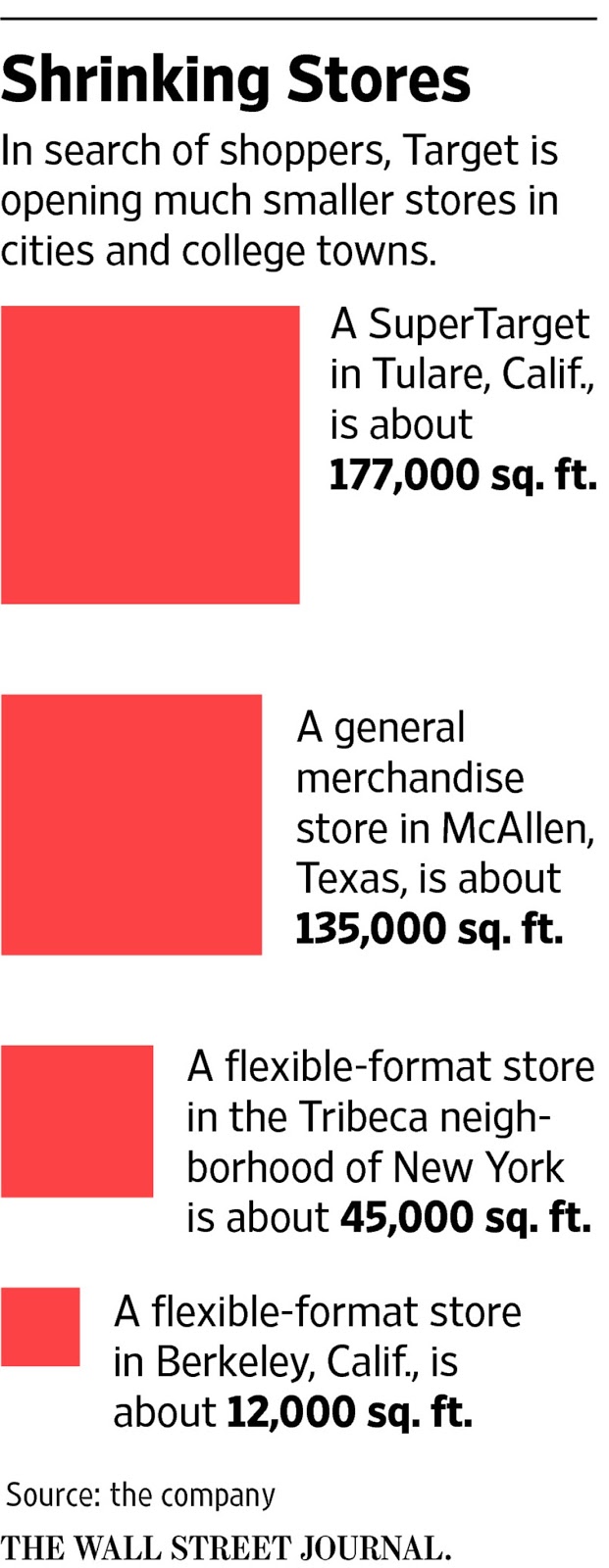
One strategic concern is that TGT is moving away from the large scale format that makes it dominant in discount retailing. Smaller stores require different resources for merchandising and different supply chain competencies. For example, the article notes that deliveries to the smaller stores must be more frequent. Stocking choices and facility layout are also likely to vary from location to location.
Such variation conflicts with the factor often associated with success in discount retail: standardization and efficiency.
A fundamental law of operations management is that volume (efficiency) and variety (catering to individual customer needs) are difficult to do together.
no positions
Sunday, November 1, 2015
Kelo Takings
Our house, was our castle and our keep
Our house, in the middle of our street
Our house, that was where we used to sleep
--Madness
Kelo v. New London was a Supreme Court ruling that significantly expanded the scope of government authority for forcibly taking real estate from private owners. Essentially, it legitimized government expropriation of eminent domain rationale for taking property for private--not public--development if it is deemed that the community at large would benefit from the development.
This can be viewed as another expression of greater good accounting.
One study estimates that a million homes have been taken since Kelo. Unfortunately, the precise reason for each taking was not measured in the investigation, although most of them are presumed to have been taken using eminent domain justification. Another limitation is that the study does not compare pre Kelo to post Kelo takings.
An important observation is that eminent domain rulings are biased toward the poor and blacks, whose households are being taken at about twice the rate of the general population.
Developer identifies some prime real estate currently occupied by low income people...developer uses the Kelo precedent to influence government to evict the occupants and score the land for its project...another mechanism for distributing wealth by force.
Our house, in the middle of our street
Our house, that was where we used to sleep
--Madness
Kelo v. New London was a Supreme Court ruling that significantly expanded the scope of government authority for forcibly taking real estate from private owners. Essentially, it legitimized government expropriation of eminent domain rationale for taking property for private--not public--development if it is deemed that the community at large would benefit from the development.
This can be viewed as another expression of greater good accounting.
One study estimates that a million homes have been taken since Kelo. Unfortunately, the precise reason for each taking was not measured in the investigation, although most of them are presumed to have been taken using eminent domain justification. Another limitation is that the study does not compare pre Kelo to post Kelo takings.
An important observation is that eminent domain rulings are biased toward the poor and blacks, whose households are being taken at about twice the rate of the general population.
Developer identifies some prime real estate currently occupied by low income people...developer uses the Kelo precedent to influence government to evict the occupants and score the land for its project...another mechanism for distributing wealth by force.
Tuesday, September 15, 2015
Progressive Racism
Sometimes I think it's a sin
When I feel like I'm winning
When I'm losing again
--Gordon Lightfoot
In a timely follow-up to Prof Williams' data-driven challenge of the Progressive racism narrative, Prof Anderson presents a case that it has been Progressive policies that have increased socioeconomic disparity among blacks. Economic regulation imposed by Progressives created monopolies where none existed and Progressive polices created new and harmful barriers to entry that blocked groups from climbing the economic ladder.
Some of these policies were intentionally racist, as demonstrated by quotes from Progressive icons such as Margaret Sanger. Similar to Lincoln, many Progressives saw the black population as negative influences on American society and sought to eliminate blacks thru both overt and covert policies. The history of Progressive labor laws, including minimum wage laws, can be viewed as a blatant attempt by powerful white coalitions to protect their franchises from competitive black labor.
Like Williams, Anderson notes that the real spread between black and white unemployment rates became more noticeable in the 1950s--after Progressive policies had a generation or so to take hold.
The irony of it all is that many blacks and well meaning Progressives embrace the very political philosophies that have widened the socioeconomic inequality that they purport to oppose.
When I feel like I'm winning
When I'm losing again
--Gordon Lightfoot
In a timely follow-up to Prof Williams' data-driven challenge of the Progressive racism narrative, Prof Anderson presents a case that it has been Progressive policies that have increased socioeconomic disparity among blacks. Economic regulation imposed by Progressives created monopolies where none existed and Progressive polices created new and harmful barriers to entry that blocked groups from climbing the economic ladder.
Some of these policies were intentionally racist, as demonstrated by quotes from Progressive icons such as Margaret Sanger. Similar to Lincoln, many Progressives saw the black population as negative influences on American society and sought to eliminate blacks thru both overt and covert policies. The history of Progressive labor laws, including minimum wage laws, can be viewed as a blatant attempt by powerful white coalitions to protect their franchises from competitive black labor.
Like Williams, Anderson notes that the real spread between black and white unemployment rates became more noticeable in the 1950s--after Progressive policies had a generation or so to take hold.
The irony of it all is that many blacks and well meaning Progressives embrace the very political philosophies that have widened the socioeconomic inequality that they purport to oppose.
Tuesday, August 18, 2015
Overbuilding
"Hope tastes good - like a cigarette should."
--Dr Yen Lo (The Manchurian Candidate)
The 21st century has been hailed as belonging to China. Social and economic reforms coupled with a huge population have vaulted China into the number two spot in GDP (~$10 trillion). As the human mind is prone to do, it is easy to extrapolate recent performance into the future and predict a dominant position for China in upcoming decades.
However, people tend to forget that, despite some positive market reforms, China remains a centrally planned economy. And central planners tend to make big mistakes when allocating capital--mistakes that impair standards of living for prolonged periods.
A classic example of this is becoming evident in Chinese infrastructure and real estate. Chinese consumption of building materials has been eye popping. For example, in three years China is estimated to have used more cement than the US used in the entire 20th century.

China's 'ghost cities' as profiled on 60 Minutes and elsewhere suggest that central planners have employed these building materials in the construction of massive infrastructure and real estate projects that are vastly underutilized. An eye-popper for me are these two pics showing Shanghai's financial district in 1987 (top) and 2013 (bottom).


One consequence of this overbuilding is that China's economic statistics look better than they actually are. For instance, massive construction spending has surely goosed China's GDP numbers--even if the fact of the matter is that many of those building projects have little economic utility.
Huge misallocation of capital by its central planners positions China (and the world) for the inevitable bust that follows the bureaucrat's misguided boom.
--Dr Yen Lo (The Manchurian Candidate)
The 21st century has been hailed as belonging to China. Social and economic reforms coupled with a huge population have vaulted China into the number two spot in GDP (~$10 trillion). As the human mind is prone to do, it is easy to extrapolate recent performance into the future and predict a dominant position for China in upcoming decades.
However, people tend to forget that, despite some positive market reforms, China remains a centrally planned economy. And central planners tend to make big mistakes when allocating capital--mistakes that impair standards of living for prolonged periods.
A classic example of this is becoming evident in Chinese infrastructure and real estate. Chinese consumption of building materials has been eye popping. For example, in three years China is estimated to have used more cement than the US used in the entire 20th century.

China's 'ghost cities' as profiled on 60 Minutes and elsewhere suggest that central planners have employed these building materials in the construction of massive infrastructure and real estate projects that are vastly underutilized. An eye-popper for me are these two pics showing Shanghai's financial district in 1987 (top) and 2013 (bottom).


One consequence of this overbuilding is that China's economic statistics look better than they actually are. For instance, massive construction spending has surely goosed China's GDP numbers--even if the fact of the matter is that many of those building projects have little economic utility.
Huge misallocation of capital by its central planners positions China (and the world) for the inevitable bust that follows the bureaucrat's misguided boom.
Saturday, August 8, 2015
Production Diversity
Well we're living here in Allentown
And they're closing all the factories down
Out in Bethlehem they're killing time
Filling out forms, standing in line
--Billy Joel
Trade theory 101 posits that two locales benefit most if each focuses on producing a particular output and then trade with each other. Productivity should be higher because of learning effects and lower switching costs. More wealth is therefore created to spread among people in both locales.
However, this stance assumes a static world that does not appreciably change. In reality, taste preferences and innovation evolve which renders production technologies obsolete over time. Locales that limit production to a few specialties to particular production specialties expose themselves to the risk of producing output that no one wants.
The finance analogy is the investor who positions his entire portfolio in a single stock. Unanticipated problems with the underlying company's operations could send the stock lower. Because the value of the investor's portfolio is entirely correlated to the performance of a single security, it is vulnerable to uncertainty.
Just as it is prudent for investors to spread risk over multiple securities, communities will be more robust if they are populated by a variety of producers. Manufacturers, service providers, big, small. The more variety, the better.
Communities that overspecialize with respect to size (e.g., catering to large producers) or sector (e.g., service over manufacturing) increase risk of economic stagnation or worse.
And they're closing all the factories down
Out in Bethlehem they're killing time
Filling out forms, standing in line
--Billy Joel
Trade theory 101 posits that two locales benefit most if each focuses on producing a particular output and then trade with each other. Productivity should be higher because of learning effects and lower switching costs. More wealth is therefore created to spread among people in both locales.
However, this stance assumes a static world that does not appreciably change. In reality, taste preferences and innovation evolve which renders production technologies obsolete over time. Locales that limit production to a few specialties to particular production specialties expose themselves to the risk of producing output that no one wants.
The finance analogy is the investor who positions his entire portfolio in a single stock. Unanticipated problems with the underlying company's operations could send the stock lower. Because the value of the investor's portfolio is entirely correlated to the performance of a single security, it is vulnerable to uncertainty.
Just as it is prudent for investors to spread risk over multiple securities, communities will be more robust if they are populated by a variety of producers. Manufacturers, service providers, big, small. The more variety, the better.
Communities that overspecialize with respect to size (e.g., catering to large producers) or sector (e.g., service over manufacturing) increase risk of economic stagnation or worse.
Subscribe to:
Posts (Atom)
![[Most Recent Quotes from www.kitco.com]](https://lh3.googleusercontent.com/blogger_img_proxy/AEn0k_uAzr2bgNo9nEkWWPanwf0Vk5bbbvWeZQf1OT1v7_HJdNXyoI0w4_-H42usdXfkFzfu-tAawN6nZPeRl0ikisw_LUkwe8TZ950ClwHc45Tb8Zgf9G-zSKChgS16RLdLSFo4Eg=s0-d)