Showing posts with label ponzi. Show all posts

Friday, June 11, 2021

Forms of Fiat

All the old paintings on the tomb
They do the sand dance, don't you know
If they move too quick
They're falling down like a domino
--Bangles

Modern money creation is a function of fiat. Government simply declares it into existence. Currently, there are three primary forms of monetary fiat:

1) Credit money. Central banks declare an interest rate, and then endeavor to make it so--primarily by setting the price of money at their 'discount window.' Banks borrow from the window at the fiat discount rate, and then use the borrowed funds as the basis for speculating or for making loans to others. Credit money therefore creates a pyramid effect thru the financial system as one dollar borrowed from the Fed's window might be leveraged 10x or even 100x in subsequent loans.

2) Security monetization. Also known as QE, monetization entails central banks lifting bonds out of primary dealer inventory in exchange for money created out of thin air. The Fed sees $500 million in Treasury and agency inventory on JP Morgan's (JPM) sheets, and it buys them from JPM by placing a digital credit of $500 million in JPM's account. Where did those funds come from? From a few clicks of a mouse, baby.

3) Money in the mail. Former Fed chair Ben Bernanke famously declared that central banks could always just drop money from helicopters if financial systems were in need of liquidity. Today, of course, dropping money from the sky isn't necessary because it's just as easy to send checks thru the mail. Where did the Federal government get the trillion$ of dollars to fund 3+ rounds of so called 'stimulus checks' associated with the CV19 situation? From a process that prints dollar values on checks and then mails them. That's all.

Questions to ponder: Which of the above is credit money and which is cash money? Which ones are most likely to result in higher prices of goods and services?

Friday, January 24, 2020

Perpetual Racket

"Now, tomorrow you collect $400 from Del Rio. And if I tell you to break a guy's nose or thumb as a 'late payment notice,' you do it!"
--Gazzo (Rocky)

Why is Social Security (and any other entitlement program for that matter) a ponzi-like racket? The poster below explains it well.

Another name for this is generational theft with the government serving as strong-armed agent for the robbing generation. Once implemented, it's hard to stop because the older 'paid in' generation feels that they are naturally entitled to what's theirs by 'social contract.'

A new generation may complain up front, but once it antes in, it's hooked. First you get robbed, then you rob.

Perpetual racket.

Thursday, October 17, 2019

Monetization, Pure and Simple

The deception, with tact
Just what are you trying to say?
--The Fixx

When it wants to employ 'monetary policy' to stimulate economic activity, the Federal Reserve can choose from three primary approaches. All three involve the creation money out of thin air (i.e., 'money printing'). However, the dynamics differ depending on the approach employed.

The most popular approach to date has been to lower the interest rate charged to banks that want to borrow funds from the Fed. All else equal, the lower the cost of borrowing money, the more money that will be borrowed. Presumably, banks would then use those borrowed funds to engage in lending, investing, and other activities that would stimulate the economy. The funds that the Fed lends are sourced out of thin air. The catch, however, is that this form of money, sometimes referred to as 'credit money,' is not free and clear. It is not like receiving a $100 bill as a gift. Instead, it is like taking out a $100 loan. The loan is a liability. You can spend the $100, but you must pay it back in the future--with interest at the rate specified by the Fed. As such, credit money created is subsequently 'destroyed' when the loan is paid back. Credit money can therefore be seen as temporary in nature. When credit contracts, so does the supply of credit money.

A second approach is to simply send checks directly to the people. This is the 'helicopter money' idea famously elaborated by former Fed chair Ben Bernanke. To date, the Fed has rarely used this approach, although central banks elsewhere have engaged in goodly amounts of helicopter money--often to the visible detriment of the monetary system (e.g., Weimar Germany, Zimbabwe, Venezuela). A recent example on a small scale here in the US was the 'tax rebate' checks sent to people in attempts to stimulate the economy during the 2008 credit collapse (a collapse which, by definition, destroyed lots of credit money discussed above). Imagine this on a larger scale, e.g., $50,000 checks sent to every US citizen every month, to get a sense of big league helicopter money.

The third approach, one that has gained recent popularity, is monetization. Monetization is where the Fed creates money out of thin air to buy assets. The Fed's three 'quantitative easing' programs (QE1, QE2, QE3) programs were large-scale monetization schemes. From 2008-2015, the Fed bought nearly $4 trillion of Treasury, agency, and other debt from bond dealers. The Fed put those assets on its balance sheet. In exchange, bond dealers got $4 trillion of freshly minted cash. How might this stimulate economic activity? The thought was that, in addition to the direct effect of putting money in bond dealers' pockets (which could be used for investment or consumption purposes), interest rates would also be pulled down by the bond buying (when bond prices go up, bond yields come down). Lower rates, as noted above, should stimulate borrowing all else equal.

Other central banks followed the Fed's lead and established their own flavors of QE-style monetization. Currently, the Bank of Japan and European Central Bank operate QE programs that dwarf the $4 trillion Fed project.

Last week, the Fed announced that, after a four year respite, it will once again buy assets. This time the focus will be on shorter duration Treasuries. The central bank adamantly denies that this is QE, but this is a semantic smokescreen.

Bond buying, whatever the duration and for whatever reason, is monetization, pure and simple.

Sunday, September 8, 2019

Debt Weight Loss

"Only unbelievable, Louden! I'm going to do an editorial for the school paper: When determination becomes insanity."
--Margie Epstein (Vision Quest)

WSJ article observes that high debt levels worldwide are weighing on economic progress. Artificially low interest rates encourage borrowing and spending that pull economies out of tail spins like the 2008 credit crisis.

However, all of this borrowing merely serves to pull future demand into the present. Down the road, there is less capacity for funding consumption as balance sheets are laden with debt and incomes must be diverted to paying creditors.

Central banks are unable to raise rates back to previous levels as higher rates add even more burden debtors and discourage additional borrowing.

What the article ignores is that economic tail spins that suppressed interest rates and borrowing are supposed to solve, like the 2008 credit crisis, were themselves funded by easy credit and debt. How does more borrowing and debt solve a problem funded by borrowing and debt?

It does not take a genius to conclude that, at some point, such a ponzi-like pyramid is destined to collapse under its own weight.

Saturday, July 20, 2019

Banking and the Business Cycle

"Never had my house pushed over before. Never had my family stuck out on the road. Never had to lose everything I had in life."
--Ma Joad (The Grapes of Wrath)

Ten years ago I began a book about the causes of the Great Depression called Banking and the Business Cycle (Phillips, McManus & Nelson, 1937). With my renewed reading campaign about the 1920s and 1930s this summer, I recently finished this insightful work.

The backdrop is compelling for several reasons. The authors are three professors who conduct their analysis with requisite academic rigor. Footnotes and data abound. The analysis focuses on monetary-related causes of depression. Findings are integrated to formulate a general theory of business cycles that goes beyond the Depressionary period. Finally, the book was written while the Depression was still at work. Similar to the recently completed Allen (1931) work, publication inside the period adds freshness and validity that later work can't replicate.

Their analysis points directly at that policies of the Federal Reserve--policies enacted during WWI and in the following decade--as causing the depth and length of economic malaise that characterized the Depression. The Federal Reserve Act was passed in 1913, a couple of years before WWI began. Relaxed parameters of the newly created central banking system (e.g., lower reserve ratios, member banks needed to deposit all reserves with Federal banks, low Federal Reserve bank reserve ratios, lower reserves required for time deposits) expanded credit creation capacity orders of magnitude greater than what was possible pre-Fed. This enabled US WWI operations to be funded primarily through the sale of government bonds that were purchased primarily by the banks. As is usually the case when war is funded by inflationary policies, prices generally increased during this period

Following the war, market forces naturally worked to correct the systemic distortions. A general deflation commenced to destroy excess credit and decrease prices. (The authors present interesting data indicating that during the two prior US wars--the war of 1812 and the Civil War), prices generally returned all the way to their pre-war levels and then some). Much of this deflation occurred during the deep but relatively brief Depression of 1920-1921.

Coming out of that depression, however, prices had only retraced about 50% of their wartime increase. This is when the Fed began a multi-year campaign to intervene in the name of 'price stability.' In 1922 the Federal Reserve embarked on the first of three rounds (they did similar in 1924 and 1927) of lowering what today we call the 'Fed Funds rate' and engaging in 'open market operations' (read: bond buying) that, coupled with the central banking system's newfound capacity for pyramiding credit through the system, created the leveraged fuel that funded several rounds of speculative investment--first in productive capacity, then in real estate, and finally in stocks--that inflated the bubble that ultimately popped with the market crash of 1929.

It is interesting to note that prices of goods and services did indeed stabilize. Despite all of the credit creation, prices of consumer goods did not change much and never reclaimed pre-WWI levels. However, prices of speculative assets such as real estate and stocks went through the roof. Although the authors did not call it such, they explain this phenomenon as if it were the Cantillon Effect. The newly created credit largely remained within the financial system, and the first users of the newly created credit bid up the prices of financial assets accordingly.

Those who cannot recognize the parallels to our present situation are not engaging their brains.

Post crash, the authors considered why economic activity persisted at such depressed levels. Their explanation centered on New Deal policies, many initiated during the Hoover administration, that extended the previous decade's price stability motive via additional rounds of monetary and fiscal policy. They make a particularly compelling argument that restricting layoffs and legislating minimum wage rates essentially institutionalized widespread unemployment. Letting labor markets clear at much lower wage rates, in authors' view, was the quickest way to end the Depression.

I was longing for a deeper dive into the effects on savings during the period. What happened to savings rates during the 1920s? And if savings were sharply lowered during the boom, then how could the economy expand significantly until those savings had been replenished? A rigorous discussion of the interaction between credit creation and real savings would have been icing on the cake.

That said, this is a superior analysis with few peers. An amazing work from individuals who were still living the times.

Reference

Phillips, C.A., McManus, C.F. & Nelson, R.W. (1937). Banking and the business cycle. New York: The Macmillan Company.

Tuesday, April 23, 2019

SS Ponzi

Now if I don't get off alive
It's just as well
I'll be waking up in heaven 
'Cause I've been through hell
On this shakedown cruise
--Jay Ferguson

Dan Mitchell is correct. Social Security is a ponzi scheme that would find its execs behind bars were it a private sector endeavor.
Estimated cumulative shortfall is currently north of $42 trillion. The 'fund' will run out of money by 2035.


Meanwhile, Washington hypocrites will continue baling water from the sinking SS Ponzi.

Monday, July 25, 2016

Card Sharks

Every gambler knows
That the secret to surviving
Is knowing what to throw away
And knowing what to keep
--Kenny Rogers

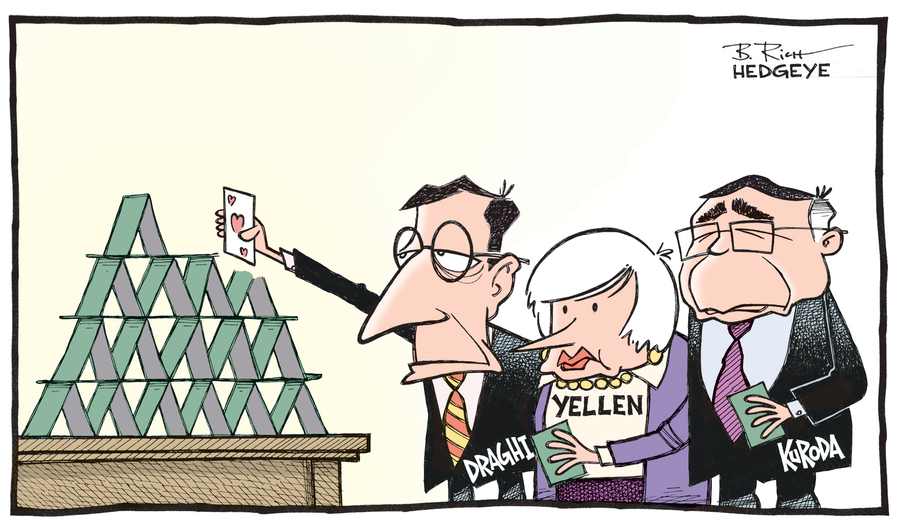
Central bankers are building the largest house of cards in the history of the world.


When the walls come tumbling down, claims will be made that the work in progress was difficult to see.

This claim will not hold water, as it failure to recognize this disaster in the making has been purely a matter of choice for those with capacity for reasoned thought.

Friday, June 24, 2016

Yes for Brexit

V: Would you...dance with me?
Evie Hammond: Now? On the eve of your revolution?
V: A revolution without dancing is a revolution not worth having.
--V for Vendetta

In a dramatic vote that took many pollsters and experts by surprise, the British people voted yesterday by substantial margin to leave the EU. While what Britain does with its increased sovereignty remains to be seen, this is clearly a blow to statism worldwide and calls future solidarity of other EU members into question.


The news has roiled financial markets worldwide, as interventionary policies designed to hold the EU ponzi together suddenly appear less likely to work in the eyes of investors. Domestically, equity markets opened down 2%+. Banks in particular have been splattered, with many domestic names down 6% or more. British bank Barclays is off a cool 23%.

We'll see what happens after the bulls attempt to bounce 'em, which appears to be in process now. If they can't, then...

As my friend Toddo tweeted this am, markets rarely mark significant bottoms on Fridays. One reason: margin calls go out over the weekend.

Should also note that gold was up about $80 at one point but has since pulled back some. Still, it remains above the $1300 resistance level that has turned the metal back several times recently.

position in SPX, gold

Tuesday, June 21, 2016

Brexit

"Think they know something we don't?"
--Major General Urquhart (A Bridge Too Far)

On Thursday, the British people will vote on whether the United Kingdom should remain a member of the European Union (EU) or whether to exit. A 'Brexit' result would signify a no confidence vote for the viability of the EU and would roil financial markets as the house of cards propping up Greece and other failing EU members depends on complete solidarity.


Stated differently, Brexit would severely weaken the viability of the EU.

Why is Britain tempted to withdraw? Because, like other big players such as Germany, it paying more into the collective than it is getting out. Moreover, its sovereignty is being restricted by EU rules and regs.

Britain would have an easier go at it than others because it never surrendered its currency to become an EU member. It kept the British Pound while countries like Germany ditched the Deutsche Mark.

Nonetheless, if Brexit happens, expect Germany to commence dialogue on Gerexit.

Thursday, March 24, 2016

Anti-Social Insecurity

You go back, Jack
And do it again
Wheels turnin' round and round
--Steely Dan

The author's purpose here is twofold. First he criticizes progressivism, claiming that it "is not a rational system of thought but a means to make progressives feel better about themselves and provide a (false) sense of control over a big, complex and often hostile world."

Such a mindset must ignore the possibility that progressive programs might fail or be cost prohibitive. Progressives must also ignore fundamental axioms such as the presence of resource scarcity in order to constantly propose spending more for programs that continue to escalate in cost.

Progressives cannot question their assumptions because, if they did, they would realize that their approach is not a viable one. So they just plow ahead. "Forward..."

The psychology is one of denial and escalation.

The author also demonstrates the flawed progressive mindset in the context of Social Security. He observes that the institution of Social Security in the 1930s was a response to previously failed government programs and actions, including US participation in WWI, the Federal Reserve, government schools, the Smoot Hawley Tariff., and, of course, the New Deal. Flawed programs never die in the minds of progressives; they get institutionalized.

Social Security lengthened the Depression and continues to cost jobs. Social Security payroll taxes increase employment costs. ECON 101 tells us that when labor prices go up, buyers of labor will purchase less of it.

The author makes an additional point that I hope to expand upon in future posts. He observes that Social Security has made older Americans dependents of the State, and molds them into supporters of the ponzi scheme of generational theft necessary to keep welfare programs afloat. "At a time when the elderly should be relying on their families," he notes, "they are forced to spend their golden years voting like automatons for the same wretched state that is destroying the future of their own children, grandchildren and great-grandchildren."

As such, Social Security and the welfare state has weakened age old bonds between parent and child. Formerly, elderly parents would live with their children and help raise the grandchildren. Now, adult children think nothing of moving thousands of miles away from their parents and outsource their elderly care problems to government-funded institutions and the tax slaves that toil for them.

Social Security can be seen as a monumental oxymoron of progressive ideals. It is not secure at all because it lacks a sustainable economic foundation. It is also anti-social in that destroys the basis for voluntary cooperation between individuals in society.

Wednesday, February 24, 2016

Paying Banks to Risk Deposits

"And I hate to tell you this, but it's a bankrupt business model. It won't work. It's systemic, it's malignant, and it's global...like cancer."
--Gordon Gekko (Wall Street: Money Never Sleeps)

If a bank was merely a 'money warehouse,' i.e., a place where you stored your money to keep it safe and accessible, then you would pay the warehouser a fee to do so. In exchange for the fee, the warehouser would give a receipt or claim check that would allow you to withdraw your funds on demand.

In fact, this was the original function of banks. They provided a secure environment for valuables and were paid to do so.

But safe storage is not the primary function of banks today. Instead, banks are leveraged lending machines, pyramiding deposits many times over to increase return on investment. Ironically, it is a bankrupt business model in that the leverage employed prohibits all funds to be returned to depositors at the same time (which is what precipitates bank runs).

In unhampered markets, there is nothing inherently illegal about this approach. However, depositors (who are really lenders) must understand the risks involved and be prepared for the possibility that their loans to banks may not be paid back.

Naturally, lenders to banks will rightly want to be appropriately compensated for such risk. The greater the risk, the greater the 'interest' paid by banks to depositors in order to attract capital. This is why banks should pay you for the privilege of taking in (and lending) your money. In a free market, banks could fail and you would not get your deposits back.

Of course, the modern day 'innovation' of deposit insurance backed by the government has distorted the risk assessment capabilities of depositors immensely. When the FDIC sign hangs on the door, depositors give nary a thought about how much risk their banking institution is taking with their funds. btw, the FDIC itself happens to be chronically underfunded in the event of widespread bank failures.

Because depositors have basically checked their brains at the door, central bankers think that NIRP has a chance of succeeding. The proposition is that depositors will be willing to pay banks a fee so that the banks can borrow deposits for leveraged lending purposes.

Absurd, I know, but with financial literacy so low, policymakers have reason to believe that people do not understand that they are lenders to banks who should demand compensation for putting their deposits at risk.

Saturday, February 20, 2016

Desperate Bankers

Don't your feet get cold in the wintertime
The sky won't snow and the sun won't shine
It's hard to tell the nighttime from the day
And you're losing all your highs and lows
Ain't it funny how the feeling goes away
--The Eagles

Steve Roach suggests central bank policies reflect escalating acts of desperation. First ZIRP, then QE, now NIRP.

"Central banking, having lost its way, is in crisis. Can the world economy be far behind?"

Should loss of confidence in the Fed et al become pervasive, then their house of cards collapses.

Saturday, February 13, 2016

NIRP, Deflation, and Gold

I'll move myself and my family aside
If we happen to be left half alive
--The Who

Gold appears to have bottomed alongside recent central bank actions. The December FOMC rate hike corresponded to THE recent bottom in gold prices. Then gold took off like a scalded (yellow) dog after the BOJ announcement of NIRP.


What is particularly interesting here is that these central bank actions are inherently deflationary. What? "I get how raising rates is deflationary," you say. "But how is NIRP deflationary? Isn't the idea to push people out of cash and into spending?"

Perhaps, Grasshopper, but NIRP should cause less funds to be deposited with financial institutions. With less funds on deposit, there is less opportunity for banks to pyramid credit which is the essence of inflation classically defined.

While common wisdom is that gold is a hedge against inflation, it is better viewed as a bet against disorder. NIRP may be the ultimate monetary disorder--one with decidedly deflationary character.

Gold is a way to keep assets out of the system and side step disorder.

position in gold

Saturday, February 6, 2016

Paper Ceiling

When the good times never stay
And the cheap thrills always seem to fade away
When will we fall?
When will we fall down?
--Toad the Wet Sprocket

Apt portrayal of the debt ceiling fantasy.


When the enablers go away, and they always do, then the paper ceiling of debt collapses.

Tuesday, September 8, 2015

Central Bank Stock Pool

All the paintings on the tombs
They do the sand dance don't you know
If they move too quick
They're fallin' down like a domino
--Bangles

Discussion of why and how central banks could send stocks soaring from here. Central banks can't let stock prices fall in a over-leveraged financial system that makes the 2008 backdrop look like a Sunday school picnic. In other words, CBs are 'all in' and believe that they need high stock prices if they are to have a fighting chance at holding their Keynesian fantasy together.

As these pages have discussed, the 'how' involves a variation of the old stock pool arrangement. At least two colluding players trade buying and selling stocks to each other, hoping that they can lure others into the game. All the while, prices spiral higher.

I believe that central banks, including the Fed, have been playing this game. It can work in low volume situations until outsiders lose their risk appetites and begin to sell. Or until colluding players soak up so many shares that Everyman no longer associates stock prices with economic well being.

The question is whether we're on the cusp of central bank stock pool irrelevance.

position in SPX

Wednesday, July 8, 2015

Deleveraging the Dragon

"The mother of all evils is speculation--leveraged debt."
--Gordon Gekko (Wall Street: Money Never Sleeps)

The China meltdown is attracting more attention after its stock markets were hammered again yesterday for a 6% loss. In an attempt to stem the selling, more than half the issues trading on China's mainland exchanges have been halted.

How this action, or any other intervention by policymakers, stems rather than exacerbates downside pressure remains to be seen.

The problem here is the problem everywhere when markets melt down: leverage. Borrowing to buy more stock magnifies returns on the way up, but it also magnifies losses on the way down.

It's been easy to borrow money to buy stocks in China. Structures such as so-called 'umbrella trusts' have made it easy for even rural peasants to get into the game on margin.

Mix in propensity for governments to bail out risk-seeking gone awry and you have a toxic combination.

Of course, the Chinese case, like the Greek case, should be a wake-up call for US investors. After all, US margin debt rests at all time highs.

Alas, the psychology of denial is an interesting thing. We can be certain that people won't recognize the problem until the margin calls arrive.

position in SPX

Monday, July 6, 2015

Euro Dominos

There's no need for argument
There's no argument at all
--Van Morrison

As ZeroHedge reports, EU exposure to Greece is complex--amounting to both direct exposure assumed by banks and indirect exposure that has been laid off to various EU members via ECB programs. Estimated country exposure as a % of GDP looks like this:


Appropriately portrayed as the Greek domino tipping a progressively larger cascade.

Friday, April 10, 2015

Policy Bound

Relax, said the night man
We are programmed to receive
You can check out anytime you like
But you can never leave
--Eagles

By now, it should be clear to any objective observer that the Fed cannot raise rates. And that markets know it.

For the better part of a decade, the Fed, while occasionally voicing hawkish rhetoric, has been nothing but dovish in action. Rates have been near the zero bound since 2007. The Fed knows that its policies have provided little positive influence on real economic activity.

But it keeps the pedal to the medal anyway.

Markets have levered up on cheap Fed funds and bid security prices to the moon. Even a tiny increase in borrowing rates will bring this leveraged house of cards down. Thus, markets buy all (bad) news that would keep rates suppressed, and sell all (good) news that would motivate central banks to raise rates.

We are too big to fail, markets are saying. Keep credit easy, lest we will collapse and make you look bad.

Central banks, ever image conscious, comply like indentured servants.

Monday, March 16, 2015

"But I Paid For It"

All the old paintings on the tomb walls
They do the sand dance don't you know
If they move too quick
They're falling down like a domino
--Bangles

A dilemma facing Tea Party and other small government types concerns entitlement program payouts. Because they have been forced to pay into Social Security, Medicare, during their working lives, many believe it only fair that they should be able to access funds from the system when they retire, reach a certain age, or are in need.

That would be reasonable if a) they had entered into a contract voluntarily, and b) if program administrators had justly managed inflows so that participants could in fact take out what they put in.

Unfortunately, neither is the case. They did not sign a valid contract. Instead, they were shaken down at the point of a gun--forced to surrender production to strong-armed agents. Arguing for an entitlement payout based on past pay-ins is like arguing for a thief to return property stolen in past robberies. The victim may have just claim on those stolen goods but it is not contractual in the classic sense of the word.

Which brings us to the more despicable second point. The thieves who confiscated past entitlement pay-ins have already spent their booty. Entitlement program administrators are running one of the greatest pyramid schemes in history--confiscating resources, consuming them, and then relying on confiscation from future generations to politically satisfy previous victims.

Stated differently, in order for those ripped off in the past to be made whole, then they must be willing to commission the same strong armed agents who stole from them to shake down a new group for some of their production in an ongoing Ponzi of generational theft.

Saturday, March 7, 2015

Perfect Storm

Ooh, a storm is threatening
My very life today
If I don't get some shelter
Oh yeah, I'm gonna fade away
--The Rolling Stones

These pages have considered the issues. Economics. Financial system. Monetary policy. Fiscal policy. Geopolitics. All dimensions are redlining.

Yet by and large, people seem unaware or dismissive.

Could be that they are so busy trying to make ends meet that they have no time to think. Could be they don't know what to monitor. Could be that they are married to current policies and can't face being wrong. Could be that they figure someone else has their back in case of a meltdown.

One thing seems certain, historians looking back on this period will ponder how the great majority watched passively as the perfect storm positioned directly over them.