Drawn into the stream
Of undefined illusion
Those diamond dreams
They can't disguise the truth
--Level 42
A significant thread runs through these pages on the subject of equality. As observed
by Hayek, equality assumes one of
two competing notions in the social context.
One notion is equality of legal treatment. Rules should not grant legal privilege to any particular interest. Government does not have the right to limit what a person can achieve. The working principle is that no person or group should have the legal power to decide what another person's status should be. This principle must not be sacrificed to gratify a particular sense of
social justice,
envy, or
resentment. All people must be treated equally under the law.
The other notion is equality of socioeconomic condition. Because the
natural state of the world is
variation and diversity, rules backed by force must be enacted to grant
privilege to some people or groups in order to achieve
sameness. This privilege legally authorizes government to limit what some people achieve, sometimes by confiscating
property, in an attempt to advance the interests others (i.e., the privileged). These privileges help 'level the playing field' in some people's minds as it creates a sense of
fairness.
Clearly, these two notions are diametrically opposed. Striving for equality of condition requires that people are treated unequally under the law. Rules grant legal power to decide a person's status, and force is authorized to limit what some people can achieve by stripping them of property and
associated decision rights.
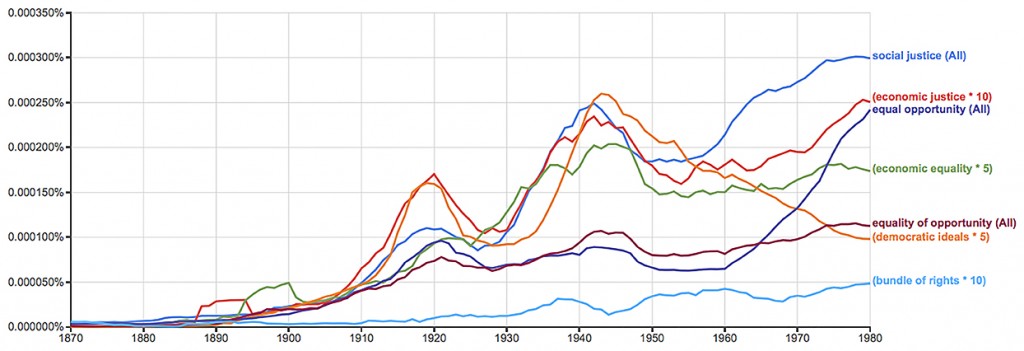
Some people might object to this dichotomous treatment of equality. There is also 'equality of opportunity,' they argue. Popular use of the term 'equal opportunity' dates at least as far back as the
Civil Rights Act of 1964 where language related to equal opportunity is sprinkled throughout
various sections of the act such as Title IV on public education and Title VII on employment. Institutionalization of the equal opportunity concept was enhanced by the formation of various commissions such as the
Equal Employment Opportunity Commission to enforce various provisions of the act.
The
general idea behind the equal opportunity concept is that all people should have an equal chance to compete within a given social framework. If people are born into low income family circumstances, for example, then that is deemed
unfair. To equalize their opportunity versus those born into more favorable circumstances, then people born into more austere conditions should be given resources (money, education, special employment oversight, etc.) that helps them better compete in the marketplace.
It is easy to see that equality of opportunity is not a third, previously ignored concept of equality. Instead, it merely a repackaging (or
positive substitute symbol) of the equality of condition concept. Rules must be tilted to grant some legal
privilege over others. Resources must be taken from some for the benefit of others. Discrimination
with respect to private property is forcibly restrained. Government has power to forcibly limit what some people can achieve. As observed by
Tocqueville and others, liberty
declines under such constructions of equality.
Like the equality of condition concept, the notion of equal opportunity necessitates
unequal treatment under the law.



![[Most Recent Quotes from www.kitco.com]](https://lh3.googleusercontent.com/blogger_img_proxy/AEn0k_v9N1bGiItkf5ed0HFLTy1b3qRceI83Qq3jkBdbk4RUFHl9-9ayBJ1NXtvfxkfp0lqzRKwPNNLFi7K5GzzqA1kpBY9Y0lyEX58_AmnCFHUHt9BDGvkUH_5O7JwZDyDlebR5oQ=s0-d)