Sunday, June 16, 2013

Oath of Hypocrisy

"Listen, I'm a politician. Which means I'm a cheat and a liar. And when I'm not kissing babies, I'm stealing their lollipops."
--Jeffrey Pelt (The Hunt for Red October)

Hypocrisy and politics go hand in hand. Nonetheless, ZH reminds us that although politicians tend to speak from both sides of their mouths, some of the then-vs-now quotes from this president are still capable of raising eyebrows.

"This administration acts like violating civil liberties is the way to enhance our security. It is not."

Well said. It channels the ideas of great statesmen like Benjamin Franklin and Patrick Henry. The problem is that this statement comes from Barack Obama--before he became president and in charge of the most powerful civil rights aggressor in existence.

Of course, it is not just politicians but also their minions that flip lids. As Nick Gillespie demonstrates, if their guy is in the White House, then people are more likely to be ok with Big Brother policies.


John Dahlberg, better known as Lord Acton, once said, "Power tends to corrupt, and absolutely power corrupts absolutely.

It appears that power particularly corrupts capacity for reason and for integrity.

Saturday, June 15, 2013

FDR and the Gold Slackers

Hey you getting drunk, so sorry
I've got you sussed
Hey you smoking Mother Nature
This is a bust!
--The Who

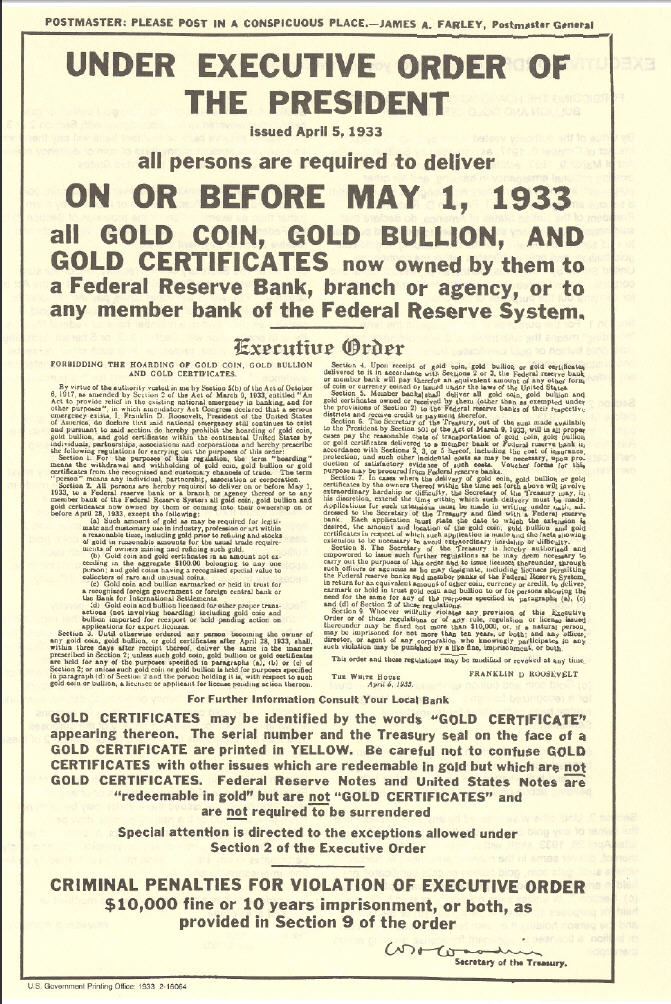
Eighty years ago this month FDR's gold confiscation order (Executive Order 6102) was being enforced.


And FDR's attorney general was publicly labeling people 'slackers' who did not turn in their gold.


The Roosevelt administration viewed this as warfare. The AG said:

"We are trying to win a war against depression and hard times...We are endeavoring to drive the gold out of hoarding. Each dollar that is held in hoard ties up from $15 to $20 in credit, or perhaps more. We are out to win this warfare."

Going into 1933, the dollar was still backed by gold. Citizens, and foreign trading partners for that matter, who felt uneasy about the federal government's monetary policy could go to the bank window and swap a $20 bill for roughly one ounce of gold. This is the discipline that a gold-back currency instills on policymakers. Either keep your inflationary urges in check, or people will drain gold from government vaults.

FDR employed aggression to overcome this problem. He confiscated the gold of US citizens. He further confiscated their property by devaluing the dollar. Because he broke the promise to repay creditors with gold if they chose, he also effectively defaulted on US government debt.

Some people suggest that the federal government couldn't do this again. After all, the dollar is no longer backed by gold, so what does the federal government care about where gold goes?

Perhaps, but gold can be viewed as a bet on disorder. Soaring gold prices signal that people are losing confidence in paper currency to the point where they will trade it for gold colored metal. Policy makers do not want to operate under such a signal.

The really interesting question isn't whether government might seek to confiscate gold again. It is whether people will obey next time around.

position in gold

Friday, June 14, 2013

Why Hasn't Libertarianism Won the Day?

Benjamin Martin: May I sit with you?
Charlotte Selton: It's a free country. Or at least it will be.
--The Patriot

Nice reply by Tom Woods to some editorials written by people who oppose libertarianism. Libertarianism is the belief in societal design grounded in voluntary cooperation among individuals. Grounded in the philosophy of natural law, libertarianism posits that people are born with the right to pursue their interests as long as they don't forcefully interfere in the pursuits of others.

Libertarians oppose forceful aggression (a.k.a. the non-aggression principle). The only legitimate use of force is for self-defense. Viewed through the libertarian lens, the proper role of government is to help people defend their property (broadly construed to include life and liberty as well as material possessions) against aggression.

A question posed by one of the editorialists was this:  If libertarianism is such a great framework, then why hasn't a country adopted it?

Before getting to Tom's response, I must first note that highly libertarian designs have been adopted at one time or another throughout history. Ancient Greece and Rome, for example, had runs that reflected may libertarian principles. Though not perfect, the system of government instituted by the United States, first under the Articles of Confederation and then under the Constitution, has been the boldest libertarian design in scale and scope enacted in the history of man.

The more accurate and interesting question to pose is this: Why has it been difficult for libertarian designs to persist?

Tom's response, which he frames as a series of rephrased questions, is based in large part on the axiom that people prefer leisure over work, and less work over more work. Stated differently, people want to get the most gain from the least amount of effort.

If people can advance their interests on the backs of others, then they are prone to do so. Because government is legalized force, then it is in the interest of some to use the strong arm of government to advance their interests at others' expense.

The history of the world can be seen as a battle of voluntary cooperation vs involuntary servitude. Peace vs aggression. Freedom vs force.

The libertarian design has been battling designs that employ aggression. Thus far, aggressive designs have had the upper hand. This obviously does not render the libertarian approach meaningless. It merely reflects the strength of human desire to force one's will onto others for personal gain.

Thursday, June 13, 2013

LIFO Bubbles and Japan

"You watch your tail, cowboy."
--Nick Conklin (Black Rain)

Peter Atwater thinks attention should focus on the sell-off in Japan and the associated spillover effects. Atwater suggests that the parabolic move in Japanese markets earlier this year reflected investor confidence in central bank ability to boost asset markets higher thru money printing. Once the last investor capable of becoming confident in central bank prowess does so, then the top in sentiment is in and the only place for confidence (and prices) to go is down.

He suspects that the harsh reversal in Japanese markets, both stocks and bonds, is a symbol that the top in central bank confidence has been put in. Because bubbles, he brilliantly observes, have a LIFO (last in first out) quality to them, the most extreme cases occur near the apex of confidence and are the first to turn. Because Japan has the makings of such an extreme case, market reversals there may signal that a systemic turn is now underway.

The Nikkei, btw, lost over 6% last night.

position in SPX, Treasuries

Why Should We Be Surprised?

"The government's been in bed with the entire telecommunications industry since the forties. They've infected everything. They get into your bank statements, computer files, email, listen to your phone calls...every wire, every airwave. The more technology used, the easier it is for them to keep tabs on you. It's a brave new world out there. At least it better be."
--Brill (Enemy of the State)

Ron Paul wonders why we should be surprised about the NSA surveillance scandal. Those who opposed the Constitution as written were among those who understood government's insatiable appetite for power and control.

Rights usually aren't forcefully taken overnight. Their erosion is gradual, steady. For instance, Judge Nap explains the erosion leading up to the present NSA situation.

We now face a situation similar to the colonists in the 1760s, who dealt with British soldiers writing their own search warrants to enter people's houses. That situation helped motivate a revolution and then a written Constitution meant to secure individual rights.

That Constitution has now been close to completely shredded.

With rights violated and Constitution shredded, what is likely to follow?

Wednesday, June 12, 2013

Laughing at Truth

I get all my papers and smile at the skies
Though I know that the hypnotized never lie
--The Who

Some fave media responses to the NSA incident and its implications over the past few days:


Surveillance and Isomorphism

I try so hard not to get upset
Because I know all the trouble I'll get
--Til Tuesday

Jacob Hornberger observes that a primary objective of government surveillance is to keep people in line. The government collects information on people. If individuals rebel in some way, then government uses that information against them. For those who have not rebelled, the surveillance process serves as a signal to others about the benefits of compliance and the consequences of rebellion.

Surveillance is a process of institutional isomorphism. Its aim is compliance.

Tuesday, June 11, 2013

Snowden's Remarkable Example

"It means if something's wrong, those who have the ability to take action have the responsibility to take action."
--Benjamin Franklin Gates (National Treasure)

Edward Snowden is the person who blew the whistle on the NSA record collection scandal. He is a rare person in today's world. An employee at government contractor Booz Allen, Snowden decided that he could no longer be a part of a process of massive surveillance of US citizens. He sacrificed a $200K/yr job, a dreamy Hawaiian lifestyle, and much of his liberty to tell the story.

He notes,

"If living unfreely but comfortably is something you're willing to accept--and I think many of us are, it's human nature--you can get up every day, you can go to work, you can collect your large paycheck for relatively little work, against the public interest, and go to sleep at night after watching your shows."

Snowden decided that he didn't want to do that anymore. And telling the truth set him free.

Will we learn from his example?

Monday, June 10, 2013

Institutional Isomorphism

"These walls are funny. First you hate 'em, then you get used to 'em. Enough time passes, you get so you depend on them. That's institutionalized."
--Ellis Boyd "Red" Redding

Institutional environments exude pressure for isomorphism, or sameness, among indiividuals who by definition are born different and unique. Processes that encourage institutional isomorphism can be mimetic, normative, or coercive in nature (DiMaggio & Powell, 1983; Meyer & Rowan, 1977; Scott, 1995). 

Mimetic isomorphism occurs when individiuals, facing uncertainty, adopt the behavior of those perceived as successfully navigating the institutional environment. Who's staying alive? Who's getting promoted? What are they doing? Copy what appears to be working.

Normative isomorphism occurs when individuals adopt behavior patterns deemed to be appropriate in the institutional environment. Here's how we do things around here. Follow the rules. Keep your nose clean.

Coercive isomorphism occurs when institutional norms are imposed on individuals by force. If you do not comply, we will break you.

Individuals who bow to these pressures often want to be seen as belonging, i.e., as legitimate in the institutional field.

The larger and more powerful the institution, the greater the pressure for isomorphism.

References

DiMaggio, P. & Powell, W. 1983. The iron cage revisited: Institutional isomorphism and collective rationality in organizational fields. American Sociological Review, 48: 147-160.

Meyer, A. & Rowan, B. 1977. Institutionalized organizations: Formal structure as myth and ceremony. American Journal of Sociology, 83: 340-363.

Scott, R. 1995. Institutions and organizations. Thousand Oaks, CA: Sage.

Sunday, June 9, 2013

Easy Money Policy Favors the Rich

We are matching spark and flame
Caught in endless repetition
Life for life, we'll be the same
I must leave before you burn me
--The Fixx

This observation is consistent with something that we have noted frequently on these pages. Quantitative easing and other inventionary monetary policy favor the rich. The rich are the primary owners of stocks and other risky financial securities. Any policy geared toward boosting the prices of these risky assets, as QE purports to do, disproportionately benefits the wealthy.

Moreover, the decreased savings and increased borrowing promoted by easy credit policies are highly correlated to corporate profits. As interest rates are forced lower, people spend and borrow more, thus transferring economic resources to corporate balance sheets. Shareholders are the recipients of this wealth transfer.

Finally, interventions that ease monetary conditions  always increase when asset prices decline. Owners of financial securities come to learn that their downside is limited because authorities will bail them out in the event of systemic decline. This moral hazard emboldens the rich to own even more stocks--because perceived risk has been artificially reduced by policy-makers.

As the article suggests, if you are rich, then why would you not conclude that, with government jacking prices higher and backstopping losses, the winning strategy is to acquire as many risky financial securities as you can?

position in SPX