Meeting you with a view to a kill
Face to faces, secret places, feel the chill
--Duran Duran
Nice list of various ways to kill economies. The list includes:
Propping up failing organizaitons and industries
Intervening in foreign trade
Regulations
Minimum wage laws
Income taxes
Wars
Socialized health care
Kicking out immigrants
Abolishing interest rates (nice way to state it)
The sad thing is that this is not a theoretical list. We are doing all of these.
Scratching your head as to why we're not getting anywhere economically? Study the list.
Also, to those of you fingering 'unfettered capitalism' as the cause of our problems, you are being disingenuous. Markets have been trending less free for decades.
Wednesday, January 9, 2013

Tuesday, January 8, 2013
US Inflation Since the American Revolution
I stood and watched the dark sky rise
With glaring sunlights in my eyes
I thought of all the times gone by
And laughed aloud at the crimson sky
--Modern English
This below chart (source here) provides an excellent 'before...after' look at the impact of the Federal Reserve on inflation.

Because the CPI data are being manipulated to supress reported inflation, the 'after' period displays a conservative effect on inflation.
This institution is the great enabler of policies that, if permitted to continue, will surely end us.
With glaring sunlights in my eyes
I thought of all the times gone by
And laughed aloud at the crimson sky
--Modern English
This below chart (source here) provides an excellent 'before...after' look at the impact of the Federal Reserve on inflation.
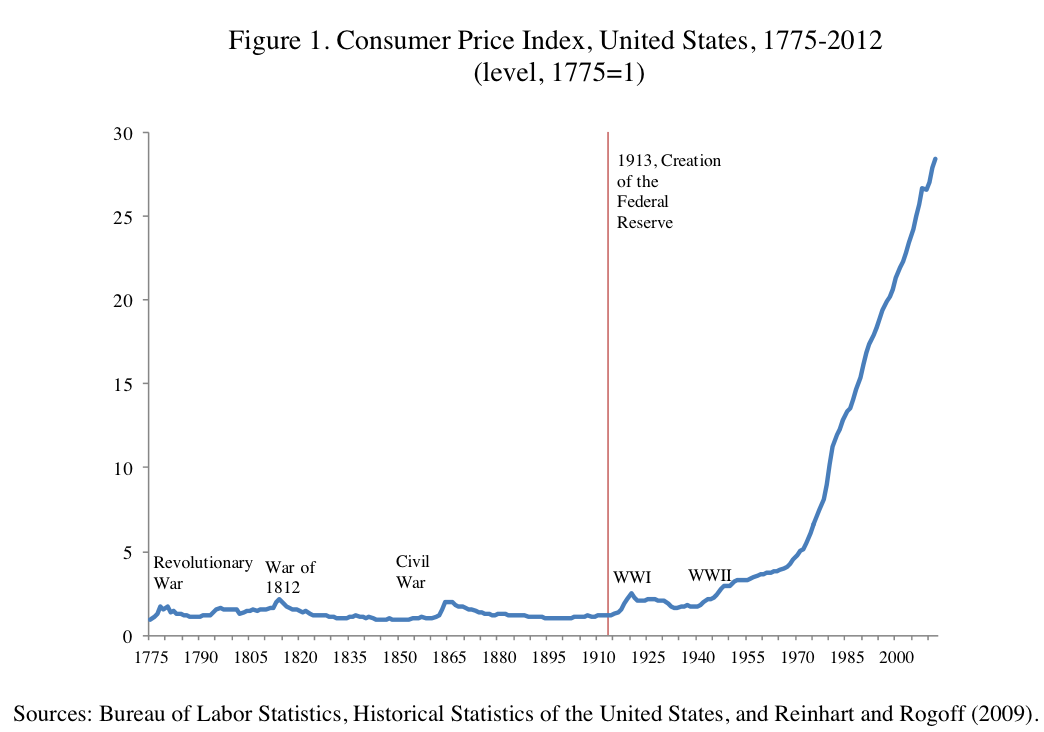
Because the CPI data are being manipulated to supress reported inflation, the 'after' period displays a conservative effect on inflation.
This institution is the great enabler of policies that, if permitted to continue, will surely end us.
Monday, January 7, 2013
Getting Stretched
I started drifting to a different place
I realized I was falling off the face of your world
And there was nothing left to bring me back
--The Plimsouls
What it does mean is that head winds to higher prices get stiffer--even in markets that are being manipulated by policy-makers and black box algo traders. If the rubber band snaps back in the other direction, then prices could retreat in a hurry.
Personally, I'm looking to use price to my advantage to add to commodities (lower prices) and short equity positions (higher prices).
positions in SPX, commodities
Sunday, January 6, 2013
Mom Shoots Intruder
Just hold on loosely
But don't let go
If you cling too tightly
You're gonna lose control
--38 Special
When people use guns in self-defense, media coverage usually does not spread far. Example here as a Georgia mom shot an intruder multiple times with a .38 last Friday.
As long as evil walks the earth, liberty is enhanced when people can defend themselves against invasion.
Freedom goes up and bad guys go down.
Saturday, January 5, 2013
Compromise, Gradualism, and Liberty
"So, Spaniard, we shall go to Rome together and have bloody adventures. And the great whore will suckle us until we are fat and happy and can suckle no more. And then, when enough men have died, perhaps you will have your freedom."
--Proximo (Gladiator)
The Left often declares that the Constitution was developed by a group of racists and slaveowners, presumably to discredit the legitimacy of the design. While it is certainly true that some signees were pro-slavery, other signees opposed slavery (Benjamin Franklin notably among them).
Moreover, all 13 states subsequently ratified the Constitution, including states with significant anti-slavery sentiment.
The accurate statement is that the Constitution was developed despite significant opposition to slavery.
So why did we do it? If the Constitution was intended by the framers to put the principles of the Declaration into practice, then why did people who strongly believed in liberty sign off on an incomplete expression of the Declaration's principles?
The reason lies in common outcomes of political calculation: compromise and gradualism.
Madison and others present at the time argued that compromises with respect to slavery were necessary to secure the ratification of the Constitution, lest slave-holding states would have bolted the Constitutional Convention. Many in the anti-slavery camp probably determined that, absent a central government that was stronger than the one enumerated by the Articles of Confederation, the likelihood of ever bringing the Constitution into complete harmony with the Declaration was remote. "We'll compromise now," they reasoned, "and then gradually amend the Constitution in service of eventual abolition of slavery."
Unfortunately, the Three-Fifths Compromise and visions to gradually undo it cost the lives and liberties of millions of individuals. Despite wars and countless legislative remedies, it can be argued that the ill effects of that original compromise are still being felt today.
Where would we be today had the original anti-slave founders stood their ground? If they had possessed more resolve with respect to their principles, perhaps we would have gotten it right the first time.
History suggests that compromising liberty today with the intent of gradually reclaiming it tomorrow is a losing strategy--one that enslaves rather than frees.
Unfortunately, we have yet to learn that lesson.
Friday, January 4, 2013
Liberty and Equality
And when you're looking for your freedom
Nobody seems to care
And you can't find the door
Can't find it anywhere
--Eagles
Nice discussion of liberty and equality from a philosophical perspective. Are liberty and equality compatible? If liberty is defined as individual freedom to pursue one's interests unencumbered by forceful interference from others, then the answer to this question depends on your definition of equality.
There are two primary definitions of equality. One is equality under the law. You are equal to others if the law does not discriminate based on your wealth level, skin color, pedigree, etc. This definition is compatible with liberty. Because no one can can use the law to benefit themselves at the expense of another, freedom is enhanced.
The other definition of equality is a material one. You are equal to others if you have the same amount of economic resources as others. When economic incomes are similar, people are equal. This definition is generally incompatible with liberty.
Because variation among people is axiomatic, people are born with different skills, interests, backgrounds, opportunities, etc. If people with more voluntarily share with people who have less (a.k.a. charity) to the point where the sharing equally distributes economic resources among all then, yes, liberty and equality are compatible--since those with more voluntarily gave to those who had less.
However, if people with more are forced to surrender resources to those who have less, then liberty and equality are obviously incompatible--the freedoms of some are compromised for the benefit of others.
Naturally, if such plunder is also legalized, then people are not being treated equally under the law.
Generally, then, equality under the law and material equality are unlikely to co-exist.
Thursday, January 3, 2013
Money for Nothing
That ain't workin,' that's the way you do it
Lemme tell ya them guys ain't dumb
--Dire Straits
Nice followup from yesterday's missive by Bill Gross. He notes, "$54 trillion of credit in the US financial system based upon trusting a central bank with nothing in the vault to back it up. Amazing!"

What the Fed and other central banks are doing is pure Ponzi, with big time inflationary consequences.
Wednesday, January 2, 2013
Why Hold Dollars?
And as our bridges turned to dust
A useless theme was quite enough
--Modern English
Increasingly, I find myself questioning why I would want to hold significant quantities of dollars given our untenable situation. Pondering our collective monetary and fiscal and monetary actions, I have difficulty not concluding that, contrary to popular rhetoric and spin, we have long since left the cliff, and that a primary casualty of the inevitable crack up at the bottom of the chasm will be the dollar.
Yet, in the face of rampant money printing, runaway government spending, and massive debt issuance and monetization, people generally remain sanguine about the greenback.
Lessons from Weimar and elsewhere suggest that people hold onto depreciating currency long after warning signs become clear. Whether this is due to ignorance, denial, hope, et al does not matter. We know that generally people stick to failing courses of monetary action far longer than they should.
We also know that confidence in a depreciating currency changes quickly. When people finally catch on that their money is quickly losing value, then there is a rush to swap out of paper and into things. It is at this point that garden variety inflation ends and hyperinflation begins.
God willing, I do not want to be one of those casualties that future generations, with benefit of hindsight, curiously question. "How could Ford have held onto his dollars, given the warning signs all around him that those dollars would become worthless?"
This is a significant change for me. These pages have often considered the inflation/deflation debate with deflation generally maintaining an edge. From where I sit, chance no longer favors deflation.
As such, my primary personal finance resolution this year is to reduce exposure to the dollar. I plan to lower cash balances in favor of other asset classes. I am not enamored with financial securities such as stocks and bonds here as their prices have been severely distorted. These distortions are likely to become, um, undistorted when people broadly recognize the dollar as a seriously flawed store of value and forces of natural law subsequently kick in to reclaim systemic balance.
Instead, I prefer hard assets. Gold, silver, other commodities, other 'alternative' assets. I will also consider several improvements to my home as I would rather do those improvements now before prices rip higher.
The trade off is that I will have a smaller cash cushion for daily living, and less financial firepower to buy bargains should I be wrong and we get a general price decline (i.e., dollars worth more) rather than a general price increase (i.e., dollars worth less).
Given my view of the world, however, I would rather sacrifice some liquidity than be left holding worthless confetti falling from a paper blizzard.
position in SPX, gold, silver, commodities
Party to the Bottom
Yeah, everybody's got a bomb
We could all die any day
But before I'll let that happen
I'll dance my life away
--Prince
Markets partying hard out of the gate on passage of fiscal cliff bill by House. Yes, House Republicans folded like tents.
Moral hazard has reached epic levels, as markets have been thoroughly conditioned to expect bailouts. Risk taking behavior has been consistently reinforced by the notion that government has the backs of investors.
For now, markets are ignoring the fiscal drag of higher tax rates on the majority of earners. Personally, I'm using this lift to trim stock and add gold.
position in SPX, gold
Tuesday, January 1, 2013
Cliff Thirteen
Nothing changes on New Year's Day
--U2
Mainstream media is hailing last night's fourteenth hour passage of a 'fiscal cliff deal' by the Senate. However, just a tiny bit of scrutiny suggests the celebration as premature. There is no guarantee that the bill (which passed the Senate by a vote of 89-8) will get thru the House. Moreover, the 'deal' focuses on the tax side of the ledger, and postpones resolution of the spending side for another 60 days. (Care to wager what will be happening 59 days and 11 hours from now?)
As I see it, there are two primary changes to tax policy worth noting:
Families earning more than $450K ($400K for individuals) will see their marginal tax rates increase to 39.6%.
All earners will see a 2% increase in payroll taxes.
The Obama administration can now take official credit for presiding over the first broad tax increase in two decades. And, per the Supreme Court, more tax increases are pending in the form of funding Obamacare.
Estimates are that the payroll tax increase takes $125 billion/yr out of taxpayer's pockets. And the marginal tax increase on the rich means less capital for investment. Hard to drink this pretty w.r.t. economic strength going forward.
An ominous start for a new year ending in 13.
Subscribe to:
Posts (Atom)