Saladin: Who defends?
Imad: Balian of Ibelin, the son of Godfrey.
Saladin: Godfrey? Godfrey nearly killed me in the Lebanon. Truly, I did not know he had a son.
Imad: It was his son at Kerak.
Saladin: The one you let live?
Imad: Yes.
Saladin: Perhaps you should not have.
Imad: Perhaps I should have had a different teacher.
--Kingdom of Heaven
One astute point made by John Locke in his Two Treatises of Government is that each of his is the product of the Creator. Each of us is the Creator's property, furnished with facilities meant to do the Creator's pleasure.
Each is therefore "bound to preserve himself, and not to quite his station wilfully." Thus the right to self-defense.
It therefore follows that people should restrain themselves from "invading others' rights."
While we often speak of the property rights of each individual, the ultimate property rights belong to the Creator.
Reference
Locke, J. (1824). Two treatises of government. London: C and J Rivington.
Wednesday, August 8, 2012

Tuesday, August 7, 2012
Off the Deck
He's got a brand new car
Looks like a Jaguar
It's got leather seats
It's got a CD player, player, player
--Feeder
Multi-month downtrend in 10 year yields has been decisively broken. TNX is approaching near term resistance just below 17 (1.7%).

Action in bonds corresponds to the SPX moving thru 1400, and first Fed repos since 2008.
position in SPX
Looks like a Jaguar
It's got leather seats
It's got a CD player, player, player
--Feeder
Multi-month downtrend in 10 year yields has been decisively broken. TNX is approaching near term resistance just below 17 (1.7%).

Action in bonds corresponds to the SPX moving thru 1400, and first Fed repos since 2008.
position in SPX
Monday, August 6, 2012
Freedom and the Agency Problem
Sue-Ellen looks so upset
This isn't the first time
And it won't be the last
There's things going on behind her back
Oh, they'll give you a heart attack
--Flesh for Lulu
It is sometimes said that freedom isn't free. The underlying truism relates to axiomatic human behavior. Humans prefer leisure over work, and less work over more work. As such, humans are inclined to seek opportunities to satisfy their needs on the backs of others, a.k.a. seeking something-for-nothing.
Absent being objects of charity, seekers of something-for-nothing will be tempted to forcefully invade the person and property of others in order to achieve their interests. These invasions constitute acts of violence and include murder, slavery, and robbery among others.
The purpose of government in a free society is to help individuals protect themselves against violent assault from those seeking something-for-nothing. Government is authorized to use force in order to help people pursue their interests without unwanted intrusion by others.
Unfortunately, people in government are not immune to something-for-nothing temptation. Some government officials will be tempted to use the strong arm of government force to satisfy their own interests. The more productive the citizenry, the more likely the phenomenon.
It is therefore necessary that people who want to remain free cannot dedicate 100% of their energies toward pursuing their interests. Some fraction of time and attention must be allocated toward keeping an eye on government, so that those authorized with use of force do not turn that force on people in a manner that restricts their liberty.
Essentially, what we have here is a classic agency problem. Freedom loving principals have retained strong armed agents to assist in protection of person and property. Since the agents' goals may differ from the principals,' it is necessary for the principals to monitor agent behavior to ensure that the agents are acting in manners that support liberty. As some anti-federalists forecast long ago, government will be quick to exploit lapses in vigilance here.
But government behavior may be difficult to monitor--particularly as the distance between government and citizenry grows. As such, freedom loving principals must complement monitoring with incentives or disincentives that keep government agent mischief in check. These incentives/disincentives might include the power to re-elect at the ballot box, sanctions for violating the law while in office, social pressure (protests, etc), pulling more government to the local level, and, in extreme cases, throwing off government in violent fashion.
The costs of monitoring and incentivizing government agents are key reasons why freedom is not free.
This isn't the first time
And it won't be the last
There's things going on behind her back
Oh, they'll give you a heart attack
--Flesh for Lulu
It is sometimes said that freedom isn't free. The underlying truism relates to axiomatic human behavior. Humans prefer leisure over work, and less work over more work. As such, humans are inclined to seek opportunities to satisfy their needs on the backs of others, a.k.a. seeking something-for-nothing.
Absent being objects of charity, seekers of something-for-nothing will be tempted to forcefully invade the person and property of others in order to achieve their interests. These invasions constitute acts of violence and include murder, slavery, and robbery among others.
The purpose of government in a free society is to help individuals protect themselves against violent assault from those seeking something-for-nothing. Government is authorized to use force in order to help people pursue their interests without unwanted intrusion by others.
Unfortunately, people in government are not immune to something-for-nothing temptation. Some government officials will be tempted to use the strong arm of government force to satisfy their own interests. The more productive the citizenry, the more likely the phenomenon.
It is therefore necessary that people who want to remain free cannot dedicate 100% of their energies toward pursuing their interests. Some fraction of time and attention must be allocated toward keeping an eye on government, so that those authorized with use of force do not turn that force on people in a manner that restricts their liberty.
Essentially, what we have here is a classic agency problem. Freedom loving principals have retained strong armed agents to assist in protection of person and property. Since the agents' goals may differ from the principals,' it is necessary for the principals to monitor agent behavior to ensure that the agents are acting in manners that support liberty. As some anti-federalists forecast long ago, government will be quick to exploit lapses in vigilance here.
But government behavior may be difficult to monitor--particularly as the distance between government and citizenry grows. As such, freedom loving principals must complement monitoring with incentives or disincentives that keep government agent mischief in check. These incentives/disincentives might include the power to re-elect at the ballot box, sanctions for violating the law while in office, social pressure (protests, etc), pulling more government to the local level, and, in extreme cases, throwing off government in violent fashion.
The costs of monitoring and incentivizing government agents are key reasons why freedom is not free.
Stop and GIGO
Been running so long
I've nearly lost all track of time
In every direction
I couldn't see the warning signs
--The Go Gos
Zerohedge shares a new indicator for me: % change in real GDP vs % change in railcar loads of waste/scrap.

Last time railcar loads of garbage dropped this much was during the credit market meltdown.
Sorta gives new meaning to the notion of garbage in, garbage out.
I've nearly lost all track of time
In every direction
I couldn't see the warning signs
--The Go Gos
Zerohedge shares a new indicator for me: % change in real GDP vs % change in railcar loads of waste/scrap.

Last time railcar loads of garbage dropped this much was during the credit market meltdown.
Sorta gives new meaning to the notion of garbage in, garbage out.
Sunday, August 5, 2012
When Questioning the Fed Goes Local
"While the truncheon may be used in lieu of conversation, words will always retain their power. Words offer the means to meaning, and for those who will listen, the enunciation of truth. And the truth is, there is something terribly wrong with this country, isn't there?"
--V (V for Vendetta)
This story recently aired on a local news show. When local media outlets begin airing pieces that question the Federal Reserve, then it is hard not to feel an uptick in optimism.
Ron Paul's 'audit the Fed' bill has passed the House and now sits on the desk of Senate majority leader Harry Reid (NV). One would think this bill would proceed to the Senate floor given Reid's part on-the-record comments that the Fed should be audited. But, surprise, surprise, Reid has recently changed his tune and now vows not to introduce the bill for a vote.
Politics and integrity are the stuff of oxymorons.
Regardless, increasing public awareness of the Federal Reserve will be central to Ron Paul's legacy. As more people at local levels come to understand the damage that this institution has done to freedom, then social power grows and State power weakens.
At some point this social power will topple the Harry Reids of Washington.
--V (V for Vendetta)
This story recently aired on a local news show. When local media outlets begin airing pieces that question the Federal Reserve, then it is hard not to feel an uptick in optimism.
Ron Paul's 'audit the Fed' bill has passed the House and now sits on the desk of Senate majority leader Harry Reid (NV). One would think this bill would proceed to the Senate floor given Reid's part on-the-record comments that the Fed should be audited. But, surprise, surprise, Reid has recently changed his tune and now vows not to introduce the bill for a vote.
Politics and integrity are the stuff of oxymorons.
Regardless, increasing public awareness of the Federal Reserve will be central to Ron Paul's legacy. As more people at local levels come to understand the damage that this institution has done to freedom, then social power grows and State power weakens.
At some point this social power will topple the Harry Reids of Washington.
Saturday, August 4, 2012
True Law is Not Relative
Stuff that works, stuff that holds up
The kind of stuff you don't hang on the wall
Stuff that's real, stuff you feel
The kind of stuff you reach for when you fall
--Guy Clark
Prior to the start of class one day, I recall a fellow student asking my high school humanities teacher, "Is everything relative?" Raising his eyes in a dry gaze, the teacher replied, "Certainly not."
Progressives like to argue that, because the Constitution was developed in a different era, it is not relevant to modern times. 'Progress' requires governance crafted for today, for situations that the founders did not anticipate.
The Progressive argument is a flavor of positivism, a legal philosophy grounded in the notion that a law is valid if it can be enforced. Law is left to the discretion of the enforcers. Law, according to Progressives, is a relative thing.
But durable law is not relative. Rather, it is grounded in natural law that does not change with the direction of the wind. The founders understood this truth. Their experience with the discretionary rule of England merely validated what they had learned from their study of history.
Their study of Rome included the writings of Cicero, the great defender of the Roman republic and master of political philosophy. Cicero wrote:
"True law is right reason, consonant in nature, spread through all people. Is is constant and eternal...There will not be one law at Rome and another at Athens, one now and another later; but all nations at all times will be bound by the one eternal and unchangeable law..."
Cicero knew that effective law is timeless.
Reference
Cicero, M.T. "On the Commonwealth." In J.E.G. Zerzel (ed.), On the commonwealth and On the laws. Cambridge: Cambridge University Press, 1999, pp. 71-72.
The kind of stuff you don't hang on the wall
Stuff that's real, stuff you feel
The kind of stuff you reach for when you fall
--Guy Clark
Prior to the start of class one day, I recall a fellow student asking my high school humanities teacher, "Is everything relative?" Raising his eyes in a dry gaze, the teacher replied, "Certainly not."
Progressives like to argue that, because the Constitution was developed in a different era, it is not relevant to modern times. 'Progress' requires governance crafted for today, for situations that the founders did not anticipate.
The Progressive argument is a flavor of positivism, a legal philosophy grounded in the notion that a law is valid if it can be enforced. Law is left to the discretion of the enforcers. Law, according to Progressives, is a relative thing.
But durable law is not relative. Rather, it is grounded in natural law that does not change with the direction of the wind. The founders understood this truth. Their experience with the discretionary rule of England merely validated what they had learned from their study of history.
Their study of Rome included the writings of Cicero, the great defender of the Roman republic and master of political philosophy. Cicero wrote:
"True law is right reason, consonant in nature, spread through all people. Is is constant and eternal...There will not be one law at Rome and another at Athens, one now and another later; but all nations at all times will be bound by the one eternal and unchangeable law..."
Cicero knew that effective law is timeless.
Reference
Cicero, M.T. "On the Commonwealth." In J.E.G. Zerzel (ed.), On the commonwealth and On the laws. Cambridge: Cambridge University Press, 1999, pp. 71-72.
Friday, August 3, 2012
Conditions that Attract Violent Aggression
"Boards don't hit back."
--Lee (Enter the Dragon)
The recent 'Batman' theater shooting in Aurora CO provides a sobering reminder of two conditions that attract violent aggressors.
Aggressors are drawn to conditions of perceived weakness. Assailants rarely attack targets perceived to be of equal or greater strength. Instead, they are much more likely to accost targets thought to be incapable of defending themselves when attacked. In the case of the Aurora shooting, the theater was a posted no concealed carry establishment - attractive to any assailant wishing to commit a violent act with a gun without having to deal with return fire.
Aggressors are drawn to conditions of surprise. Assailents are unlikely to assault targets who have been forewarned or otherwise prepared to deal with an attack. Aggressors like surprise. Surprise causes people to delay defensive responses until they can collect their wits. In many cases, surprise attacks can freeze victims who are overcome with fear. In the Aurora case, the shooter almost certainly anticipated a surprise advantage. Choice of venue, film subject, garb, entry pattern, initial behavior as described by witnesses, etc suggest that the shooter believed that his targets would not be able to respond quickly to his assault.
As usual, most of the discussion following the shooting has involved gun control. It does not take a PhD in criminal economics to determine that laws making it more difficult for individuals to defend themselves increase the probability of violent crime. Whatever the technologies of violence that laws seek to control, those wishing to do violence to others will acquire those technologies on black markets which inevitably form for any outlawed product. Perceiving conditions of weakness as outlined above, relatively well armed aggressors will then proceed to assault weakly armed obedients of the law.
As the founders understood, gun control laws impair the capability of individuals to defend themselves.
For those wishing to improve their self-defense capacity, the more relevant discussion involves how individuals can reduce conditions of weakness and surprise that might give aggressors a perceived advantage.
--Lee (Enter the Dragon)
The recent 'Batman' theater shooting in Aurora CO provides a sobering reminder of two conditions that attract violent aggressors.
Aggressors are drawn to conditions of perceived weakness. Assailants rarely attack targets perceived to be of equal or greater strength. Instead, they are much more likely to accost targets thought to be incapable of defending themselves when attacked. In the case of the Aurora shooting, the theater was a posted no concealed carry establishment - attractive to any assailant wishing to commit a violent act with a gun without having to deal with return fire.
Aggressors are drawn to conditions of surprise. Assailents are unlikely to assault targets who have been forewarned or otherwise prepared to deal with an attack. Aggressors like surprise. Surprise causes people to delay defensive responses until they can collect their wits. In many cases, surprise attacks can freeze victims who are overcome with fear. In the Aurora case, the shooter almost certainly anticipated a surprise advantage. Choice of venue, film subject, garb, entry pattern, initial behavior as described by witnesses, etc suggest that the shooter believed that his targets would not be able to respond quickly to his assault.
As usual, most of the discussion following the shooting has involved gun control. It does not take a PhD in criminal economics to determine that laws making it more difficult for individuals to defend themselves increase the probability of violent crime. Whatever the technologies of violence that laws seek to control, those wishing to do violence to others will acquire those technologies on black markets which inevitably form for any outlawed product. Perceiving conditions of weakness as outlined above, relatively well armed aggressors will then proceed to assault weakly armed obedients of the law.
As the founders understood, gun control laws impair the capability of individuals to defend themselves.
For those wishing to improve their self-defense capacity, the more relevant discussion involves how individuals can reduce conditions of weakness and surprise that might give aggressors a perceived advantage.
Thursday, August 2, 2012
Dividend Stock Euphoria
Hey now, hey now
Don't dream it's over
Hey now, hey now
When the world comes in
--Crowded House
Drawn from this missive, the chart below indicates the premium being paid for 'blue chip' dividend paying equities. Blue chip in this case means those companies with high payout ratios, implying that the dividends are relatively safe.
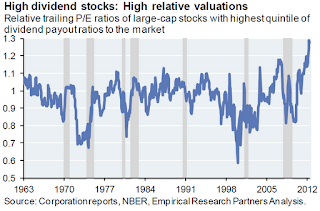
Investors are paying up for yield. The chart indicates that PEs for blue chip dividend payers are at 50 year highs.
The driver of this behavior is 'financial repression,' the term being assigned to the zero interest rate policies (ZIRP) by central banks world wide. Before the current state of financial repression, investors in need of income had various fixed income alternatives to choose from that provided a stream of cash at low or moderate risk.
In the face of ZIRP, those fixed income instruments have been bid thru the roof, driving down their effective yields. As such, income-starved investors have been pouring into dividend paying stocks to get income. Sectors that typically pay high dividends such as utilities, health care, and consumer staples have been hitting new price highs for months.
I must confess that I have been partial to some dividend paying stocks myself, but have been trimming my exposure in these names into the recent buying euphoria. It's becoming increasing hard for me to hold 'em in the current environment...
Future historians will surely highlight this ZIRP period as a textbook case of central planning gone wrong. By suppressing interest rates below market, central bankers are forcing capital into investment choices with risk/reward profiles that have altogether been distorted. In the case of dividend paying stocks, investors are paying ever higher prices for ever smaller streams of cash--a recipe for disaster for instruments that have relatively uncertain cash streams and principals.
What central planners really seem to be planning is an epic capital wipeout.
position in SPX
Don't dream it's over
Hey now, hey now
When the world comes in
--Crowded House
Drawn from this missive, the chart below indicates the premium being paid for 'blue chip' dividend paying equities. Blue chip in this case means those companies with high payout ratios, implying that the dividends are relatively safe.

Investors are paying up for yield. The chart indicates that PEs for blue chip dividend payers are at 50 year highs.
The driver of this behavior is 'financial repression,' the term being assigned to the zero interest rate policies (ZIRP) by central banks world wide. Before the current state of financial repression, investors in need of income had various fixed income alternatives to choose from that provided a stream of cash at low or moderate risk.
In the face of ZIRP, those fixed income instruments have been bid thru the roof, driving down their effective yields. As such, income-starved investors have been pouring into dividend paying stocks to get income. Sectors that typically pay high dividends such as utilities, health care, and consumer staples have been hitting new price highs for months.
I must confess that I have been partial to some dividend paying stocks myself, but have been trimming my exposure in these names into the recent buying euphoria. It's becoming increasing hard for me to hold 'em in the current environment...
Future historians will surely highlight this ZIRP period as a textbook case of central planning gone wrong. By suppressing interest rates below market, central bankers are forcing capital into investment choices with risk/reward profiles that have altogether been distorted. In the case of dividend paying stocks, investors are paying ever higher prices for ever smaller streams of cash--a recipe for disaster for instruments that have relatively uncertain cash streams and principals.
What central planners really seem to be planning is an epic capital wipeout.
position in SPX
Promises, Promises
Second time around, I'm still believing
The words that you said
You said you'd always be here
--Naked Eyes
After last week's dovish central banker chatter, the FOMC and ECB meetings have come and gone with no movement toward easier policy. Thus far, domestic stocks have largely shrugged off the lack of CB action.
This suggests that there's an awful lot of hope out there. Of course, hope springs eternal for addicts. The next fix is always just around the corner.
Hard not to wonder what happens if/when this hope leaves the tape.
position in SPX
The words that you said
You said you'd always be here
--Naked Eyes
After last week's dovish central banker chatter, the FOMC and ECB meetings have come and gone with no movement toward easier policy. Thus far, domestic stocks have largely shrugged off the lack of CB action.
This suggests that there's an awful lot of hope out there. Of course, hope springs eternal for addicts. The next fix is always just around the corner.
Hard not to wonder what happens if/when this hope leaves the tape.
position in SPX
Wednesday, August 1, 2012
Government Debt Markets as Slave Markets
Colonel Robert Gould Shaw: It stinks, I suppose.
Trip: Yeah, it stinks bad. And we all covered up in it too. Ain't nobody clean. Be nice to get clean, though.
--Glory
Bond buyers exchange an amount of capital today for the borrowers' promise to pay back principal and interest in the future. Essentially, the borrower is obligated to work for the lender in the sense that a portion of future production, to the extent that it is valuable, legally must go to the lender to settle the debt.
In the private sector this exchange is voluntary, meaning that the lender does not force the borrower into the arrangement of servitude. When buying corporate bonds, for example, creditors do not hold guns to the heads of companies and say, "we order you to sell us your bonds and work for us." Corporations voluntarily enter into this arrangement. Stakeholders in corporations, such as shareholders, employees, customers, and suppliers, who do not like the terms of a debt arrangement are free to walk away.
The same is true of individuals who borrow to fund, say, a house. Servitude is entered into voluntarily.
It is different, however, in the realm of government debt.
Government debt can only be repaid on the backs of the citizenry. When buying government bonds, creditors are relying on government force to coerce citizens into working for the creditor. Taxpayers who do not like the terms of a government debt deal are not free to walk away. Instead, they are forced into the arrangement with guns pointed at their heads.
Because the exchange is not voluntary, are not government bond buyers essentially contracting with strong armed government agents to force people into conditions of servitude? Is not the market for government debt a market for slavery?
no positions
Trip: Yeah, it stinks bad. And we all covered up in it too. Ain't nobody clean. Be nice to get clean, though.
--Glory
Bond buyers exchange an amount of capital today for the borrowers' promise to pay back principal and interest in the future. Essentially, the borrower is obligated to work for the lender in the sense that a portion of future production, to the extent that it is valuable, legally must go to the lender to settle the debt.
In the private sector this exchange is voluntary, meaning that the lender does not force the borrower into the arrangement of servitude. When buying corporate bonds, for example, creditors do not hold guns to the heads of companies and say, "we order you to sell us your bonds and work for us." Corporations voluntarily enter into this arrangement. Stakeholders in corporations, such as shareholders, employees, customers, and suppliers, who do not like the terms of a debt arrangement are free to walk away.
The same is true of individuals who borrow to fund, say, a house. Servitude is entered into voluntarily.
It is different, however, in the realm of government debt.
Government debt can only be repaid on the backs of the citizenry. When buying government bonds, creditors are relying on government force to coerce citizens into working for the creditor. Taxpayers who do not like the terms of a government debt deal are not free to walk away. Instead, they are forced into the arrangement with guns pointed at their heads.
Because the exchange is not voluntary, are not government bond buyers essentially contracting with strong armed government agents to force people into conditions of servitude? Is not the market for government debt a market for slavery?
no positions
Subscribe to:
Posts (Atom)
![[Most Recent Quotes from www.kitco.com]](https://lh3.googleusercontent.com/blogger_img_proxy/AEn0k_tnKxLozlrgKBT6yEAFwVF2ZsHA28-B26DXcoulS_QnPWnhlaxYWeoYBlv4t_53V49lLFJssusvr68IE9-K3qz6Bew4uPtLop_aT2mqBvRw6sDULYH0vJnP8pCPJ_LbbRIu_A=s0-d)