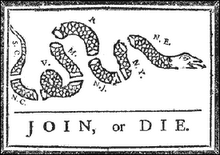
"Like everyone else you were born into bondage. Into a prison that you cannot taste or see or touch. A prison for your mind."
--Morpheus (The Matrix)
Previously, we examined Groseclose's (2011) political quotient (PQ) as the basic building block for measuring the degree of liberal bias in the media. Because it measures the extent to which the roll call votes of Congresspeople align with the agenda of the liberal interest group Americans for Democratic Action (ADA), the PQ cannot be directly determined for media outlets.
Groseclose needed a way to link the bias exhibited by politicians to the bias exhibited by media outlets. He did so by using citations to think tanks. To give their positions more legitimacy and credibility, politicians embed think tank citations when giving speeches. Journalists have the same need for legitimacy and credibility, so they embed think tank citations in their stories.
Think tanks are a useful data source because they span the politican spectrum from far Left to far Right. And because politicians as well as journalists are likely to support their points of view with 'authoritative' sources that espouse similar views (courtesy of confirmation bias/selective reasoning), it is likely that those on the Left will prefer citing Leftist think tanks and those on the Right will prefer citing Rightist think tanks (although that is not a direct hypothesis put forth by Groseclose & Milyo 2005).
Groseclose and Milyo's (2005) analytical method basically proceeded as follows. First, scan the Congressional record over a period of time for instances where members of Congress cited a prominent think tank or policy groups (using an authoritative source, the researchers had established a list of about 200 such organizations). Next, record the PQ of that member of Congress.
The stories of media outlets over a similar period of time were also scanned in search of citations to the same list of think tanks.
In Table 1 of their paper, Groseclose and Milyo (2005) list the 50 most cited think tanks by media outlets, along with the average PQ of Congresspeople who cited the same think tank and the number of times those Congresspeople cited the source was cited. When scanning the list, one takeaway is that the average PQ of Congressional citations matches conventional wisdom about the ideological positions of various think tanks. For example, thinks tanks broadly considered to lean 'conservative' (e.g., Heritage Foundation, Christian Coalition, National Right to Life Foundation) were associated with low PQs, while think tanks broadly considered to lean 'liberal' (e.g., NAACP, Sierra Club, Common Cause) were associated with high PQs.
It is also worth noting that among the top ten think tanks cited by the media, four of them were assoicated with PQs above 60 while only one was associated with a PQ below 40. I calculate the average PQ associated w/ the top ten cited sources to be 55.8. In other words, the most popular think tank sources used by media outlets lean Left.
Another preliminary indicator of media bias comes by comparing the PQs of the top ten media-cited think tanks with the top ten Congress-cited think tanks. Four of the top ten think tanks cited had a PQ less than 40, and the average PQ of the top 10 sources by Congress was by my calcs 47.3 (altho also by my calcs the difference between the two means was not significant using a simple two-sided t-test (p=.22)). The findings suggest that the media is more liberal than Congress, although the differences captured by this rudimentary analysis are not conclusive.
It is after this rudimentary phase that the two PhDs earn their pay. To conduct a more thorough, generalizable analysis, Groseclose and Milyo (2005) essentially use a series of regression models to estimate the degree of liberal bias in the media. The methods are beyond our scope here, but the basic thought process is: "I know that there is a significant relationship between a Congressperson's PQ and the extent to which that person cites various think tanks. So if I have data on the extent to which a particular media outlet cites various think tanks, then I should be able to estimate a PQ for that media source."
Groseclose (2011) calls this estimate the Slant Quotient (SQ). The higher the SQ, the more liberal the media outlet. An SQ of zero means that a media outlet sounds about as conservative as a speech by Michelle Bachman. An SQ of 100 means that the outlet sounds about as liberal as a speech by Nancy Pelosi. An SQ of 50 means that the outlet is perfectly centrist, displaying the same level of liberal bias as the typical American voter.
Here are SQs of variou media outlets. We'll discuss more in the future, but it should be apparent from a cursory scan of the data the media is biased Left, and significantly so.
References
Groseclose, T. 2011. Left turn: How liberal media bias distorts the American mind. New York: St Martin's Press.
Groseclose, T. & Milyo, J. 2005. A measure of media bias. Quarterly Journal of Economics, 120(4): 1191-1237.
Wednesday, November 16, 2011

Tuesday, November 15, 2011
Right Triangle
But somehow I can't believe
That anything should happen
I know where I belong
And nothing's gonna happen
--Tal Bachman
The eyes of many traders are glued to the 'flag' or pennant' pattern forming in the SPX. Among the traders that I follow, it seems that most anticipate an upside resolution to the pattern.
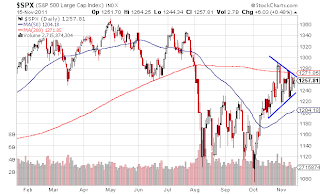
Classic technical analysis says that chance favors resolution the direction of the previously prevailing trend. Yes, we've rallied off the early October lows, suggesting that the prevailing trend is up.
A counter view is that we've been experiencing only a bear market rally since October. A broader time horizon suggests a series of 'lower highs' since spring--in which case the primary trend could be interpreted as down.
In any event, we should get an answer pretty soon...
position in SPX
That anything should happen
I know where I belong
And nothing's gonna happen
--Tal Bachman
The eyes of many traders are glued to the 'flag' or pennant' pattern forming in the SPX. Among the traders that I follow, it seems that most anticipate an upside resolution to the pattern.

Classic technical analysis says that chance favors resolution the direction of the previously prevailing trend. Yes, we've rallied off the early October lows, suggesting that the prevailing trend is up.
A counter view is that we've been experiencing only a bear market rally since October. A broader time horizon suggests a series of 'lower highs' since spring--in which case the primary trend could be interpreted as down.
In any event, we should get an answer pretty soon...
position in SPX
Insider Trading in DC
"Ah, Mr Gekko, that's not what I do. I could lose my license. If the SEC found out, I could go to jail. It's inside information, isn't it?"
--Bud Fox (Wall Street)
As pathetic as 60 Minutes is at 'investigative journalism,' once in a while the show does good work. Such is the case with last Sunday's segment on insider trading in Washington.
Essentially, there is no law prohibiting federally elected officials from trading on information that they are privy to in their government jobs. In the private sphere, of course, those who trade using non-public information are subject to prosecution in Gekko-like fashion.
A current high profile example involves the former head of hedge fund Galleon Group Raj Rajaratnam, who was sentenced to 11 years in prison and ordered to pay over $150 million in fines after being convicted of insider trading.
Ironcially, if Mr Rajaratnam had made the same trades as a member of the US Congress, no criminal proceedings would have been no criminal proceedings at all.
In a bipartisan effort, 60 Minutes staff cornered both current House Speaker Boehner and former House Speaker Pelosi on their trading behavior. There are many more where those came from.
It should also be noted that, although 60 Minutes deserves a shout out for bringing this issue to the masses, the good folks at Minyanville were on the case here months ago.
When a mainstream outlet like 60 Minutes finally decides to pursue a story like this, one has to wonder whether the time is ripe for reversing the Double Standard that Washington enjoys.
--Bud Fox (Wall Street)
As pathetic as 60 Minutes is at 'investigative journalism,' once in a while the show does good work. Such is the case with last Sunday's segment on insider trading in Washington.
Essentially, there is no law prohibiting federally elected officials from trading on information that they are privy to in their government jobs. In the private sphere, of course, those who trade using non-public information are subject to prosecution in Gekko-like fashion.
A current high profile example involves the former head of hedge fund Galleon Group Raj Rajaratnam, who was sentenced to 11 years in prison and ordered to pay over $150 million in fines after being convicted of insider trading.
Ironcially, if Mr Rajaratnam had made the same trades as a member of the US Congress, no criminal proceedings would have been no criminal proceedings at all.
In a bipartisan effort, 60 Minutes staff cornered both current House Speaker Boehner and former House Speaker Pelosi on their trading behavior. There are many more where those came from.
It should also be noted that, although 60 Minutes deserves a shout out for bringing this issue to the masses, the good folks at Minyanville were on the case here months ago.
When a mainstream outlet like 60 Minutes finally decides to pursue a story like this, one has to wonder whether the time is ripe for reversing the Double Standard that Washington enjoys.
Monday, November 14, 2011
Income Mobility
Out in the woods
Or in the city
It's all the same to me
When I'm driving free
The world's my home
When I'm mobile
--The Who
Nice little missive warning against concluding much about 'income inequality' from distribution of income studies like the one recently issued by CBO.
An important limitation of income distribution studies is that they group earners by category. For example, earners are often filed into one of five categories, top 20%, next 20%,..., bottom 20%. Thus, when CBO reports change in income for the top 20% compared to change in income for the bottom 20% over a given period, it is tempting to conclude that individual incomes in each group changed, on average, by that amount.
Such an approach is prone to faulty conclusions because it ignores the influence of income mobility. Income mobility measures the extent to which individuals move between categorical brackets.
Citing findings from a recent income mobility study by Treasury, the author demonstrates that many individuals tracked over periods of time move in directions opposite those suggested by the static distribution of income studies. In the Treasury study, for example, incomes of those in the top one and five percent in 1996 were actually lower in 2005, while those in the bottom 20% in 1996 saw their incomes increase on average by 91% in 2005.
Static income distribution studies miss the dynamic effects of income mobility as the situations of individuals change over time.
Or in the city
It's all the same to me
When I'm driving free
The world's my home
When I'm mobile
--The Who
Nice little missive warning against concluding much about 'income inequality' from distribution of income studies like the one recently issued by CBO.
An important limitation of income distribution studies is that they group earners by category. For example, earners are often filed into one of five categories, top 20%, next 20%,..., bottom 20%. Thus, when CBO reports change in income for the top 20% compared to change in income for the bottom 20% over a given period, it is tempting to conclude that individual incomes in each group changed, on average, by that amount.
Such an approach is prone to faulty conclusions because it ignores the influence of income mobility. Income mobility measures the extent to which individuals move between categorical brackets.
Citing findings from a recent income mobility study by Treasury, the author demonstrates that many individuals tracked over periods of time move in directions opposite those suggested by the static distribution of income studies. In the Treasury study, for example, incomes of those in the top one and five percent in 1996 were actually lower in 2005, while those in the bottom 20% in 1996 saw their incomes increase on average by 91% in 2005.
Static income distribution studies miss the dynamic effects of income mobility as the situations of individuals change over time.
Sunday, November 13, 2011
The Parable of the Talents
"A king may move a man. A father may claim a son. But remember that, even when those who move you be kings or men of power, your soul is in your keeping alone. When you stand before God you cannot say 'but I was told by others to do thus' or that 'virtue was not convenient at the time.' This will not suffice. Remember that."
--King Baldwin IV (Kingdom of Heaven)
In the cycle of scripture readings constituting Ordinary Time in the Catholic church, today's gospel came from Matthew 25. The passage is often called 'The Parable of Talents.'
Before leaving on a trip, a master trusts portions of his wealth, measured in 'talents,' to three servants. He gives 5 talents to one servant, 2 talents to a another, and 1 talent to a third.
While the master is away, the servant with 5 talents invests them and makes 5 more. The servant with 2 talents also doubles his money.
The servant with 1 talent, however, does nothing with his small trust. Instead, he buries it in the ground.
Upon return from his trip, the master congratulates the two servants who had wisely invested their talents, and tells the pair that, because they have done well with 'small matters,' they will be entrusted with more opportunities in the future.
To the third servant, the one who did nothing with his talent, the master has no kind words to say. He berates the servant for taking no risk at all. At the very least, the master notes, the talent could have been put in the bank where it could have earned at least a small, low risk return.
The servant is then shown the door.
This story resonates with me more than any other passage in the Bible. From where I sit, the lessons are many:
1) Our Creator bestows 'talents' with each of us.
2) For reasons unexplained, the distribution of talent is uneven. Some are given more talents than others.
3) Regardless of the level of endowment, each of us is expected to employ the talents that we are given to the best of our ability.
4) If we do so in small matters (here on earth), then we will be rewarded in large matters (the afterlife).
5) Those who squander their talents on earthly matters will not be rewarded in the hereafter.
The most interesting twist in the story to me is that the servant endowed with the least number of talents is the one that gets hammered by the master. In the spirit of 'social justice,' one would think that the master would pick on the most richly endowed servant for not doing more, and cut the lesser endowed servants some slack.
The message seems to be that, even if our talent endowment is meager, the Creator expects that we do our best with it. No quarter will be given to those who squander their talents, however modest those talents may be.
--King Baldwin IV (Kingdom of Heaven)
In the cycle of scripture readings constituting Ordinary Time in the Catholic church, today's gospel came from Matthew 25. The passage is often called 'The Parable of Talents.'
Before leaving on a trip, a master trusts portions of his wealth, measured in 'talents,' to three servants. He gives 5 talents to one servant, 2 talents to a another, and 1 talent to a third.
While the master is away, the servant with 5 talents invests them and makes 5 more. The servant with 2 talents also doubles his money.
The servant with 1 talent, however, does nothing with his small trust. Instead, he buries it in the ground.
Upon return from his trip, the master congratulates the two servants who had wisely invested their talents, and tells the pair that, because they have done well with 'small matters,' they will be entrusted with more opportunities in the future.
To the third servant, the one who did nothing with his talent, the master has no kind words to say. He berates the servant for taking no risk at all. At the very least, the master notes, the talent could have been put in the bank where it could have earned at least a small, low risk return.
The servant is then shown the door.
This story resonates with me more than any other passage in the Bible. From where I sit, the lessons are many:
1) Our Creator bestows 'talents' with each of us.
2) For reasons unexplained, the distribution of talent is uneven. Some are given more talents than others.
3) Regardless of the level of endowment, each of us is expected to employ the talents that we are given to the best of our ability.
4) If we do so in small matters (here on earth), then we will be rewarded in large matters (the afterlife).
5) Those who squander their talents on earthly matters will not be rewarded in the hereafter.
The most interesting twist in the story to me is that the servant endowed with the least number of talents is the one that gets hammered by the master. In the spirit of 'social justice,' one would think that the master would pick on the most richly endowed servant for not doing more, and cut the lesser endowed servants some slack.
The message seems to be that, even if our talent endowment is meager, the Creator expects that we do our best with it. No quarter will be given to those who squander their talents, however modest those talents may be.
Friday, November 11, 2011
Eternal Law, Natural Law, and Natural Rights
Benjamin Martin: May I sit with you?
Charlotte Selton: It's a free country, or at least it will be.
--The Patriot
Laws that govern the functioning of the universe can be thought of as Eternal Law. Scientific rules of physics, chemistry, biology, et al govern eternal law. These rules are self-evident--whether or not we understand or misunderstand their workings. The truthfulness of Eternal Law requires no explanation or proof in order for it to exist.
Human command cannot alter Eternal Law. As stated by Sir Thomas More's character in Robert Bolt's play A Man for All Seasons, "Some men think the Earth round, others think it flat...But if it is flat, will the King's command make it round? And if it is round, will the King's command flatten it?"
Natural Law governs human behavior in the context of Eternal Law. People have yearnings which they seek to fulfill. In the natural state of the world, people are in possession of reason and free will that can be employed in pursuit of desired ends.
Natural Law is flouted when one individual or group interferes with the pursuits of another individual. For example, confiscation of property is wrong in the context of Natural Law because it impairs human endeavors that produce things and/or trade for other things to enrich life.
When government interferes with the natural order of things, even if the beneficiaries of that intervention constitute the majority, someone will always pay the price of having his/her human nature transgressed upon.
Stated differently, government intervention is certain to violate the freedom of at least one individual.
The rules of social interaction necessary to allow individuals to pursue their inclinations are known as Natural Rights. Natural Rights are not granted by the government. As Jefferson famously observed, these rights are unalienable, and include the rights to life, liberty, and the pursuit of happiness. These rights are granted to us by our humanity, not by government.
Natural Rights are grounded in the principle of nonaggression. We are free to choose and pursue our interests, but only to the extent that our actions do not infringe upon the freedom of others.
Natural Rights can be expressed in various forms: speech, religion, assembly, association, self-defense, etc. However, all of these freedoms are extensions of one central right: the right to own property. Property begins with one's own body, and extends to our freedom to use it in pursuit of our interests and to enjoying the fruits of our pursuits.
As sagely noted by Rothbard (1982), an individual does not have a 'right to freedom of speech.' Instead, the person has the right to rent an assembly hall and speak to those who enter and listen, or to publish a pamphlet and distribute it to those willing to read it. What the individual has is property rights, including the right of free contract and the right to trade--be that trade in goods or ideas.
An important implication is that those who refuse to recognize some aspect of property rights are essentially denying the validity of all Natural Rights. It is inconsistent, for example, to claim a right to free speech while disparaging the right to tangible property.
Of course, such inconsistency is constantly on display among politicians and their special interest groups.
Reference
Rothbard, M.N. 1982. The ethics of liberty. Atlantic Highlands, NJ: Humanities Press.
Charlotte Selton: It's a free country, or at least it will be.
--The Patriot
Laws that govern the functioning of the universe can be thought of as Eternal Law. Scientific rules of physics, chemistry, biology, et al govern eternal law. These rules are self-evident--whether or not we understand or misunderstand their workings. The truthfulness of Eternal Law requires no explanation or proof in order for it to exist.
Human command cannot alter Eternal Law. As stated by Sir Thomas More's character in Robert Bolt's play A Man for All Seasons, "Some men think the Earth round, others think it flat...But if it is flat, will the King's command make it round? And if it is round, will the King's command flatten it?"
Natural Law governs human behavior in the context of Eternal Law. People have yearnings which they seek to fulfill. In the natural state of the world, people are in possession of reason and free will that can be employed in pursuit of desired ends.
Natural Law is flouted when one individual or group interferes with the pursuits of another individual. For example, confiscation of property is wrong in the context of Natural Law because it impairs human endeavors that produce things and/or trade for other things to enrich life.
When government interferes with the natural order of things, even if the beneficiaries of that intervention constitute the majority, someone will always pay the price of having his/her human nature transgressed upon.
Stated differently, government intervention is certain to violate the freedom of at least one individual.
The rules of social interaction necessary to allow individuals to pursue their inclinations are known as Natural Rights. Natural Rights are not granted by the government. As Jefferson famously observed, these rights are unalienable, and include the rights to life, liberty, and the pursuit of happiness. These rights are granted to us by our humanity, not by government.
Natural Rights are grounded in the principle of nonaggression. We are free to choose and pursue our interests, but only to the extent that our actions do not infringe upon the freedom of others.
Natural Rights can be expressed in various forms: speech, religion, assembly, association, self-defense, etc. However, all of these freedoms are extensions of one central right: the right to own property. Property begins with one's own body, and extends to our freedom to use it in pursuit of our interests and to enjoying the fruits of our pursuits.
As sagely noted by Rothbard (1982), an individual does not have a 'right to freedom of speech.' Instead, the person has the right to rent an assembly hall and speak to those who enter and listen, or to publish a pamphlet and distribute it to those willing to read it. What the individual has is property rights, including the right of free contract and the right to trade--be that trade in goods or ideas.
An important implication is that those who refuse to recognize some aspect of property rights are essentially denying the validity of all Natural Rights. It is inconsistent, for example, to claim a right to free speech while disparaging the right to tangible property.
Of course, such inconsistency is constantly on display among politicians and their special interest groups.
Reference
Rothbard, M.N. 1982. The ethics of liberty. Atlantic Highlands, NJ: Humanities Press.
Thursday, November 10, 2011
Escape Route
Forty seven dead beats living in the back street
North, east, west, south--all in the same house
Sitting in the back room waiting for the big boom
I'm in a bedroom waiting for my baby
--Escape Club
The more I ponder the global macro situation, with particular attention on Europe, the more I feel the urge to move more dollars out of the banking system. As my buddy Fil observes, if people begin lining up to take their money out of European banks, then it will be game in a matter of days.
At that point, depositors either a) lose their wealth in a deflationary bank collapse, or b) lose their wealth in a hyperinflationary confettifest of money printing to return nominal balances to depositors.
Either way, wealth gets destroyed.
That's Europe...not our problem, you say. Perhaps. But the world is an interwoven one. There is more than one row of dominos that links the European finanical system to the US. Moreover, it is easy to visualize a fraction of US citizens edging their way toward the exits of domestic banks should a full fledged European banking crisis be plastered across CNN.
In a banking system leveraged 10:1 or more, it would not take much loss of confidence to render the system insolvent.
In any event, I've been buying more precious metal recently. Today I bought my first physical silver in more than three years.
position in gold, silver
North, east, west, south--all in the same house
Sitting in the back room waiting for the big boom
I'm in a bedroom waiting for my baby
--Escape Club
The more I ponder the global macro situation, with particular attention on Europe, the more I feel the urge to move more dollars out of the banking system. As my buddy Fil observes, if people begin lining up to take their money out of European banks, then it will be game in a matter of days.
At that point, depositors either a) lose their wealth in a deflationary bank collapse, or b) lose their wealth in a hyperinflationary confettifest of money printing to return nominal balances to depositors.
Either way, wealth gets destroyed.
That's Europe...not our problem, you say. Perhaps. But the world is an interwoven one. There is more than one row of dominos that links the European finanical system to the US. Moreover, it is easy to visualize a fraction of US citizens edging their way toward the exits of domestic banks should a full fledged European banking crisis be plastered across CNN.
In a banking system leveraged 10:1 or more, it would not take much loss of confidence to render the system insolvent.
In any event, I've been buying more precious metal recently. Today I bought my first physical silver in more than three years.
position in gold, silver
Wednesday, November 9, 2011
Italy on the Margin
Lunatic fringe
I know you're out there
You're in hiding
And you hold your meetings
--Red Rider
Turmoil is increasing in Italy. Yesterday a major London clearing house raise margin requirements on Italian sovereign debt, sparking a wave of bond selling. Longer dated Italian sovereign debt is marking new lows this am. Commensurately, Italian swap spreads are blowing out.
Italy PM Berlusconi is rumored to be stepping down soon. My buddy Fil shares some thoughts on the consequences.
Markets around the world are listening to some chin music as a result. Stateside markets have opened down a coupla percent.
position in SPX
I know you're out there
You're in hiding
And you hold your meetings
--Red Rider
Turmoil is increasing in Italy. Yesterday a major London clearing house raise margin requirements on Italian sovereign debt, sparking a wave of bond selling. Longer dated Italian sovereign debt is marking new lows this am. Commensurately, Italian swap spreads are blowing out.
Italy PM Berlusconi is rumored to be stepping down soon. My buddy Fil shares some thoughts on the consequences.
Markets around the world are listening to some chin music as a result. Stateside markets have opened down a coupla percent.
position in SPX
Tuesday, November 8, 2011
Collective Bargaining is not a Right
"Let me explain something to ya, sonny boy. Nothin' moves off these docks without it don't get loaded by the union. I don't see no union people around here. Do you?"
--Tony Two Toes (Eraser)
Perhaps the biggest issue on the ballot in Ohio today is Issue 2. Issue 2 is a referendum on Ohio Senate Bill 5, a bill signed into law earlier this year. Similar to a law passed in Wisconsin last year, SB5 is mired in controversy because it seeks to cuts costs related to workers on the state payroll.
Naturally, people linked to public worker special interest groups do not like SB5. Deep union pockets have spent millions on propaganda ahead of the election. Similar to protests over the Wisconsin law, a primary argument against SB5 is that it takes away worker 'rights' to collective bargaining.
But no person or group possesses a de facto right to bargain collectively. In fact, no person or group possesses a right to bargain at all. Bargaining is a negotiation between entities. This negotiation is voluntary. If one side of the table chooses not to bargain with the other side, then there is nothing that the other side can do to force negotiation.
But that is precisely what public worker unions would like to do. They want to keep the law bent in their favor to force the union's position to the table. They would like to write the law so that the other side of the table, the taxpayer, has no choice but to bargain with the union.
Indeed, the 'right' that is being violated under the arrangement that the unions favor is called freedom of association. Freedom of association means that you or I have the freedom to decide what friends I keep, what groups I belong to, and who I choose to do business with.
Freedom of association is a right that is borne from our humanity. It is not granted to us by government. It is protected by the Fourth Amendment, which secures individuals against unlawful seizure.
Once again, the Left has twisted around the issue. What they claim is a 'right to bargain' issue for public sector workers is really a 'right to associate' issue for the taxpayer. Any law that mandates a 'closed shop' strips taxpayers of their freedom to negotiate with any party they choose, and to choose to walk away if desired.
--Tony Two Toes (Eraser)
Perhaps the biggest issue on the ballot in Ohio today is Issue 2. Issue 2 is a referendum on Ohio Senate Bill 5, a bill signed into law earlier this year. Similar to a law passed in Wisconsin last year, SB5 is mired in controversy because it seeks to cuts costs related to workers on the state payroll.
Naturally, people linked to public worker special interest groups do not like SB5. Deep union pockets have spent millions on propaganda ahead of the election. Similar to protests over the Wisconsin law, a primary argument against SB5 is that it takes away worker 'rights' to collective bargaining.
But no person or group possesses a de facto right to bargain collectively. In fact, no person or group possesses a right to bargain at all. Bargaining is a negotiation between entities. This negotiation is voluntary. If one side of the table chooses not to bargain with the other side, then there is nothing that the other side can do to force negotiation.
But that is precisely what public worker unions would like to do. They want to keep the law bent in their favor to force the union's position to the table. They would like to write the law so that the other side of the table, the taxpayer, has no choice but to bargain with the union.
Indeed, the 'right' that is being violated under the arrangement that the unions favor is called freedom of association. Freedom of association means that you or I have the freedom to decide what friends I keep, what groups I belong to, and who I choose to do business with.
Freedom of association is a right that is borne from our humanity. It is not granted to us by government. It is protected by the Fourth Amendment, which secures individuals against unlawful seizure.
Once again, the Left has twisted around the issue. What they claim is a 'right to bargain' issue for public sector workers is really a 'right to associate' issue for the taxpayer. Any law that mandates a 'closed shop' strips taxpayers of their freedom to negotiate with any party they choose, and to choose to walk away if desired.
Silver Cup
Cromwell: I have evidence that Sir Thomas, when he was a judge, accepted bribes.
Duke of Norfolk: What? Goddammit, he was the only judge since Cato who didn't accept bribes! When was there last a Chancellor whose possessions after three years in office totaled one hundered pounds and a gold chain?
--A Man for All Seasons
Silver appears to be tracing out a cup and handle-ish pattern. Added to my SLV position this am and may add a bit more around here.

Should SLV start to 'fill the gap' precipitated by the mid Sept meltdown, then a trade 'works' to 38ish.
position in SLV
Duke of Norfolk: What? Goddammit, he was the only judge since Cato who didn't accept bribes! When was there last a Chancellor whose possessions after three years in office totaled one hundered pounds and a gold chain?
--A Man for All Seasons
Silver appears to be tracing out a cup and handle-ish pattern. Added to my SLV position this am and may add a bit more around here.

Should SLV start to 'fill the gap' precipitated by the mid Sept meltdown, then a trade 'works' to 38ish.
position in SLV
Subscribe to:
Posts (Atom)
![[Most Recent Quotes from www.kitco.com]](https://lh3.googleusercontent.com/blogger_img_proxy/AEn0k_vHQlHeVJKgGyWKR6WMcBpJ1A8KFz7lQUn_tFgG_tRydAdgs4Rtybrlp3cgraKUvigsOFgiuSIZLeA7MCqVz6Z0atabfSvLjpZFzocSUpIRNg2y7R34SkdkKpazTh7eAcMdgA=s0-d)