Remember when the days were long
And rolled beneath a deep blue sky
--Don Henley
Ten years.
I was down in the basement, finishing up my morning workout. Nokia (NOK) had shared some positive pre-market news and futes were up big. I happened to be long calls in various names including NOK, and was thinking that I might ring the register on some trades later that morning.
About 8:45ish the radio station broke in with news that a 'small plane' had hit one of the World Trade Center towers. An eyewitness in a building across from the north tower had not seen the plane hit but was describing the post-crash situation. Smoke, fire, office paper fluttering everywhere. Judging by the wingspan of the gaping hole in the side of the building, he opined, the plane that hit the building was larger than a Cessna.
"Oh my God!" he suddenly screamed. Another plane had hit the WTC complex--this time the south tower.
I remember that eyewitness's account as if it were my own. And as he let out his screams of terror, my world permanently changed.
Prior to that day I lived my life pretty much oblivious to the political arena. Yes, my interest in markets had me learning a bit of geopolitics, and tuning into the coverage of the previous year's election deadlock hinted that I was largely clueless about civics. By and large, however, I was happy to leave political issues to others.
After watching the towers come down while standing in my living room, it began to hit me just how ignorant I was. I had never heard of Osama Bin Laden. But clearly there were those in the world willing to die while killing US citizens. My martial arts training had taught me to detect possible threats. But this type of threat had not been on my radar.
By the afternoon, nationwide air traffic had been shutdown and F-18s were patrolling the cobalt blue skies above our heads. Coping with this kind of threat found government officials acting to suspend various liberties in the name of national security.
My most cogent thought that afternoon was that we as a country would never be as free as we were before 9/11. In order to be safe, we would have to give up some freedom.
But is this a worthy trade? I wondered.
I didn't know much about the Constitution at the time (I had never read it), but it seemed that foregoing liberty, the primary principle upon which the United States was founded, was not something we should consent to lightly. After all, to stop more threats similar to what brought down the Towers would require a police state.
Surely those who founded this country had noodled over what took thousands of deaths in NYC, DC, and the Pennsylvania countryside for me to realize: that there is a fundamental tradeoff between safety and freedom.
What did the founders have to say on the subject? I didn't know but I aimed to find out.
Thus began my self-study of free society that persists to this day. On this 10th anniversary of the Day My World Changed, the best thing I can do to honor those who perished that day is to continue pursuit of the truth wherever it leads.
position in SPX
Sunday, September 11, 2011

Friday, September 9, 2011
Greece Fire
Lunatic fringe
I know you're out there
You're in hiding
And you hold your meetings
--Red Rider
Domestic stocks down almost 3% today on chatter that Greece may default as early as this weekend. Germany is said to be readying plans to help banks if Greece does in fact default.
Euro banks stocks were pounded for another 7% plus today with SocGen of France down 11%.

For the SPX, the August double bottom of 1120 is coming into clearer view...
You can bet that many market participants will be monitoring news flow out of Europe this wkend.
position in SPX
I know you're out there
You're in hiding
And you hold your meetings
--Red Rider
Domestic stocks down almost 3% today on chatter that Greece may default as early as this weekend. Germany is said to be readying plans to help banks if Greece does in fact default.
Euro banks stocks were pounded for another 7% plus today with SocGen of France down 11%.

For the SPX, the August double bottom of 1120 is coming into clearer view...
You can bet that many market participants will be monitoring news flow out of Europe this wkend.
position in SPX
How Weak Currency Initiatives Could Hammer Gold
There's a room where the light won't find you
Holding hands while
The walls come tumbling down
When they do, I'll be right behind you
--Tears for Fears
Fil Zucchi shares an interesting thesis that actions by central banks to weaken currencies could put downward pressure on the price of gold. This is counterintuitive because interventions to weaken a currency are typically viewed as bullish for gold.
Because there is building political pressure against weakening a currency via money printing, Fil posits that central banks might sell some of their gold reserves, and use the proceeds to buy foreign currencies (forex). Price of forex would rise, and domestic currency would weaken as per the objective.
I hadn't given this scenario much thought but I do think Fil has an interesting angle. Domestically, the Tea Party movement and other social awakenings seem to be sensitizing the public about the dangers of money printing by the Fed and other central banks. By selling gold to weaken the currency, central banks can achieve their goal in a politically expedient manner--i.e., they cannot be accused of pure money printing to manipulate currency cross rates.
Should such actions occur, it would almost certainly drive the price of gold lower. How much lower and for how long would be anybody's guess. What we do know is that central banks could not engage in this operation indefinitely as they would run out of gold to sell at some point.
Fil notes that, while the selling of gold by central banks would be bearish for gold price in the near term, it would likely set up a very bullish scenario for gold at some point. Once central banks deplete their gold, then the only way to continue currency debasement (which is the heart and soul of central banking) would be to crank up the printing presses full force. At that point, 'big inflation' would be en force; gold would be situated for a moonshot increase.
It would also constitute poetic justice of sorts, since gold will have left government hands and landed in the hands of the people--where it naturally belongs.
Like Fil, I'm currently out of 'paper' gold and silver, having sold the last of my trading position in SLV last week before ensuing price weakness (better lucky than smart). I do maintain exposure via my physical metals position--a position that I do not plan to sell.
Meanwhile, I'm going to watch gold price from the sidelines for a while, and look for evidence that Fil's thesis may be playing out.
position in gold, silver, USD
Holding hands while
The walls come tumbling down
When they do, I'll be right behind you
--Tears for Fears
Fil Zucchi shares an interesting thesis that actions by central banks to weaken currencies could put downward pressure on the price of gold. This is counterintuitive because interventions to weaken a currency are typically viewed as bullish for gold.
Because there is building political pressure against weakening a currency via money printing, Fil posits that central banks might sell some of their gold reserves, and use the proceeds to buy foreign currencies (forex). Price of forex would rise, and domestic currency would weaken as per the objective.
I hadn't given this scenario much thought but I do think Fil has an interesting angle. Domestically, the Tea Party movement and other social awakenings seem to be sensitizing the public about the dangers of money printing by the Fed and other central banks. By selling gold to weaken the currency, central banks can achieve their goal in a politically expedient manner--i.e., they cannot be accused of pure money printing to manipulate currency cross rates.
Should such actions occur, it would almost certainly drive the price of gold lower. How much lower and for how long would be anybody's guess. What we do know is that central banks could not engage in this operation indefinitely as they would run out of gold to sell at some point.
Fil notes that, while the selling of gold by central banks would be bearish for gold price in the near term, it would likely set up a very bullish scenario for gold at some point. Once central banks deplete their gold, then the only way to continue currency debasement (which is the heart and soul of central banking) would be to crank up the printing presses full force. At that point, 'big inflation' would be en force; gold would be situated for a moonshot increase.
It would also constitute poetic justice of sorts, since gold will have left government hands and landed in the hands of the people--where it naturally belongs.
Like Fil, I'm currently out of 'paper' gold and silver, having sold the last of my trading position in SLV last week before ensuing price weakness (better lucky than smart). I do maintain exposure via my physical metals position--a position that I do not plan to sell.
Meanwhile, I'm going to watch gold price from the sidelines for a while, and look for evidence that Fil's thesis may be playing out.
position in gold, silver, USD
Thursday, September 8, 2011
Yield Variation and the Fed
"Better get under cover, Sylvester. There's a storm blowin' up--a whopper, using the vernacular of the peasantry."
--Professor Marvel (The Wizard of Oz)
The chart below displays yields on the 10 year T-note over the past 200+ years.

If we were to calculate the standard deviation of interest rates for the first half of the series, and then do the same for the second half, which standard deviation would be higher?
Answer: the second half by a mile. Long bond rates have been significantly more volatile during the past 100 years than during the previous 100.
A key difference between the two periods is the presence of the Federal Reserve. The Fed came into being in 1913, and has been getting progressively more intrusive in markets since then.
Ironically, a primary justification for the Fed was that a central bank was needed to stabilize economies and markets that purportedly were too volatile in their free unregulated states.
The interest rate data above suggest just the opposite. The Fed's presence increases, rather than decreases, volatility in credit markets which, because of credit's centrality to economic activity, spills instability into the entire economic and financial system.
Stated differently, credit markets unhampered by central bank regulation are likely to be more stable, rather than less, stable. How can that not be a boon for economic activity?
no positions
--Professor Marvel (The Wizard of Oz)
The chart below displays yields on the 10 year T-note over the past 200+ years.
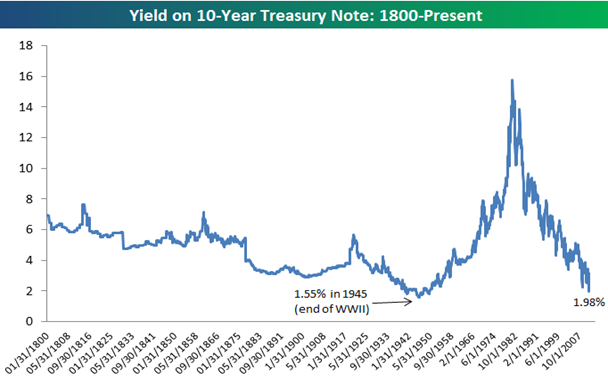
If we were to calculate the standard deviation of interest rates for the first half of the series, and then do the same for the second half, which standard deviation would be higher?
Answer: the second half by a mile. Long bond rates have been significantly more volatile during the past 100 years than during the previous 100.
A key difference between the two periods is the presence of the Federal Reserve. The Fed came into being in 1913, and has been getting progressively more intrusive in markets since then.
Ironically, a primary justification for the Fed was that a central bank was needed to stabilize economies and markets that purportedly were too volatile in their free unregulated states.
The interest rate data above suggest just the opposite. The Fed's presence increases, rather than decreases, volatility in credit markets which, because of credit's centrality to economic activity, spills instability into the entire economic and financial system.
Stated differently, credit markets unhampered by central bank regulation are likely to be more stable, rather than less, stable. How can that not be a boon for economic activity?
no positions
Wednesday, September 7, 2011
Nicely Put
When the walls come tumblin' down
When the walls come crumblin' crumblin'
--John Mellencamp
The last 5-6 paragraphs of John Hussman's weekly missive are must read material. Then they are re-read material...
Until policy making returns to market driven themes such as private savings and investment, and rejects themes grounded in Fed money printing and government stimulus, we have 'an economy built on speculation and paper, stacked into a flimsy house of cards.'
Very nicely put.
position in SPX
When the walls come crumblin' crumblin'
--John Mellencamp
The last 5-6 paragraphs of John Hussman's weekly missive are must read material. Then they are re-read material...
Until policy making returns to market driven themes such as private savings and investment, and rejects themes grounded in Fed money printing and government stimulus, we have 'an economy built on speculation and paper, stacked into a flimsy house of cards.'
Very nicely put.
position in SPX
Tuesday, September 6, 2011
Euro Bravado
Yeah, a storm is threatening
My very life today
If I don't get some shelter
Lord I'm gonna fade away
--Rolling Stones
After yesterday's carnage in Europe, domestic markets put on a brave face after gapping down 3%--grinding higher basically all day to close down 'only' 1% or less. Bulls have to consider this a victory, or at least a temporary reprieve.
I continue to sense that US markets are not adequately discounting the risk streaming from Europe. Today's action was a nice example of that.
My friend Fil Zucchi expresses the EU situation well here. Like him, I smell trouble in the air for the next couple of months.
Accordingly, I continue to add to downside exposure into price strength.
position in SPX
My very life today
If I don't get some shelter
Lord I'm gonna fade away
--Rolling Stones
After yesterday's carnage in Europe, domestic markets put on a brave face after gapping down 3%--grinding higher basically all day to close down 'only' 1% or less. Bulls have to consider this a victory, or at least a temporary reprieve.
I continue to sense that US markets are not adequately discounting the risk streaming from Europe. Today's action was a nice example of that.
My friend Fil Zucchi expresses the EU situation well here. Like him, I smell trouble in the air for the next couple of months.
Accordingly, I continue to add to downside exposure into price strength.
position in SPX
Monday, September 5, 2011
European Pregame
Your face appears again
I see the beauty there
But I see danger
Stranger beware
--Animotion
Markets not trading on Labor Day, but futes are 2% in the red in the early going, with some big US banks like Bank of America (BAC) off 5% in European trading.
In fact, it was pretty much a bloodbath across Europe today, with indexes on average down 4%. Some European banks were down about 2x that as hopes waned (again) of a EU sponsored bailout of Greece et al.

The all important DAX was clubbed for 5%. More importantly, perhaps, is that it gapped lower from August lows and never looked back. Past support is now resistance...
A date between US indexes and their August lows seems increasingly likely.

On the SPX, that equates to 1120ish.
position in SPX
I see the beauty there
But I see danger
Stranger beware
--Animotion
Markets not trading on Labor Day, but futes are 2% in the red in the early going, with some big US banks like Bank of America (BAC) off 5% in European trading.
In fact, it was pretty much a bloodbath across Europe today, with indexes on average down 4%. Some European banks were down about 2x that as hopes waned (again) of a EU sponsored bailout of Greece et al.

The all important DAX was clubbed for 5%. More importantly, perhaps, is that it gapped lower from August lows and never looked back. Past support is now resistance...
A date between US indexes and their August lows seems increasingly likely.

On the SPX, that equates to 1120ish.
position in SPX
Sunday, September 4, 2011
Off the Marx
Been away so long I hardly knew the place
Gee it's good to be back home
Leave it till tomorrow to unpack my case
Honey disconnect the phone
--The Beatles
Classic example of an argument that starts out with the wrong premise, thereby negating everything that follows. The author claims out of the gate that we are experiencing a 'once in a lifetime crisis of capitalism' without bothering to justify how our current system reflects capitalism.
Indeed, it is much easier to justify the opposite--that capitalism has been waning and that we are instead experiencing a crisis of socialism. Capitalism is private ownership and control of the means of production. At the oppositive end of the spectrum of economic organizing is socialism. Socialism is public (read: government) owership and control of the means of production.
The most straightforward means of justifying a claim of increasing socialism is simply to observe the gargantuan levels of trends of government spending. When governments spend, they take control of assets that were formerly privately owned. A purely capitalistic system would see only enough resources taken by government to support property rights. We passed that limit a long time ago.
Since the author cites Marx, it is also useful to examine Marx and Engel's 10 point plan for gradually overthrowing a capitalistic society. It is hard to argue that nearly every one of the items on the list have not been moving in the direction prescribed by Marx and Engels.
The author suggests that the world 'give Marx a chance' to save things. The world has been giving him a chance for at least the past 100 years. As Mises rightly observed, that chance has pushed the globe to the brink of chaos.
Gee it's good to be back home
Leave it till tomorrow to unpack my case
Honey disconnect the phone
--The Beatles
Classic example of an argument that starts out with the wrong premise, thereby negating everything that follows. The author claims out of the gate that we are experiencing a 'once in a lifetime crisis of capitalism' without bothering to justify how our current system reflects capitalism.
Indeed, it is much easier to justify the opposite--that capitalism has been waning and that we are instead experiencing a crisis of socialism. Capitalism is private ownership and control of the means of production. At the oppositive end of the spectrum of economic organizing is socialism. Socialism is public (read: government) owership and control of the means of production.
The most straightforward means of justifying a claim of increasing socialism is simply to observe the gargantuan levels of trends of government spending. When governments spend, they take control of assets that were formerly privately owned. A purely capitalistic system would see only enough resources taken by government to support property rights. We passed that limit a long time ago.
Since the author cites Marx, it is also useful to examine Marx and Engel's 10 point plan for gradually overthrowing a capitalistic society. It is hard to argue that nearly every one of the items on the list have not been moving in the direction prescribed by Marx and Engels.
The author suggests that the world 'give Marx a chance' to save things. The world has been giving him a chance for at least the past 100 years. As Mises rightly observed, that chance has pushed the globe to the brink of chaos.
Friday, September 2, 2011
Euro Credit Deja Vu
Here comes the rain again
Raining in my head like a tragedy
Tearing me apart like a new emotion
--Eurythmics
On the back of failing talks between Greece and EU/IMF officials (and perhaps exacerbated by today's weak US jobs report), credit spreads are blowing out again in Europe. Greek CDS spreads are once again at records, and Italian and French bonds are also getting hammered.
While it is easy to get distracted by talk of QE3 and the potential for new stimulus packages here in the US, I continue to view Europe as ground zero for synchronized global market probs.
Still adding short side hedge in order to manage risk.
position in SPX
Raining in my head like a tragedy
Tearing me apart like a new emotion
--Eurythmics
On the back of failing talks between Greece and EU/IMF officials (and perhaps exacerbated by today's weak US jobs report), credit spreads are blowing out again in Europe. Greek CDS spreads are once again at records, and Italian and French bonds are also getting hammered.
While it is easy to get distracted by talk of QE3 and the potential for new stimulus packages here in the US, I continue to view Europe as ground zero for synchronized global market probs.
Still adding short side hedge in order to manage risk.
position in SPX
Thursday, September 1, 2011
Truth
I'd gladly lose me to find you
I'd gladly give up all I had
To find you I'd suffer anything and be glad
--The Who
It has been said that a worthy goal of life is pursuit of 'the truth.' But what is the truth in this context?
Someone who is truthful is honest. Honesty can be expressed in one's dealings with others. We are honest when we do not lie to others, or when we do not cheat them. Moreover, we can be honest with people by always being ourselves instead of pretending to be someone we're not. Original rather than fabricated. Consistent, straightforward...true.
Indeed, honesty in social interactions seems a necessary component of lifelong pursuit of the truth. Necessary but not sufficient.
Just as important if not more so is the internal component to truth seeking--striving to be honest with one's self. Truth of mind. Intellectual honesty.
Intellectual honesty means seeking to extend the domain of what we know to be true. By definition, truths cannot be falsified. Thus, when we encounter contradictions during the sensemaking of our daily lives, intellectual honesty requires that we reason through these anomolies.
For example, we might develop propositions about the contradictions and test them against what we know to be true. The testing process might involve marshalling lessons learned from passed studies, gathering new empirical evidence, or applying logic. All are processes of reason.
The hallmark of intellectual honesty is persistence. When contradictions are encountered, intellectually honest people do not set them aside. Instead, intellectual honesty requires grappling with problems until truth is obtained.
The pursuit of truth, therefore, is an internal, highly personal journey--the quality of which cannot be judged by other people.
The ultimate arbiter in this regard will certainly be our Creator.
I'd gladly give up all I had
To find you I'd suffer anything and be glad
--The Who
It has been said that a worthy goal of life is pursuit of 'the truth.' But what is the truth in this context?
Someone who is truthful is honest. Honesty can be expressed in one's dealings with others. We are honest when we do not lie to others, or when we do not cheat them. Moreover, we can be honest with people by always being ourselves instead of pretending to be someone we're not. Original rather than fabricated. Consistent, straightforward...true.
Indeed, honesty in social interactions seems a necessary component of lifelong pursuit of the truth. Necessary but not sufficient.
Just as important if not more so is the internal component to truth seeking--striving to be honest with one's self. Truth of mind. Intellectual honesty.
Intellectual honesty means seeking to extend the domain of what we know to be true. By definition, truths cannot be falsified. Thus, when we encounter contradictions during the sensemaking of our daily lives, intellectual honesty requires that we reason through these anomolies.
For example, we might develop propositions about the contradictions and test them against what we know to be true. The testing process might involve marshalling lessons learned from passed studies, gathering new empirical evidence, or applying logic. All are processes of reason.
The hallmark of intellectual honesty is persistence. When contradictions are encountered, intellectually honest people do not set them aside. Instead, intellectual honesty requires grappling with problems until truth is obtained.
The pursuit of truth, therefore, is an internal, highly personal journey--the quality of which cannot be judged by other people.
The ultimate arbiter in this regard will certainly be our Creator.
Subscribe to:
Posts (Atom)
![[Most Recent Quotes from www.kitco.com]](https://lh3.googleusercontent.com/blogger_img_proxy/AEn0k_u-GI5RjWx6gL9sidvY1OPhCQHM7KSEoYemnFyw5g83DHxbDQvw-bV75DSQua7bfa-YeUHcxh5H7MV9TKqoC3Qgbb-ig6p9rFZL6ZsFFxFCV0OvmcMwLDUBFKMjbGLrz5uSgA=s0-d)